
Listen to this article in summarized format
Loading...
××
Subscribe to

Unlock AI Briefing and Premium Content
New Year Offer 24 Hours Left
Subscribe NowAlready a member? Sign In
What's Included
- Exclusive Stories
- Daily ePaper Access
- Smart Market Tools
- Curated Investment Ideas
- Ad-lite Experience
Subscription

The exit polls for the 2026 Assembly elections in Assam offer the first clear signal of whether the ruling BJP can retain power or if the Congress can mount a comeback in a tightly contested race. As polling concludes across states and Union Territories — West Bengal, Assam, Kerala, Tamil Nadu and Puducherry — all eyes have turned to exit polls, with multiple agencies broadly projecting an advantage for the BJP-led NDA.
Axis My India has estimated 88–100 seats for the BJP and 24–36 for the Congress, while JVC pegs the BJP at 88–101 seats and the Congress at 23–33, with the AIUDF at 0–2 and others at three.
Matrize has also forecast a BJP lead with 85–95 seats, placing the Congress at 25–32 and others at 6–12.
Polling for all 126 Assembly constituencies in Assam was conducted in a single phase on April 9, with counting scheduled for May 4. The release of exit poll projections coincides with the conclusion of the final phase of voting in West Bengal, offering an early sense of the electoral mood across states.
Assam voted alongside Kerala, Tamil Nadu and West Bengal, marking the end of a crucial election cycle. Exit polls for all these states, along with Puducherry, are being released today.
Record turnout signals heightened stakes
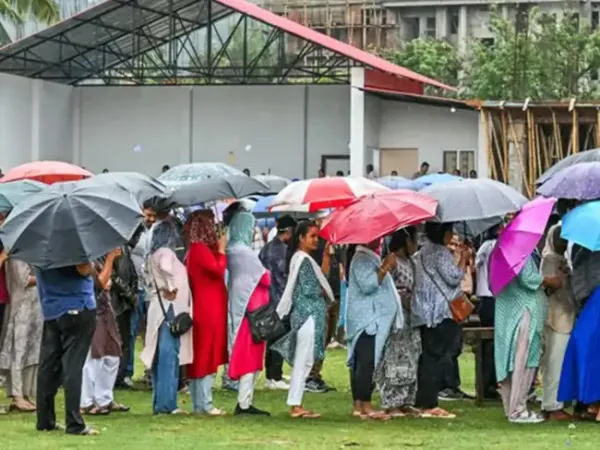
Assam recorded a voter turnout of 85.38%, surpassing its previous highest of 84.67% in 2016, reflecting strong voter participation in what is being seen as a closely watched contest.
A total of 2.50 crore voters were eligible to vote, including 1.25 crore women and 318 third-gender voters. The electorate also included 6.42 lakh first-time voters, 2.50 lakh senior citizens aged above 80 — including over 2,400 centenarians — and 2.05 lakh persons with disabilities.
Polling was conducted across 31,490 polling stations in 35 districts under extensive security arrangements, including deployment of Central Armed Police Forces and webcasting at all booths.
Key candidates and high-profile contests
A total of 722 candidates are in the fray, including several prominent political figures.
Among the key names are Chief Minister Himanta Biswa Sarma, Congress state president Gaurav Gogoi, Leader of Opposition Debabrata Saikia, AIUDF chief Badruddin Ajmal, Raijor Dal leader Akhil Gogoi and Assam Jatiya Parishad president Lurinjyoti Gogoi.
Several constituencies have emerged as high-profile battlegrounds. In Jalukbari, Sarma is seeking a sixth consecutive term, while in Jorhat, Gaurav Gogoi is attempting his Assembly debut. AIUDF chief Ajmal is contesting from Binnakandi in a triangular contest, while Sibsagar and Khowang are witnessing multi-cornered fights involving key regional players.
BJP vs Congress: A direct contest with regional players in mix
The Assam elections have largely crystallised into a direct fight between the BJP-led NDA and the Congress-led opposition alliance.
The BJP is aiming for a third consecutive term, with its campaign centred on the plank of “jati-mati-bheti” — focusing on protection of identity, land and culture — along with a strong pitch against alleged illegal infiltration.
The Congress, on the other hand, has positioned the election as a battle against what it terms “divisive politics,” targeting Chief Minister Himanta Biswa Sarma and foregrounding issues such as inflation, unemployment and governance reforms.
The contest has also been shaped by the 2023 delimitation exercise, which redrew constituency boundaries and is seen to have altered the political landscape, particularly reducing the influence of Muslim voters of Bangladesh origin across seats.
While the Congress has fielded the highest number of candidates at 99, the BJP has put up 90 candidates. Regional parties including AIUDF, Asom Gana Parishad, Bodoland People’s Front, Raijor Dal and Assam Jatiya Parishad are also playing a significant role, making several contests multi-cornered.
A defining political battle
The 2026 Assam election has evolved into more than a routine electoral contest. At its core is a face-off between Himanta Biswa Sarma’s entrenched BJP machinery and a Congress revival attempt led by Gaurav Gogoi.
For the BJP, retaining power would cement its dominance in the Northeast and further strengthen Sarma’s political standing. For the Congress, a strong performance could signal a resurgence in a region where it has struggled in recent years.
What happened in 2021
In the 2021 Assam Assembly elections, most exit polls had projected an advantage for the BJP-led NDA.
The India Today-Axis My India poll estimated 75–85 seats for the NDA, while ABP News-C Voter projected a tighter race with 58–71 seats. News 24-Today’s Chanakya also indicated a clear edge for the NDA.
The final results saw the NDA secure 75 seats in the 126-member Assembly, while the Congress-led ‘Grand Alliance’ won 50 seats.
Similarly, in 2016, exit polls had forecast a strong performance for the BJP-led alliance, which eventually ended the Congress’ 15-year rule in the state.
Exit polls to set the tone
With polling now complete, exit polls are expected to offer the first major indication of whether the BJP can retain power for a third term or if the Congress can stage a comeback.
However, the final verdict will only be known on May 4, when votes are counted across Assam and other poll-bound states.
Axis My India has estimated 88–100 seats for the BJP and 24–36 for the Congress, while JVC pegs the BJP at 88–101 seats and the Congress at 23–33, with the AIUDF at 0–2 and others at three.
Matrize has also forecast a BJP lead with 85–95 seats, placing the Congress at 25–32 and others at 6–12.
Polling for all 126 Assembly constituencies in Assam was conducted in a single phase on April 9, with counting scheduled for May 4. The release of exit poll projections coincides with the conclusion of the final phase of voting in West Bengal, offering an early sense of the electoral mood across states.
Assam voted alongside Kerala, Tamil Nadu and West Bengal, marking the end of a crucial election cycle. Exit polls for all these states, along with Puducherry, are being released today.
Record turnout signals heightened stakes
Assam recorded a voter turnout of 85.38%, surpassing its previous highest of 84.67% in 2016, reflecting strong voter participation in what is being seen as a closely watched contest.
A total of 2.50 crore voters were eligible to vote, including 1.25 crore women and 318 third-gender voters. The electorate also included 6.42 lakh first-time voters, 2.50 lakh senior citizens aged above 80 — including over 2,400 centenarians — and 2.05 lakh persons with disabilities.
Polling was conducted across 31,490 polling stations in 35 districts under extensive security arrangements, including deployment of Central Armed Police Forces and webcasting at all booths.
Key candidates and high-profile contests
A total of 722 candidates are in the fray, including several prominent political figures.
Among the key names are Chief Minister Himanta Biswa Sarma, Congress state president Gaurav Gogoi, Leader of Opposition Debabrata Saikia, AIUDF chief Badruddin Ajmal, Raijor Dal leader Akhil Gogoi and Assam Jatiya Parishad president Lurinjyoti Gogoi.
Several constituencies have emerged as high-profile battlegrounds. In Jalukbari, Sarma is seeking a sixth consecutive term, while in Jorhat, Gaurav Gogoi is attempting his Assembly debut. AIUDF chief Ajmal is contesting from Binnakandi in a triangular contest, while Sibsagar and Khowang are witnessing multi-cornered fights involving key regional players.
BJP vs Congress: A direct contest with regional players in mix
The Assam elections have largely crystallised into a direct fight between the BJP-led NDA and the Congress-led opposition alliance.
The BJP is aiming for a third consecutive term, with its campaign centred on the plank of “jati-mati-bheti” — focusing on protection of identity, land and culture — along with a strong pitch against alleged illegal infiltration.
The Congress, on the other hand, has positioned the election as a battle against what it terms “divisive politics,” targeting Chief Minister Himanta Biswa Sarma and foregrounding issues such as inflation, unemployment and governance reforms.
The contest has also been shaped by the 2023 delimitation exercise, which redrew constituency boundaries and is seen to have altered the political landscape, particularly reducing the influence of Muslim voters of Bangladesh origin across seats.
While the Congress has fielded the highest number of candidates at 99, the BJP has put up 90 candidates. Regional parties including AIUDF, Asom Gana Parishad, Bodoland People’s Front, Raijor Dal and Assam Jatiya Parishad are also playing a significant role, making several contests multi-cornered.
A defining political battle
The 2026 Assam election has evolved into more than a routine electoral contest. At its core is a face-off between Himanta Biswa Sarma’s entrenched BJP machinery and a Congress revival attempt led by Gaurav Gogoi.
For the BJP, retaining power would cement its dominance in the Northeast and further strengthen Sarma’s political standing. For the Congress, a strong performance could signal a resurgence in a region where it has struggled in recent years.
What happened in 2021
In the 2021 Assam Assembly elections, most exit polls had projected an advantage for the BJP-led NDA.
The India Today-Axis My India poll estimated 75–85 seats for the NDA, while ABP News-C Voter projected a tighter race with 58–71 seats. News 24-Today’s Chanakya also indicated a clear edge for the NDA.
The final results saw the NDA secure 75 seats in the 126-member Assembly, while the Congress-led ‘Grand Alliance’ won 50 seats.
Similarly, in 2016, exit polls had forecast a strong performance for the BJP-led alliance, which eventually ended the Congress’ 15-year rule in the state.
Exit polls to set the tone
With polling now complete, exit polls are expected to offer the first major indication of whether the BJP can retain power for a third term or if the Congress can stage a comeback.
However, the final verdict will only be known on May 4, when votes are counted across Assam and other poll-bound states.