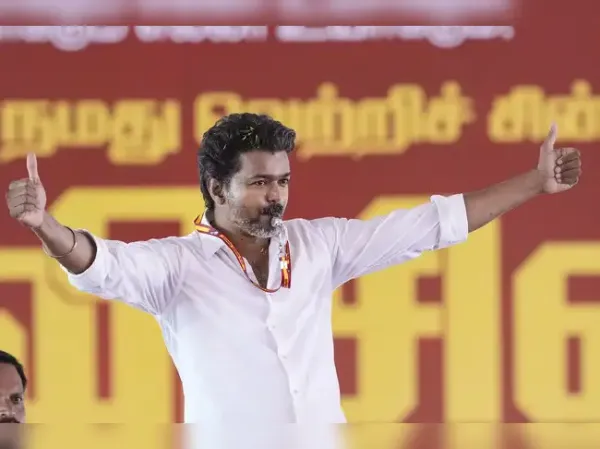
Tamil superstar Joseph Vijay's entry into electoral politics with his party, Tamilaga Vettri Kazhagam (TVK), has made the 2026 Tamil Nadu Assembly elections far more intriguing. While the primary battle is expected to remain between the Dravida Munnetra Kazhagam (DMK)-led alliance and the All India Anna Dravida Munnetra Kazhagam (AIADMK)-led NDA, Vijay’s entry has introduced a compelling third dimension.
Why Vijay Could Be the X-Factor
Vijay, popularly known as “Thalapathy,” enjoys massive fan following across Tamil Nadu. His political appeal cuts across traditional caste lines, which could work to his advantage in a state where caste dynamics still play a significant role in elections. His identity and mass appeal make him relatable to a broad voter base, especially among youth and urban voters.
Beyond identity, Vijay’s anti-establishment messaging and focus on governance reforms position TVK as an alternative to the entrenched Dravidian parties. His campaign is targeting first-time voters, job seekers, and the urban middle class with promises centered on employment and economic opportunities.
The Solo Gamble: Strength or Setback?
TVK’s decision to contest independently, rather than forming alliances, is a high-risk move. Tamil Nadu’s electoral history shows that strong coalitions and deep-rooted cadre networks often determine outcomes. Both DMK and AIADMK have decades-old grassroots machinery that ensures vote conversion at the booth level.
By going solo, TVK faces the challenge of building this organizational strength from scratch. While Vijay’s rallies have drawn massive crowds, Indian electoral trends suggest that crowd enthusiasm doesn’t always translate into votes. The absence of a strong ground network could limit TVK’s ability to convert popularity into seats.
Vote Split Risk and Political Impact
TVK’s core voter base—youth, urban middle classes, and politically disengaged citizens—overlaps significantly with the AIADMK-led alliance. This raises the possibility of vote splitting, which could indirectly benefit the ruling DMK in closely contested constituencies.
For AIADMK, Vijay’s emergence is a direct threat, especially in urban and semi-urban regions. For DMK, however, TVK could act as a spoiler for opposition votes. For Vijay himself, this election is crucial: even a modest vote share could establish TVK as a serious political player, while poor performance may relegate it to the margins.
Can Star Power Beat Ground Reality?
TVK’s campaign narrative focuses on anti-corruption, governance reform, and a break from welfare-heavy politics. However, Tamil Nadu elections have historically been driven by a combination of narrative, alliances, caste equations, and strong booth-level mobilization.
Critics have questioned Vijay’s lack of political experience, with opponents arguing that governance requires more than popularity. Vijay has countered this by positioning himself as a clean alternative, emphasizing integrity and administrative support.
The Bottom Line
Vijay’s political debut has undoubtedly shaken up the Tamil Nadu electoral landscape. But the real test lies in whether his cinematic popularity can translate into electoral success. In a state dominated by established parties and deep-rooted political networks, TVK’s performance will reveal whether Vijay is a genuine disruptor—or just a temporary spoiler.
Why Vijay Could Be the X-Factor
Vijay, popularly known as “Thalapathy,” enjoys massive fan following across Tamil Nadu. His political appeal cuts across traditional caste lines, which could work to his advantage in a state where caste dynamics still play a significant role in elections. His identity and mass appeal make him relatable to a broad voter base, especially among youth and urban voters.
Beyond identity, Vijay’s anti-establishment messaging and focus on governance reforms position TVK as an alternative to the entrenched Dravidian parties. His campaign is targeting first-time voters, job seekers, and the urban middle class with promises centered on employment and economic opportunities.
The Solo Gamble: Strength or Setback?
TVK’s decision to contest independently, rather than forming alliances, is a high-risk move. Tamil Nadu’s electoral history shows that strong coalitions and deep-rooted cadre networks often determine outcomes. Both DMK and AIADMK have decades-old grassroots machinery that ensures vote conversion at the booth level.
By going solo, TVK faces the challenge of building this organizational strength from scratch. While Vijay’s rallies have drawn massive crowds, Indian electoral trends suggest that crowd enthusiasm doesn’t always translate into votes. The absence of a strong ground network could limit TVK’s ability to convert popularity into seats.
Vote Split Risk and Political Impact
TVK’s core voter base—youth, urban middle classes, and politically disengaged citizens—overlaps significantly with the AIADMK-led alliance. This raises the possibility of vote splitting, which could indirectly benefit the ruling DMK in closely contested constituencies.
For AIADMK, Vijay’s emergence is a direct threat, especially in urban and semi-urban regions. For DMK, however, TVK could act as a spoiler for opposition votes. For Vijay himself, this election is crucial: even a modest vote share could establish TVK as a serious political player, while poor performance may relegate it to the margins.
Can Star Power Beat Ground Reality?
TVK’s campaign narrative focuses on anti-corruption, governance reform, and a break from welfare-heavy politics. However, Tamil Nadu elections have historically been driven by a combination of narrative, alliances, caste equations, and strong booth-level mobilization.
Critics have questioned Vijay’s lack of political experience, with opponents arguing that governance requires more than popularity. Vijay has countered this by positioning himself as a clean alternative, emphasizing integrity and administrative support.
The Bottom Line
Vijay’s political debut has undoubtedly shaken up the Tamil Nadu electoral landscape. But the real test lies in whether his cinematic popularity can translate into electoral success. In a state dominated by established parties and deep-rooted political networks, TVK’s performance will reveal whether Vijay is a genuine disruptor—or just a temporary spoiler.