Few constituencies in West Bengal capture the state’s political pulse quite like Bhabanipur — a compact South Kolkata seat that has, over the past decade, become synonymous with incumbent Chief Minister Mamata Banerjee’s political identity.
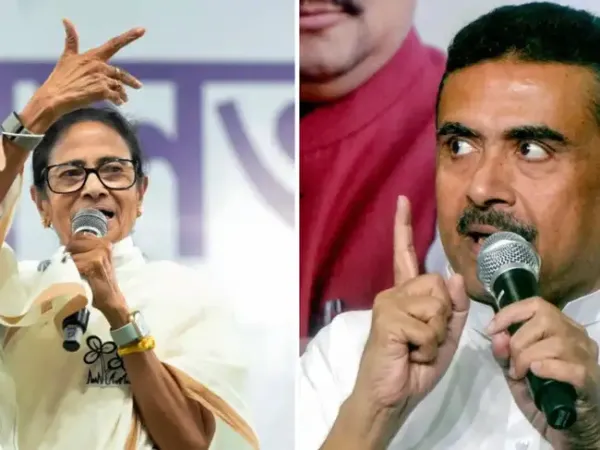
This time, Banerjee is pitted against her former confidant Suvendu Adhikari. Adhikari is the current Leader of Opposition in the Bengal Assembly and emerged victorious in a tightly contested poll from East Midnapore's Nandigram seat in 2021.
Since its formation in 2011 following delimitation, Bhabanipur has evolved into more than just an assembly segment. It is Banerjee’s home turf, and a stage where symbolism, history and electoral arithmetic intersect in ways that make it exceptionally difficult for challengers to dislodge her.
In the early hours of April 29, Kolkata voters saw quite a different Mamata Banerjee on the polling day. A figure, who hardly ever made ground visits on the day of polling in her over four decades worth electoral politics, was seen guarding a TMC camp in South Kolkata's Chetla early in the morning.
Election watchers said the move was being perceived as Banerjee protecting her safe seat as her primary rival, Adhikari is launching quite a strong bid.
Banerjee, then Railway Minister in the Manmohan Singh Cabinet, was formally in New Delhi but remained the unmistakable face of opposition politics in Bengal. Her leadership of the Singur and Nandigram movements — mass agitations against land acquisition — had already altered the state’s political trajectory.
The 2011 assembly election delivered a decisive mandate, ending the Left Front’s 34-year rule and installing Banerjee as chief minister. Soon after, Bakshi vacated Bhabanipur, paving the way for her to enter the Assembly through a by-election. She won by over 54,000 votes, establishing an early and emphatic grip on the constituency.
Adhikari’s trajectory mirrors key phases of Banerjee’s rise. Beginning as a Congress councillor in Kanthi in the 1990s, he emerged as a central figure in the 2007 Nandigram movement, leading the Bhumi Uchhed Pratirodh Committee against proposed land acquisition. The mobilisation became a defining moment in Bengal politics and significantly strengthened Banerjee’s position.
Over the years, Adhikari expanded the Trinamool Congress’s footprint in regions such as Jangal Mahal, served as MP from Tamluk, and later as a minister in the state government after winning the Nandigram seat in 2016. His resignation from the party in December 2020 and subsequent entry into the Bharatiya Janata Party marked a sharp political realignment.
The 2021 Nandigram contest between Banerjee and Adhikari was among the closest in recent memory. Spread over 17 rounds of counting and marked by delays and confusion, the result eventually went in Adhikari’s favour by 1,956 votes. Banerjee’s return to Bhabanipur in the subsequent bypoll saw her secure a comfortable victory, reaffirming the constituency’s status as her fallback bastion.
Even so, no challenger has managed to fundamentally breach the constituency’s voting pattern. Banerjee’s repeated returns, often with decisive margins, have reinforced Bhabanipur’s image as a seat where organisational depth and leadership identity align strongly.

In Bengal’s political idiom, references to Ma, Kaali and Durga are not merely symbolic but embedded in everyday life and public discourse. The cultural imagination of feminine power has long shaped political messaging and leadership perception in the state.
The All India Trinamool Congress has also seen a visible presence of outspoken women leaders in Parliament and public life, reinforcing this dimension of representation.
Banerjee's politics has long been marked by an image of resilience, street-level mobilisation and direct engagement — and has often resonated within this framework. Her rise through protest movements, from Singur to Nandigram, positioned her not just as a political leader but as a figure associated with resistance and assertion.
At the same time, electoral dynamics are not static. Observers point to signs of anti-incumbency, a factor that typically emerges over successive terms in office. Episodes such as Banerjee’s public interventions during investigations by the Enforcement Directorate have drawn varied interpretations — viewed by supporters as acts of defiance and by critics as politically driven responses.
Women voters, often considered a key support base, have also become an important constituency in the evolving narrative. Issues related to safety, governance and public messaging have featured prominently in political discourse, with rival parties, including the Bharatiya Janata Party, highlighting these aspects in their campaigns.
As the contest unfolds, this interplay of leadership image, voter expectations and political messaging is expected to remain a significant factor in shaping outcomes, particularly in a constituency as closely associated with Banerjee as Bhabanipur.
Administrative developments have also added new variables. The Special Intensive Revision (SIR) of electoral rolls reportedly led to the deletion of a significant number of voters during adjudication, including sections that had historically supported the Trinamool Congress. The extent and impact of these changes remain part of the broader political discourse.
At the same time, Banerjee continues to command organisational backing and visibility in the constituency, while the BJP’s decision to field a high-profile opponent underscores the strategic importance of the seat.
Bhabanipur’s electoral story often turns on the fine balance within its wards, each with a distinct social mix and voting pattern. Ward 70 has often been seen as leaning towards the Bharatiya Janata Party, as compared to its adjacent wards. But the presence of a major Bengali population has historically helped TMC. In 2021, the TMC gathered a over 4,000 votes margin. (Data from West Bengal State Election Commission website)
In Ward 72, the dynamics are more layered. The Trinamool Congress had a 1,735 lead here last time out, against an independent candidate. The recent entry of Chandra Kumar Bose, a member of Subhas Chandra Bose’s extended family, into the TMC fold is viewed by party workers as a boost to organisational morale in such pockets.
Elsewhere, Ward 73, represented by councillor Kajari Banerjee, has been a reliable contributor to the Trinamool’s tally. Ward 82, associated with Kolkata mayor Firhad Hakim, continues to be seen as a stronghold. Beyond Bhabanipur, adjoining areas such as Ward 77 in Khidirpur also feed into the broader electoral equation, underlining how the constituency’s outcome is shaped as much by micro-level ward dynamics as by larger political narratives.
For Bhabanipur, the contest represents more than a constituency battle. It is a convergence of history, identity and political positioning — a seat where past movements, personal equations and shifting voter trends all play a role.
For now, Bhabanipur remains one of the most difficult constituencies to prise away from Mamata Banerjee — a political citadel shaped as much by narrative and legacy as by the arithmetic of votes.
This time, Banerjee is pitted against her former confidant Suvendu Adhikari. Adhikari is the current Leader of Opposition in the Bengal Assembly and emerged victorious in a tightly contested poll from East Midnapore's Nandigram seat in 2021.
Since its formation in 2011 following delimitation, Bhabanipur has evolved into more than just an assembly segment. It is Banerjee’s home turf, and a stage where symbolism, history and electoral arithmetic intersect in ways that make it exceptionally difficult for challengers to dislodge her.
In the early hours of April 29, Kolkata voters saw quite a different Mamata Banerjee on the polling day. A figure, who hardly ever made ground visits on the day of polling in her over four decades worth electoral politics, was seen guarding a TMC camp in South Kolkata's Chetla early in the morning.
Election watchers said the move was being perceived as Banerjee protecting her safe seat as her primary rival, Adhikari is launching quite a strong bid.
From party seat to personal bastion
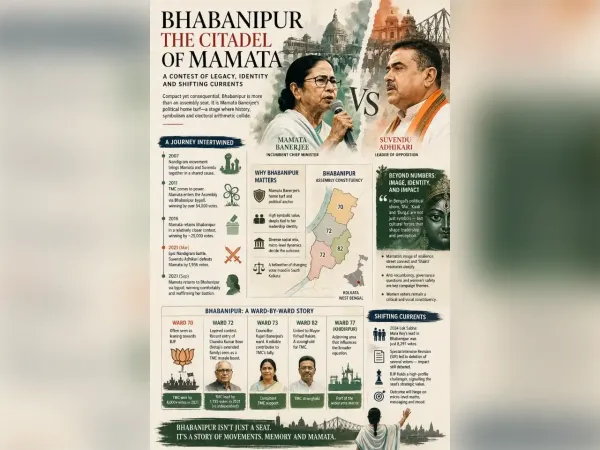
Bhabanipur entered West Bengal’s political map at a moment of churn. The All India Trinamool Congress fielded veteran leader Subrata Bakshi in 2011, who shifted from the Chowringhee seat. The central Calcutta assembly constituency, in turn, was handed to Congress veteran Somen Mitra’s wife, Sikha Chowdhury Mitra, reflecting the alliance arithmetic of the time.Banerjee, then Railway Minister in the Manmohan Singh Cabinet, was formally in New Delhi but remained the unmistakable face of opposition politics in Bengal. Her leadership of the Singur and Nandigram movements — mass agitations against land acquisition — had already altered the state’s political trajectory.
The 2011 assembly election delivered a decisive mandate, ending the Left Front’s 34-year rule and installing Banerjee as chief minister. Soon after, Bakshi vacated Bhabanipur, paving the way for her to enter the Assembly through a by-election. She won by over 54,000 votes, establishing an early and emphatic grip on the constituency.
Consolidation through cycles
Bhabanipur has since functioned as Banerjee’s political anchor. She retained the seat in 2016 and returned to it again through a bypoll in 2021 after shifting to Nandigram — a high-risk contest against her former confidant-turned-rival Suvendu Adhikari.Adhikari’s trajectory mirrors key phases of Banerjee’s rise. Beginning as a Congress councillor in Kanthi in the 1990s, he emerged as a central figure in the 2007 Nandigram movement, leading the Bhumi Uchhed Pratirodh Committee against proposed land acquisition. The mobilisation became a defining moment in Bengal politics and significantly strengthened Banerjee’s position.
Over the years, Adhikari expanded the Trinamool Congress’s footprint in regions such as Jangal Mahal, served as MP from Tamluk, and later as a minister in the state government after winning the Nandigram seat in 2016. His resignation from the party in December 2020 and subsequent entry into the Bharatiya Janata Party marked a sharp political realignment.
The 2021 Nandigram contest between Banerjee and Adhikari was among the closest in recent memory. Spread over 17 rounds of counting and marked by delays and confusion, the result eventually went in Adhikari’s favour by 1,956 votes. Banerjee’s return to Bhabanipur in the subsequent bypoll saw her secure a comfortable victory, reaffirming the constituency’s status as her fallback bastion.
A seat Mamata Banerjee rarely loses her grip on
Despite its reputation as a safe seat, Bhabanipur has seen moments of competitive pressure. The closest contest came in 2016, when Congress leader Deepa Das Munshi — wife of veteran Priyaranjan Das Munshi — cut Banerjee’s winning margin to around 25,000 votes, considered relatively narrow in the context of TMC's historical South Kolkata's electoral battles.Even so, no challenger has managed to fundamentally breach the constituency’s voting pattern. Banerjee’s repeated returns, often with decisive margins, have reinforced Bhabanipur’s image as a seat where organisational depth and leadership identity align strongly.
The layers beneath the numbers: Gender, perception and shifting political signals
In West Bengal’s political landscape, leadership identity often carries layered meaning. Mamata Banerjee, as a woman leader projecting a formidable and assertive image, occupies a distinctive space. Her political persona has, over the years, aligned with a broader cultural idiom in the state that frequently invokes feminine 'Shakti' in both symbolism and rhetoric.In Bengal’s political idiom, references to Ma, Kaali and Durga are not merely symbolic but embedded in everyday life and public discourse. The cultural imagination of feminine power has long shaped political messaging and leadership perception in the state.
The All India Trinamool Congress has also seen a visible presence of outspoken women leaders in Parliament and public life, reinforcing this dimension of representation.
Banerjee's politics has long been marked by an image of resilience, street-level mobilisation and direct engagement — and has often resonated within this framework. Her rise through protest movements, from Singur to Nandigram, positioned her not just as a political leader but as a figure associated with resistance and assertion.
At the same time, electoral dynamics are not static. Observers point to signs of anti-incumbency, a factor that typically emerges over successive terms in office. Episodes such as Banerjee’s public interventions during investigations by the Enforcement Directorate have drawn varied interpretations — viewed by supporters as acts of defiance and by critics as politically driven responses.
Women voters, often considered a key support base, have also become an important constituency in the evolving narrative. Issues related to safety, governance and public messaging have featured prominently in political discourse, with rival parties, including the Bharatiya Janata Party, highlighting these aspects in their campaigns.
As the contest unfolds, this interplay of leadership image, voter expectations and political messaging is expected to remain a significant factor in shaping outcomes, particularly in a constituency as closely associated with Banerjee as Bhabanipur.
Shifting currents
Recent electoral signals, however, point to evolving dynamics. In the 2024 Lok Sabha elections, the Trinamool Congress’s South Kolkata candidate Mala Roy recorded a relatively narrow lead of 8,297 votes in Bhabanipur, suggesting a tighter contest than in previous cycles.Administrative developments have also added new variables. The Special Intensive Revision (SIR) of electoral rolls reportedly led to the deletion of a significant number of voters during adjudication, including sections that had historically supported the Trinamool Congress. The extent and impact of these changes remain part of the broader political discourse.
At the same time, Banerjee continues to command organisational backing and visibility in the constituency, while the BJP’s decision to field a high-profile opponent underscores the strategic importance of the seat.
Bhabanipur’s electoral story often turns on the fine balance within its wards, each with a distinct social mix and voting pattern. Ward 70 has often been seen as leaning towards the Bharatiya Janata Party, as compared to its adjacent wards. But the presence of a major Bengali population has historically helped TMC. In 2021, the TMC gathered a over 4,000 votes margin. (Data from West Bengal State Election Commission website)
In Ward 72, the dynamics are more layered. The Trinamool Congress had a 1,735 lead here last time out, against an independent candidate. The recent entry of Chandra Kumar Bose, a member of Subhas Chandra Bose’s extended family, into the TMC fold is viewed by party workers as a boost to organisational morale in such pockets.
Elsewhere, Ward 73, represented by councillor Kajari Banerjee, has been a reliable contributor to the Trinamool’s tally. Ward 82, associated with Kolkata mayor Firhad Hakim, continues to be seen as a stronghold. Beyond Bhabanipur, adjoining areas such as Ward 77 in Khidirpur also feed into the broader electoral equation, underlining how the constituency’s outcome is shaped as much by micro-level ward dynamics as by larger political narratives.
A contest of legacy and leverage
The renewed face-off between Banerjee and Adhikari in Bhabanipur brings together two leaders whose political trajectories have intersected repeatedly — from collaboration during the rise of the Trinamool Congress to direct electoral confrontation.For Bhabanipur, the contest represents more than a constituency battle. It is a convergence of history, identity and political positioning — a seat where past movements, personal equations and shifting voter trends all play a role.
For now, Bhabanipur remains one of the most difficult constituencies to prise away from Mamata Banerjee — a political citadel shaped as much by narrative and legacy as by the arithmetic of votes.