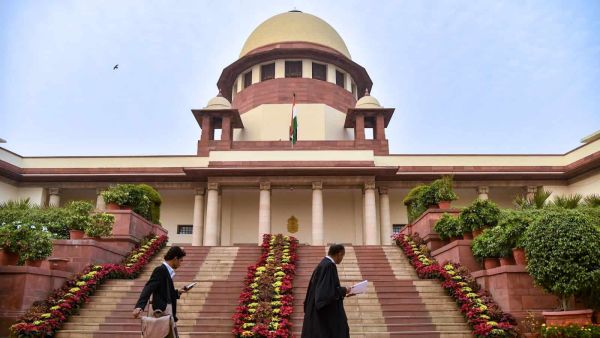
New Delhi: The Supreme Court on Friday, April 24, permitted a 15-year-old girl to terminate her 28-week pregnancy and held that making a woman continue with her unwanted pregnancy will be a direct insult to her right to live with dignity and reproductive autonomy.
A bench of justices BV Nagarathna and Ujjal Bhuyan emphasised that constitutional courts must prioritise the best interests of the pregnant woman over the statutory and procedural limitations under the Medical Termination of Pregnancy (MTP) Act when dealing with cases of unwanted pregnancies, likely to result in major mental and physical trauma.
“No court ought to compel any woman, and more so a minor child, to carry a pregnancy to full term against her will,” the court stated while allowing the 15-year-old, currently admitted at All India Institute of Medical Sciences (AIIMS) Delhi since April 10, to end the pregnancy.

The bench observed that the right to make decisions regarding one’s body, specifically for reproduction, is a core aspect of personal liberty and privacy provided under Article 21.
“If the pregnant woman carrying an unwanted pregnancy is compelled to continue such a pregnancy, then the constitutional rights of the pregnant woman would be breached,” the court observed.
The bench highlighted that the mother’s welfare takes priority and warned against methods that render her “subordinate to the child yet to be born.”
In cases of unwanted pregnancy, directing continuation would invalidate her long-term well-being, autonomy, and dignity, the apex court added.
Role of constitutional courts
The ruling clarified the role of constitutional courts in cases where written laws provide no solution or create an impasse, particularly when pregnancies cross the prescribed gestational limits (typically 24 weeks) under the MTP Act.
The court dismissed the constrained statutory timelines and said that courts exercising writ jurisdiction under Articles 226 (empowers High Courts to issue writs) and 32 (an individual’s right to move the Supreme Court for the enforcement of fundamental rights) must look at the case from the woman’s perspective.
“Can the constitutional court say that since the statutory remedy is not available, no constitutional remedy would also be available? That cannot be the approach,” the court observed, saying that such an interpretation would lead women towards unsafe and illegal abortion centres.
The court cautioned against denying relief in such cases, saying it could ultimately endanger women, notably minors, with severe consequences, including seeking alternative procedures that may cause irreversible harm.
Court noted minor’s history of suicides
The bench took note of the minor’s mental distress, as it was reported that she had attempted to take her own life multiple times, and observed that forcing continuation would have “long-lasting repercussions.”
The pregnancy, although a result of a consensual relationship between two minors, was clearly unwarranted, the court said. Denying relief to her would coerce her into enduring “irreversible consequences” and contradict the constitutional principles acknowledging reproductive choice as a fundamental right.
It subsequently quashed the Delhi High Court’s April 21 order that dismissed the petition filed by the minor’s mother seeking to abort the 28-week foetus.
Union govt warns against the risk of proceeding with abortion
The Union government argued against the termination, citing the risk of undergoing the procedure at an advanced stage, and insisted that the state would guarantee full support to the child if the pregnancy was completed.
The government was represented through Solicitor General Tushar Mehta and Additional Solicitor General Aishwaria Bhati.
However, the court pointed out that compelling continuation in unwanted pregnancies pushes women to “illegal centres and quacks.” “In a case like this, there is no question of winning. Everyone loses,” the bench said.
The court directed the procedure to be carried out at AIIMS Delhi with the required medical safeguards and asked the minor’s legal guardian to submit a formal consent for the termination.
-
Hong Kong pays 20 couples US$7,700 each in baby bonuses for three children

-
Hania spotted at Asim’s NYC concert, rumours reignite

-
How to choose sweet and fresh mango? Take care of these small things

-
Job Seeker Ends Interview After Recruiter Calls His Salary Expectations Cute

-
Life Goes Back To Normal For 4 Zodiac Signs On April 25, 2026, Says An Astrologer