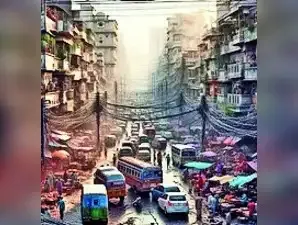
We all keep moaning about it. But when real estate billionaire legend - and this year's ET Lifetime Achievement Award winner - K P Singh speaks on infrastructure, you listen. His recent warning that India's urbanisation is in an 'utter mess' isn't just a critique, but a call for a radical shift from 20-yr 'patchwork' planning to 100-yr master plans. For a country where urban areas will house 40.73% of the population by 2031, Singh is bang on: well-planned cities are the only way to sustain national prosperity.
Authorities can't sidestep this issue any more. The 16th Finance Commission has provided fiscal ammunition to make this leap. Stakes have been raised with ₹3.56 lakh cr allocation to urban local bodies (ULBs) for 2026-31 - a 2.3x increase from the previous commission. Crucially, it has increased the urban share of local grants to 45% (up from 36%). About 52% (₹1.84 lakh cr) of these grants are now untied, a 5.5x jump that grants ULBs the autonomy to address specific local needs.
To move forward, cities must leverage new specialised instruments like special infrastructure components (₹56,100 cr) targeted at 22 cities to build comprehensive wastewater systems and mitigate flooding; and urbanisation premium (₹10,000 cr), a first-of-its-kind incentive for states to merge peri-urban villages into cities, ensuring planned rather than haphazard rural-to-urban transitions. With per-capita urban allocations projected to rise to ₹7,165 (up from ₹3,403 under the 15th Finance Commission), ULBs no longer have the excuse of dry coffers. It's time to utilise this 1.8x increase in total local grants to institutionalise 100-yr planning cities become engines of growth, rather than sad symbols of congestion - in more ways than one.
Authorities can't sidestep this issue any more. The 16th Finance Commission has provided fiscal ammunition to make this leap. Stakes have been raised with ₹3.56 lakh cr allocation to urban local bodies (ULBs) for 2026-31 - a 2.3x increase from the previous commission. Crucially, it has increased the urban share of local grants to 45% (up from 36%). About 52% (₹1.84 lakh cr) of these grants are now untied, a 5.5x jump that grants ULBs the autonomy to address specific local needs.
To move forward, cities must leverage new specialised instruments like special infrastructure components (₹56,100 cr) targeted at 22 cities to build comprehensive wastewater systems and mitigate flooding; and urbanisation premium (₹10,000 cr), a first-of-its-kind incentive for states to merge peri-urban villages into cities, ensuring planned rather than haphazard rural-to-urban transitions. With per-capita urban allocations projected to rise to ₹7,165 (up from ₹3,403 under the 15th Finance Commission), ULBs no longer have the excuse of dry coffers. It's time to utilise this 1.8x increase in total local grants to institutionalise 100-yr planning cities become engines of growth, rather than sad symbols of congestion - in more ways than one.