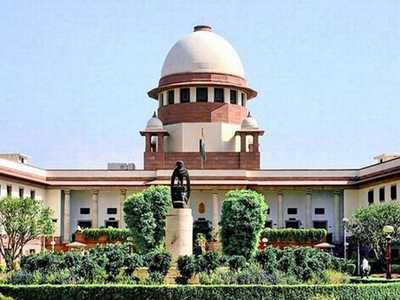
New Delhi [India], April 22 (ANI): The Supreme Court on Wednesday said that while examining the maintainability of pleas filed by three officers of the Directorate of Enforcement (ED), seeking registration of an FIR by the Central Bureau of Investigation (CBI) over an alleged attack by West Bengal Police during a search at the I-PAC office in Kolkata, it cannot ignore "the practical realities" and have to keep in view "the extraordinary situation" unfolding in the election-bound State.
Terming the alleged interference by the West Bengal Chief Minister Mamata Banerjee, in the midst of an investigation being carried out by a Central agency as perilous to democracy, a bench of Justices Prashant Kumar Mishra and N.V. Anjaria said that the alleged act committed by 'a CM of a State' has 'put the entire democracy in jeopardy'.
"This is not a dispute between the state and the union. We never thought that in this country, a day would come when a sitting CM would walk into the office where some investigating agency is...The Chief Minister of any state cannot walk in in the midst of an investigation, put the democracy in peril, and then say that 'don't convert this into a dispute between the state and the union'. This is an act committed by an individual who happens to be the chief minister, keeping the whole democracy in jeopardy," the Court remarked.
The observations came from the Court while it was hearing arguments raised by the West Bengal government on the maintainability of the ED's petitions filed under Article 32 Writ Jurisdiction of the Supreme Court.
The State opposes the pleas on two key grounds. First, it argues that the ED, being a state agency, is not a "natural person" entitled to invoke fundamental rights, and its officers, when acting in their official capacity, cannot claim protection under Article 32. Second, it points out that the ED has already approached the Calcutta High Court and parallel proceedings before two constitutional courts are not maintainable.
Responding to these objections, the Court indicated that the legal question cannot be examined in isolation from the situation on the ground, while deprecating the alleged "gherao" and the keeping hostage of the Judicial Officers deputed in the West Bengal Special Intensive Revision (SIR) exercise.
"This is an extraordinary situation. Before the other Bench (in the SIR matter), we have seen judicial officers being kept hostage. We cannot shut our eyes to realities. You may argue abstract legal principles, but we cannot lose sight of the practical situation occurring in the State," the Court verbally observed.
During the hearing today, detailed submissions were made by Senior Advocates Abhishek Manu Singhvi, Maneka Guruswamy and Siddharth Luthra, who appeared for the West Bengal Director General of Police (DGP), the Commissioner of Police (CP) in Kolkata and the Superintendent of Police (SP), Barasat, respectively.
Dr. Singhvi argued that the ED and its officers cannot invoke fundamental rights while discharging official functions, and that Article 32 is not meant to be used in such circumstances.
"ED has no Fundamental Right to investigate. Its officers have no fundamental rights. No representative capacity since it's governed by the Prevention of Money Laundering Act (PMLA). The ED officer as an individual may have Fundamental Right, only when he is not discharging official duty, but while acting as ED officer no separate Fundamental Right", he submitted.
He further argued that, as per the doctrine of 'parens patriae', it cannot be used by the State (Union government and ED) for the protection of itself. The doctrine only protects the marginalised/deprived, Singhvi argued.
Senior Advocate Maneka Guruswamy, drawing from constitutional history and structure, argued that fundamental rights are meant to protect individuals against the State and not to be invoked by the State or its instrumentalities.
"Individual/citizen enforces FR against the State. As Babasaheb BR Ambedkar called the Government of India Act 1935 'a slaved Constitution' as it was in contrast with Part III (Fundamental Rights) of our Constitution, which Ambedkar called 'the soul' of the Constitution) Article 32, even against the majority legislatures, it is a trigger for people - if ED officers move the Court, it will give rise to a situation not intended by the framers. This was unenvisaged by the Framers and it would, if allowed, weaken citizen protection", she said.
Referring to the landmark judgement in Kesavananda Bharati v State of Kerala, Guruswamy argued that all Fundamental Rights relate to State action.
She further argued that there is nothing in Part III of the Constitution that is intended to enable interdepartmental warfare or allow the State to trigger it as a victim rather than as a constitutional violator.
"State shall not deny, not discriminate, ensure opportunity etc.. all 'by the State' - nothing in Part III enables interdepartmental warfare. The state cannot trigger Part III as a victim. FR are rights against the State, not for the State", she contended.
Fundamental rights are rights against the State. They exist to protect individuals from State action. The State, therefore, cannot position itself as a victim to invoke these rights, she added.
"Article 32, described as the "soul of the Constitution," is a remedy that can be triggered only when there is a violation of fundamental rights. It is designed for those whose rights are infringed, not for the State itself," submitted Guruswamy.
She added that the State cannot occupy the position of both the wrongdoer and the victim at the same time
Guruswamy further cautioned against expanding Article 32 to cover such disputes, arguing that the correct constitutional route, if any, would lie elsewhere.
"If at all maintainable, not under Article 32, a proper route for the Union government (ED) would be under Article 131 (apex court's jurisdiction to resolve disputes between Centre and State government). Proper parties here would be Union vs State, not ED officers. Allowing this lets constitutional functionaries claim personal Fundamental Rights, it would set a dangerous precedent", Guruswamy argued.
She further also contended that if at all the Court allows the maintainability of EDs pleas under Article 32, then owing to the unprecedented constitutional question, the issue may be referred to a larger bench of the Supreme Court.
Senior Advocate Siddharth Luthra also opposed the maintainability of the ED petitions, arguing that the ED, as an agency, lacks the legal character required to invoke Article 32.
"ED cannot file WP under Article 32. It is not a 'person'. Has no separate identity. It is an internal department of the Ministry of Finance. Its powers are under PMLA/FEMA. Even Vijay Madanlal Choudhary v Union of India (judgement) reflects the position that only natural persons can invoke Article 32 - ED cannot", Luthra submitted.
Taking the Court through academic commentary and comparative jurisprudence, Luthra added, "Enforcement of FRs would not be covered under Article 131 because government functionaries cannot invoke FR - they cannot be allowed to invoke FR."
Referring to legal academic luminary D.D. Basu's commentary in which a decision of the German Constitutional Court has been underscored in this context, Luthra argued that the constitution cannot confer basic rights on corporations that exercise public functions.
"This is the view of D.D. Basu... that FRs protect natural, not artificial persons", the senior lawyer said.
He also reiterated another challenge to EDs plea and questioned whether ED can maintain two petitions at the same time?, adding, "As ED's pleas seeking same remedies have remained pending before the Calcutta High Court while the matter is presently being examined by the apex court."
After hearing submissions by the three senior lawyers, the Court has listed that matter to be heard tomorrow, when counter arguments would be made by the ED. (ANI)
-
UP: Multi-vehicle collision in Mirzapur leaves 11 dead, probe underway

-
UK steak restaurant giant loved by families sells branch - 140 sites across country

-
Tenerife-bound easyjet flight forced to divert to Gatwick Airport after 'welfare issue'

-
I'm A Celebrity fans say same thing as campmates forced to leave with immediate effect

-
St George's Day LIVE: When is St George's Day 2026 as £2,500 flag warning issued