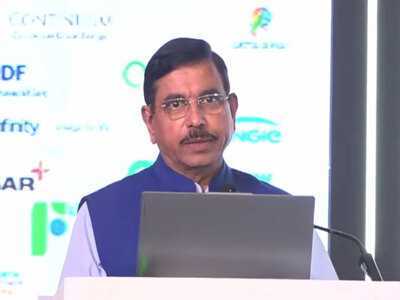
New Delhi [India], April 22 (ANI): Union Minister Prahlad Joshi on Wednesday, addressing the World Earth Day, said India is rapidly expanding its wind energy capacity and is now among the top four countries globally in the sector.
Speaking at the 13th foundation day of the Wind Independent Power Producers Association (WIPPA), he said, "We are celebrating the 13th foundation day of WIPPA. Over the years, it has emerged as an effective voice for the energy sector."
Highlighting sectoral growth, Joshi said, "We have added 6.1 GW wind capacity in 2023-24. Today India ranks 4th globally with over 46.1 GW of installed wind capacity and another 28 GW under implementation."
He added that India had made significant annual progress, stating, "Last year we achieved growth from 6 to 10 gigawatt scale."
Joshi said India's potential remains largely untapped, stating, "India's wind energy potential is 1,164 GW at 150 metres height. Even if we utilise 25 per cent of this, there is still huge scope for development."
Outlining future targets, the Minister said, "Our target is 100 GW by 2030 and 156 GW by 2036. It is ambitious, but not impossible." He also shared that the association is working towards net zero goals, adding, "To achieve net zero by 2070, India must add nearly 10 GW every year for the next decade."
Joshi said wind energy remains crucial due to its round-the-clock potential, noting, "Solar power is limited to daylight hours, but wind power is stronger in the evening and night. Nearly 45 per cent of wind generation comes at peak demand hours."
He added, "Wind is not just a complementary source, it is a stabilising anchor for India's energy system... The future lies in integrated hybrid systems combining wind, solar and storage. This is the new normal."
Calling for coordinated efforts, he said, "The journey to 156 GW by 2036 is ambitious but achievable," which would require resolving existing challenges, while stressing that, "This changing global landscape is a strategic opportunity for India. India can emerge as a trusted manufacturing and supply partner."
In line with Prime Minister Narendra Modi's announcement at COP26, the Ministry of New and Renewable Energy is also working towards achieving 500 GW of installed electricity capacity from non-fossil sources by 2030.
As part of efforts to meet energy targets, the government earlier approved the National Green Hydrogen Mission (NGHM) with an initial outlay of Rs 19,744 crore, to be spent by 2029-30. The mission aims to produce at least 5 million metric tonnes of green hydrogen annually by 2030. It is also expected to add 125 GW of renewable energy capacity, attract over Rs 8 lakh crore in investments, create more than 6 lakh full-time jobs, and reduce carbon dioxide emissions by 50 million metric tonnes annually.
India also achieved its highest-ever annual wind capacity addition of 6.05 GW during FY 2025-26, forty-six per cent higher than the 4.15 GW added in FY 2024-25. The cumulative installed wind power capacity has crossed 56 GW, positioning India fourth globally in terms of installed wind turbine capacity. A capex allocation of Rs 500 crore was made under the Wind GBI Scheme. The Generation-Based Incentive (GBI) scheme is a renewable energy policy by the Ministry of New and Renewable Energy designed to promote wind and solar power by providing financial incentives per unit (kWh) of electricity fed into the grid. (ANI)
-
UP: Multi-vehicle collision in Mirzapur leaves 11 dead, probe underway

-
UK steak restaurant giant loved by families sells branch - 140 sites across country

-
Tenerife-bound easyjet flight forced to divert to Gatwick Airport after 'welfare issue'

-
I'm A Celebrity fans say same thing as campmates forced to leave with immediate effect

-
St George's Day LIVE: When is St George's Day 2026 as £2,500 flag warning issued