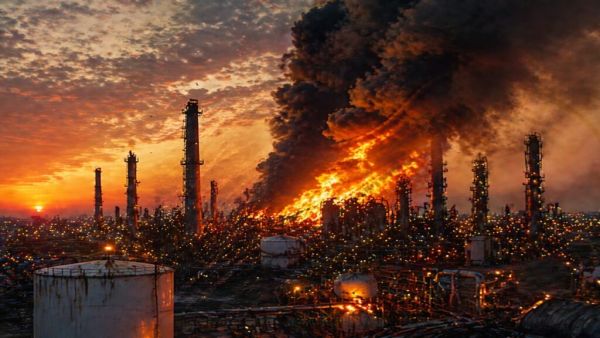
Prime Minister Narendra Modi was to inaugurate a refinery at Pachapadra in Rajasthan on Tuesday. Conceived about 13 years ago, this project was a dream come true. However, just a day before the inauguration, a major fire broke out in the refinery’s main processing units, postponing the inauguration.
An investigation into the cause of the massive fire at the refinery of Hindustan Petroleum Corporation Limited (HPCL) is underway. Surprisingly, fires at oil assets around the world, particularly at refineries, are showing a distinct pattern. This incident is happening at a time when natural resources like oil and gas are being used as weapons in the wake of ongoing wars in West Asia.
On 28 February 2026 America and Israel Since airstrikes on Iran started a wider conflict in West Asia, there have been incidents of fires at oil refineries in six countries, including India. All these refineries are outside the war zone. These incidents have led to debate over whether the refinery fires were a coincidence or a pattern.
In the past two months, fires have disrupted operations at refineries in the US, Australia, Mexico, Ecuador and Russia. Russia’s case is different, as Ukraine has attacked its oil facilities there. Russia and Ukraine have been at war since February 2022. However, fires at refineries in all other countries are believed to be caused by technical malfunctions or internal problems in the project.
Women Reservation: ‘Nari Shakti’ is still waiting! The percentage of women voters increased, but why did the candidates decrease?
Fire incidents have also occurred in two oil plants in India. Apart from Hindustan Petroleum Corporation Limited’s (HPCL) Rajasthan refinery, there has also been an accident at Oil and Natural Gas Corporation’s (ONGC) oil field off the coast of Mumbai. A fire broke out at this ONGC project on April 12, which has been brought under control.
Fortunately, there was no serious damage to infrastructure at Pachapadra Refinery in Rajasthan. The Ministry of Petroleum and Natural Gas said that a high-level committee has been constituted to investigate the root cause of the incident. HPCL said preliminary investigations revealed that the fire was caused by hydrocarbon leakage from a valve/flange in the heat exchanger circuit.
According to the information available so far, all these fires in oil refineries could be accidents, but there is a common thread. Explosions and fires have also occurred at two US oil plants: Valero Energy’s Port Arthur refinery and Marathon Petroleum’s El Paso refinery. A fire at one of Australia’s largest oil refineries has yet to fully restart. Fires have also occurred at oil refineries in Ecuador and Mexico.
On April 20, a powerful explosion occurred at the Hmawbi River port in Myanmar’s Sagaing region, engulfing more than 10 fuel tankers and ships in flames. The fire spread rapidly and the tanker fell to its prey. Emergency crews were unable to fully control the fire and the fire continued to smolder till Tuesday. “It’s not even 24 hours since an oil refinery fire broke out in India and now more than 10 fuel tankers are on fire after a major explosion at the Hmawbi port in Myanmar’s Sagaing region. The situation is getting out of hand,” an X user posted.
On April 16, a verified account holder named Arvind posted on X, “Indian oil refineries should take extra security measures, especially in case of insider conspiracies.” This happened four days before the oil refinery fire in Rajasthan. In his post, Arvind had said that he strongly suspected that enemy countries could target the country’s oil refineries. He wrote, “For geopolitical reasons, enemies can set fire to oil refineries to increase oil prices and affect India’s economy.” Just four days later, on April 20, a fire broke out at the HPCA oil refinery.
One of the biggest lessons from the US-Israel-Iran war is how heavily dependent countries around the world are on crude oil, natural gas and petrochemical products. After the US and Israeli attacks on Iran, Tehran responded with missile and drone attacks on several US bases in the Gulf region, as well as on major Israeli cities.
Iran also attacked oil refineries in the Gulf, disrupting oil and gas supplies through the Strait of Hormuz. A large part of the world’s energy supply passes through this route. The ongoing conflict in the Middle East has affected the global oil and gas market. Crude oil prices, which were around $66 per barrel in February, rose above $100 per barrel in March. Prices fell slightly amid a two-week ceasefire announced by US President Donald Trump, which is set to expire this week.
Oil asset fires around the world
Meanwhile, within 45 days of the US-Iran war, oil refineries in five different countries caught fire. According to reports, these fires were not caused by drone or missile strikes, but by technical malfunctions or small leaks, as these oil refineries were far from the war zone. On March 23, an explosion occurred at Valero Energy’s Port Arthur plant in Texas. The explosion occurred after a diesel hydrotreater caught fire. Initially, there was speculation that Iran was involved, but officials have not officially confirmed this. A high-level inquiry was ordered to probe the matter.
On April 4, a fire broke out at ONGC’s SHP platform at Mumbai High, in which 10 workers sustained minor injuries. Emergency teams responded immediately and brought the fire under control. ONGC has not revealed the cause of the fire. On 10 April, another major fire broke out in Texas, USA, when a technical fault broke out at Marathon Petroleum’s El Paso refinery, which was quickly extinguished.
A fire broke out in Australia on April 16. Emergency crews rushed to Viva Energy’s Korio Oil Refinery (Geelong, south-west of Melbourne). The refinery produces about 50% of Victoria’s and 10% of the nation’s fuel, but has not fully recovered following the incident. The government has warned of possible impact on petrol production. Then, on April 20, a fire broke out just a day before the inauguration of the HPCL refinery in Rajasthan. Fire engines were deployed to douse the fire and the situation was later brought under control.
Why do oil refineries around the world catch fire?
A North American ‘X’ account has claimed that these fires affecting oil assets around the world may not be a coincidence, but a method designed to disrupt oil supplies. Writing on ‘X’ after the HPCL Rajasthan refinery incident, Arvind also said that fires at refineries in various countries could be an indication of a disruption in the supply of refined oil globally. “One side wants to create an oil shortage and has already prepared for it, while the other side wants to pressure the other side by maintaining an abundant supply of oil,” he said, referring to the ongoing war between the US and Iran.
Oil has emerged as the most important weapon in the US-Iran war. America and Iran cannot be compared in terms of military power. Even US President Donald Trump initially thought the war would end in a matter of weeks. However, when Iran blocked the Strait of Hormuz, the main sea route for oil and gas exports from the Persian Gulf, and attacked oil facilities in the Gulf, the situation changed. This had a significant impact on global supply and led to a large increase in the price of oil, affecting industries around the world.
If the oil refining capacity of various countries is affected, it may benefit those involved in war or those with large reserves. Venezuela has the world’s largest oil reserves (303.2 billion barrels), while Iran is third (208.6 billion barrels). If global supplies are disrupted and oil refineries shut down, countries with large oil reserves may gain a strategic advantage. Interestingly, China, the world’s largest importer of crude oil, has been largely unaffected by such fires. Overall, these events are being officially attributed to technical causes or accidents, but the continued occurrence of events has also raised fears of a ‘global pattern’.
Who will bear the cost of RSS Mohan Bhagwat’s Z+ security? Important statement of Bombay High Court regarding the safety of Sarsangh leaders
-
Health Tips: Risk of heart disease is increasing due to changing lifestyle; Lack of awareness about bypass surgery

-
Oily Skin: Are you also troubled by oily skin? Then follow these tips to keep your skin shiny and young all the time.

-
The growing use of AI in the music industry! 97% of users are hard to identify, what does the research say?

-
Rodri set to miss Burnley trip as Manchester City chases Arsenal in Premier League

-
Abhishek Sharma Profile: Net Worth, IPL 2026 Salary, Career Stats, Girlfriend And Full List Of T20 Records