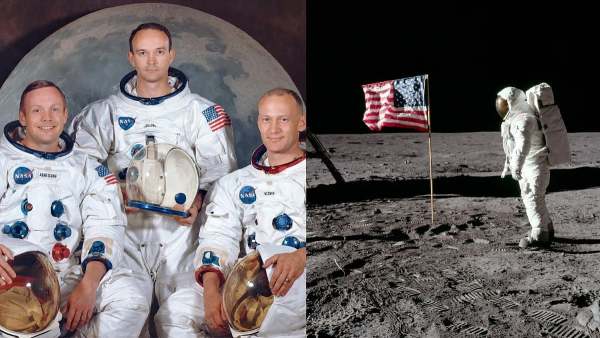
On July 20, 1969, Armstrong and Aldrin descended to the lunar surface in the Apollo Lunar Module Eagle, while Collins remained in orbit aboard the command module. As Armstrong stepped onto the Moon, he famously declared, “That’s one small step for man, one giant leap for mankind.” This moment symbolised not only American achievement but also a breakthrough for all humanity in space exploration.
The NASA Apollo program marked a defining chapter in human history, with Apollo 11 Moon Landing standing as its greatest achievement. The revolutionary mission launched on July 16, 1969, aboard the powerful Saturn V rocket. Apollo 11 carried astronauts Neil Armstrong, Buzz Aldrin, and Michael Collins on a historic journey to the Moon. Apollo 11 was the American spaceflight that first landed humans on the Moon, and the fifth crewed mission of NASA's Apollo program. With Buzz Aldrin and Michael Collins, Neil Armstrong, who was also a crew member of the mission, became the first man to land on the surface of the Moon.
Apollo 11 mission successfully landed on Moon
On July 20, 1969, Armstrong and Aldrin descended to the lunar surface in the Apollo Lunar Module Eagle, while Collins remained in orbit aboard the command module. As Armstrong stepped onto the Moon, he famously declared, “That’s one small step for man, one giant leap for mankind.” This moment symbolised not only American achievement but also a breakthrough for all humanity in space exploration.
The mission was a culmination of intense scientific effort and geopolitical competition during the Cold War, particularly the Space Race between the United States and the Soviet Union. Apollo 11 demonstrated technological superiority and showcased human ingenuity, precision engineering, and teamwork on an unprecedented scale.
-
UK Set to Implement Groundbreaking Anti-Smoking Legislation

-
Morrisons to close UK branch as supermarket giant confirms 'difficult decision'

-
US nuclear chief 'escorted out Pentagon' as probe launched into 'sensitive leak'

-
Heartbreaking truth behind Jimmy Bullard's sudden I'm a Celeb exit revealed

-
Michael Jackson movie biopic Part 2 release date teased by studio