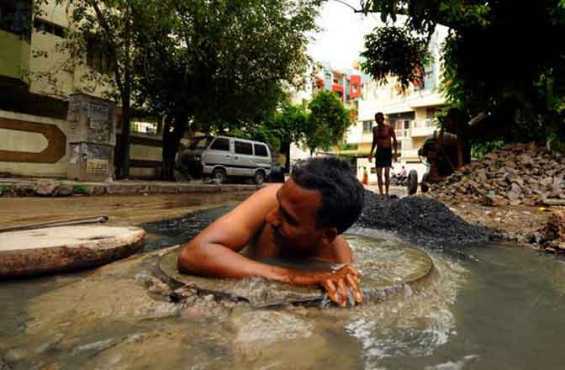
Manual scavenging is not merely a vestige of colonial sanitation methods but remains a continuing human rights violation, entrenched in caste hierarchies and social complicity
Published Date – 20 April 2026, 12:32 AM
For a country that aspires to be a Vishwaguru, it is embarrassing that the successive governments have failed to rid the country of the abominable practice of manual scavenging. It is a matter of collective shame that over 315 sanitation workers have died in the last five years while cleaning sewers and septic tanks across the country. For many hapless workers, sewers are turning out to be virtual death traps. Though the dehumanising practice was officially banned in 2013, people from disadvantaged sections are being forced into it because of lack of other livelihood options. They are hired by local corporations and even private contractors to clean the blocked sewers and drains. The presence of lethal gases such as methane and hydrogen sulphide in sewers puts the lives of these workers at risk. Carbon monoxide poisoning, diarrhoea, nausea and tuberculosis are some of the other health problems faced by them. Yet, safety protocols are routinely ignored by contractors seeking to cut costs, and the authorities look the other way. Manual scavenging is not merely a vestige of colonial sanitation methods but remains a continuing human rights violation, entrenched in caste hierarchies and social complicity. Globally recognised as a form of modern slavery, it stands in direct violation of international treaties such as the Universal Declaration of Human Rights (UDHR), the International Covenant on Civil and Political Rights (ICCPR), and the International Convention on the Elimination of all Forms of Racial Discrimination (ICERD), all of which are binding on India.
The government’s efforts towards complete mechanisation of sewer and septic tank cleaning have not yielded desired results. Though the Prohibition of Employment as Manual Scavengers and their Rehabilitation Act has been in force since 2013, the implementation remains weak and patchy. Mechanised cleaning, mandated as the norm, is either unavailable or underutilised, particularly in smaller towns. When deaths occur, compensation may be announced, but accountability is diluted. Prosecutions are rare, and systemic reform is even rarer. There has been an absolute failure to rehabilitate workers, mainly because the Act does not specify an authority to oversee this. Many families of workers who died while on duty are also not paid compensation as per the guidelines. Unfortunately, the sanitation work continues to be carried out largely by marginalised communities, perpetuating a cycle of social discrimination and neglect. The persistence of such practices raises disturbing questions about human dignity and equality. One wonders how a nation can aspire to become ‘Viksit’ (developed) by 2047, when a section of its citizens is engaged in absolutely dehumanising work. Manual scavenging not only violates the right to dignity but also the rights to health, life and liberty. There is a need to impose strict criminal liability on those responsible for violating safety norms mandated by the Supreme Court. Urban local bodies must ensure universal mechanisation of sewer cleaning.
-
Giorgi Mamardashvili hospitalised after Liverpool beat Everton as update offered

-
How Arsenal's Gabriel escaped red card vs Man City despite Erling Haaland confrontation

-
Ranvir Shorey says he has no favourite genre in cinema

-
Countryfile's Adam Henson shut down by guest after inappropriate question

-
Gujarat Titans vs Mumbai Indians: A Clash of Bowling Styles