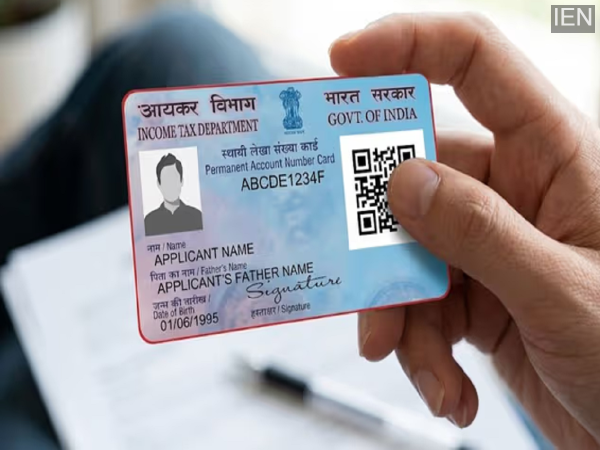
PAN Card Mandatory Transactions: Most people believe that the utility of a PAN card is limited solely to filing Income Tax Returns (ITR). However, in reality, it is through this very card that the government keeps a keen watch on your hard-earned income and major financial transactions. According to Rule 114B of the Income Tax Rules, providing your PAN is mandatory for the 17 activities listed below, in order to maintain transparency and prevent tax evasion.
For Which 17 Major Transactions is a PAN Card Mandatory?
- Buying/Selling a Vehicle: For any vehicle, excluding two-wheelers.
- Bank Account: For opening a new account at any bank (excluding Basic Savings Bank Deposit Accounts or BSDA).
- Cards and Demat: When applying for a credit/debit card or opening a Demat account for the stock market.
- Hotel Bills: When making a cash payment exceeding ₹50,000 at a hotel or restaurant.
- Foreign Travel: When making a cash payment exceeding ₹50,000 for foreign travel or for purchasing foreign currency.
- Mutual Funds: When making an investment exceeding ₹50,000.
- Debentures or Bonds: When purchasing bonds worth more than ₹50,000 from any company.
- RBI Bonds: When making a payment exceeding ₹50,000 to purchase bonds issued by the Reserve Bank of India (RBI).
- Cash Deposits: When depositing cash exceeding ₹50,000 in a bank on a single day.
- Bank Drafts: When obtaining a bank draft or pay order exceeding ₹50,000 by paying in cash.
- Fixed Deposits (FD): When opening a Fixed Deposit (FD) exceeding ₹50,000 at a bank or post office.
- Digital Wallets: When loading an amount exceeding ₹50,000 into an e-wallet or prepaid card over the course of a financial year.
- LIC Premiums: When paying a life insurance premium exceeding ₹50,000 in a financial year.
- Securities: For transactions exceeding ₹1 lakh involving securities other than shares.
- Unlisted Shares: For the purchase of shares worth over ₹1 lakh in a company that is not listed on a stock exchange.
- Property: For the buying or selling of land, a house, or a shop valued at over ₹10 lakh.
- Other Purchases: For any transaction exceeding ₹2 lakh involving the purchase of goods or services.
Does the Department become aware if the rules are violated?
Yes, the Income Tax Department is fully prepared to handle this. According to the Department, it is the legal responsibility of the entity receiving the payment from you to ensure compliance. For instance, if you open a bank account, it is the bank’s responsibility to collect your PAN card details. If any institution facilitates such transactions without a PAN, they may face punitive action. In this manner, the Department tracks every high-value transaction.
What changes have been introduced to PAN card rules effective April 2026?
Effective April 1, 2026, the procedure for obtaining a PAN card has undergone changes. You can no longer obtain a PAN card solely on the basis of your Aadhaar card. It is now mandatory to provide separate proof of your Date of Birth (DOB). For this purpose, you may submit a Birth Certificate, Voter ID, Passport, Driving License, or your Class 10th Marksheet.
What are the new forms for foreign citizens and companies?
To apply for a PAN card, the government has now replaced the old Form 49AA with the following new forms:
- Form 95: For individuals who are not citizens of India.
- Form 96: For companies or entities registered outside of India.
- View the official post by ‘Income Tax India’ on ‘X’ regarding this update:
-
PM Modi and myself don’t have ‘wife issue’: Rahul Gandhi
-
Centre notifies Women’s Reservation Act in assemblies, J-K, UTs

-
India’s smartphone shipments drop 3 pc in Jan-Mar, mark weakest quarter in 6 yrs

-
Aamir Khan likely to play role of Ashneer Grover in his next

-
Shreya Ghoshal trolled: Said no to ‘Fevicol Se’, now dancing to ‘Chikni Chameli’?