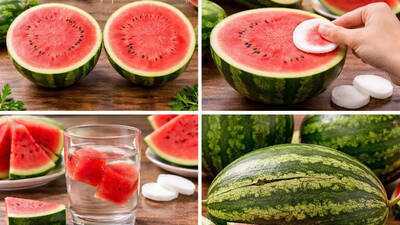
Watermelons are among the most favoured fruits during summer due to their tasty flavour and high water content, which helps in cooling down the body. In recent times, there have been instances where it has been observed that watermelons are either dyed or injected with artificial elements to make them look good and add more sweetness.
This may lead to health hazards for consumers; therefore, it becomes imperative for them to be cautious while purchasing fruits. People often overlook the fact that there are various ways to check whether the watermelons they are consuming are natural or have undergone any kind of processing.
How to distinguish natural and chemically injected watermelon
It might be hard to recognise whether your watermelon is artificially treated or not, but there are ways that you can use to distinguish between the two. Just by analysing its colour, texture, and seed presence, as well as conducting several tests at home, you will easily see the results for yourself. This will not take much time.
Check the colour and appearance of the watermelon
A very simple way to distinguish between a genuine watermelon and one that has been tampered with is through the colour of the fruit. The natural colour of a watermelon should not be too bright but rather have an irregular red hue.
In case the colour of the watermelon appears too good or red for a normal fruit, then chances are that the watermelon has been tampered with.
Use the cotton ball test to detect artificial colour
One of the easiest methods suggested by food safety specialists is that of the cotton ball test. Just cut the watermelon and wipe the fruit’s flesh with cotton or a tissue.
If the colour of the cotton changes to red, it means that artificial dyes might have been used. In case nothing happens, it means that the fruit is organic. This method is one of the fastest for testing chemicals.
Try the water test at home
The water test is another efficient method. Get some samples of watermelon flesh and put them into a glass of water. If the water turns red immediately, there is a possibility that artificial colour was used. If the watermelon is natural, no colour should be extracted from it. It is simple and fast to perform.
Observe the seeds carefully
The presence of the seed is also another indication to determine the genuineness of the fruit. The natural colour of the seeds in watermelon fruits is generally black or dark brown. If one finds the seed appearing reddish or discoloured, then there is something wrong with the fruit.
Check the texture and firmness
Watermelons injected with other substances also differ in terms of texture. For example, if the melon seems to be too soft in one place while being hard in another part, then it might not be a natural watermelon. Natural watermelons should not feel inconsistent in terms of texture.
Look for injection marks or cracks
Some injected watermelons might have tiny holes, cracks, or peculiar markings on their exterior surface.
Such markings could be indicative of the insertion point for chemicals. Specialists recommend staying away from any fruit that exhibits these peculiarities.
Why chemically treated watermelon can be harmful
There are instances when fruits may have been treated with chemicals to improve their appearance. Nevertheless, consumption of these products can have health hazards.
The use of some chemicals in the process of producing watermelons can cause digestive problems or even allergies.
Selecting the appropriate watermelon will not be difficult if one notices the minor things about it. Some simple tests will help to detect the use of chemicals in its making.
Awareness while purchasing and eating watermelons will help one take full advantage of the fruit's benefits.
-
Miracle of honey-garlic – weight will reduce rapidly, just use it like this
-
Consumption of Raisins: Soaked or Dry, Which is Better?
-
Preparation to implement UCC in Chhattisgarh, committee will be formed, decision in cabinet meeting

-
Cecilia Cheung reveals declining health

-
Who is Johnny Somali? Controversial Youtuber jailed in South Korea