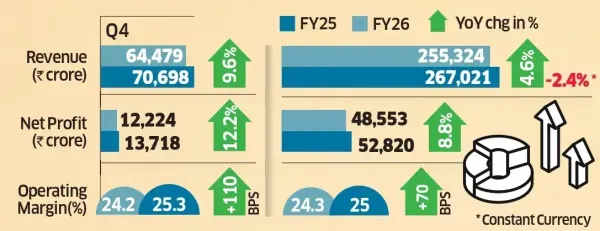
Tata Consultancy Services (TCS), India’s largest software services company, posted a 12% rise in net profit to Rs 13,718 crore in the March quarter, while revenue rose 9.6% to 70,698 crore. Sequentially, profit was up 19.4% and revenue rose 5.4%.
The numbers exceeded or matched expectations after several quarters of muted growth, aided by a weak rupee and large deal wins. An ET poll of analysts had pegged net profit at Rs 13,802 crore and revenue at Rs 69,894 crore.
The IT bellwether, however, posted its first annual revenue decline since going public at 2.4% in constant currency terms for FY26. "The traditional IT services model built on scale, utilisation, and linear headcount growth is running out of road," Phil Fersht chief executive, HfS Research said in a note.
As AI takes centrestage, India's services leaders will be jolted into more aggressive action. In dollar terms, FY26 revenue stood at $30.02 billion.
CEO K Krithivasan said TCS is “getting into next year with a lot of positivity and confidence,” with some cautiousness baked in due to the West Asia war.
The company, which also reported the highest net margin in the last four years, said its AI revenue crossed $2.3 billion. It clocked the highest total contract value (TCV) ever with three large deals for the quarter and five for the year, signalling a potential turnaround as uncertainties sparked by the war in West Asia continue to weigh on growth. TCV was $40.7 billion in FY26 and $12 billion in Q4.
US-listed shares of industry peers Infosys and Wipro were down in afternoon trade on the New York Stock Exchange (NYSE), with shares falling over 2% in early trade, in a possible reaction to TCS' results.
“At this time, I think the impact (of the war) will be limited to the travel and transportation (industry) and probably the work we do in West Asia,” he said. “We have not been hearing any other specific concerns from our clients in other industries or other job fields. If it continues and results in further supply and disruption or any other secondary issues, it may have an impact.”
For the full financial year, TCS reported revenue of Rs 2,67,021 crore, up 4.6%, although it declined 2.4% in constant currency terms.
“While the macroeconomic headwinds continue, we see sustained customer conviction in technology investments, which positions us well for the opportunities ahead,” said Krithivasan.
AI services revenue leaps
Fourth-quarter AI services revenue rose to $2.3 billion from $1.8 billion in the December quarter and $1.5 billion in the September quarter, when the company first reported the category separately.
The company’s investment in the new HyperVault Data Centres unit is “a catalyst in forging strategic partnerships with OpenAI, AMD and ABB, further strengthening our positioning across infrastructure-to-intelligence,” said chief operating officer Aarthi Subramanian. “Our engagements with hyperscalers and frontier AI model companies have moved beyond early exploration into design alignment, security frameworks, side-view diligence, and commercial structures. We see the demand converging around large anchor AI workloads in the 100-200 MW range per customer.”
During the fourth quarter, TCS signed contracts with OpenAI and AMD for building data centres powered by AI chips.
Operating margin, a key metric, swelled to 25% in FY26, its highest in four years, the company said.
TCS already commands the highest margin among all large cap IT peers due to its scale and operational efficiencies. However, from a quarterly perspective, margin growth was almost flat at 25.3% at March-end, up 10 basis points.
NelsonHall principal research analyst Gaurav Parab said the company’s performance was better than expected and comes after nearly a year of sustained disruption in discretionary spending, driven first by tariff-led uncertainty and then broader macro volatility.
“The fact that TCS has maintained operational discipline through this phase builds confidence that large providers are learning to operate in a slower, more selective demand environment rather than waiting for a sharp rebound,” he said.
Also Read: TCS rides AI demand; mega deals power Q4 results
Lower headcount
TCS ended the quarter with 584,519 employees, down 23,460 from a year ago, although it added 2,356 employees sequentially with lateral and fresher hiring.
The company had said last year that it will lay off 2% of its workforce and tighten bench policies, which also led to voluntary exits, primarily in the mid-to-senior layer. “The restructuring exercise was completed,” the company said on Thursday.
Last quarter, TCS had said that its non-traditional or next-generation services, which excludes legacy units such as application development, testing and BPS (business process services), now account for $11 billion in revenue. These service lines are expanding faster than the overall average growth rate. More than 85% of its clients with over $20 million in contract value now use the company for AI-led transformation work.
On Thursday, TCS’ board approved this fiscal’s final dividend of Rs 31 per equity share, which shall be paid post the conclusion of its annual general meeting.
The earnings were announced after market hours. TCS shares ended 1.09% higher at Rs 2587.75 on the BSE, while the Sensex was down 1.20%.
The growth was led by the energy and utilities sector, which grew 6.1%, and consumer business, which grew 2.4% after a prolonged slowdown. The company’s largest client segment BFSI (banking, financial services, insurance), which accounts for 31.6% of revenue, grew by a marginal 0.1% in the quarter.
Among core markets, North America remained the leader with 48.5% revenue share, but remained flat in terms of sequential growth. The UK region accounted for 17.2% revenue and grew the strongest at 2.4%. The rest of Europe grew at 2.1% on a sequential basis. The India market posted 1.7% growth but constitutes only 6% of revenue.
The numbers exceeded or matched expectations after several quarters of muted growth, aided by a weak rupee and large deal wins. An ET poll of analysts had pegged net profit at Rs 13,802 crore and revenue at Rs 69,894 crore.
The IT bellwether, however, posted its first annual revenue decline since going public at 2.4% in constant currency terms for FY26. "The traditional IT services model built on scale, utilisation, and linear headcount growth is running out of road," Phil Fersht chief executive, HfS Research said in a note.
As AI takes centrestage, India's services leaders will be jolted into more aggressive action. In dollar terms, FY26 revenue stood at $30.02 billion.
CEO K Krithivasan said TCS is “getting into next year with a lot of positivity and confidence,” with some cautiousness baked in due to the West Asia war.
The company, which also reported the highest net margin in the last four years, said its AI revenue crossed $2.3 billion. It clocked the highest total contract value (TCV) ever with three large deals for the quarter and five for the year, signalling a potential turnaround as uncertainties sparked by the war in West Asia continue to weigh on growth. TCV was $40.7 billion in FY26 and $12 billion in Q4.
US-listed shares of industry peers Infosys and Wipro were down in afternoon trade on the New York Stock Exchange (NYSE), with shares falling over 2% in early trade, in a possible reaction to TCS' results.
“At this time, I think the impact (of the war) will be limited to the travel and transportation (industry) and probably the work we do in West Asia,” he said. “We have not been hearing any other specific concerns from our clients in other industries or other job fields. If it continues and results in further supply and disruption or any other secondary issues, it may have an impact.”
For the full financial year, TCS reported revenue of Rs 2,67,021 crore, up 4.6%, although it declined 2.4% in constant currency terms.
“While the macroeconomic headwinds continue, we see sustained customer conviction in technology investments, which positions us well for the opportunities ahead,” said Krithivasan.
AI services revenue leaps
Fourth-quarter AI services revenue rose to $2.3 billion from $1.8 billion in the December quarter and $1.5 billion in the September quarter, when the company first reported the category separately.
The company’s investment in the new HyperVault Data Centres unit is “a catalyst in forging strategic partnerships with OpenAI, AMD and ABB, further strengthening our positioning across infrastructure-to-intelligence,” said chief operating officer Aarthi Subramanian. “Our engagements with hyperscalers and frontier AI model companies have moved beyond early exploration into design alignment, security frameworks, side-view diligence, and commercial structures. We see the demand converging around large anchor AI workloads in the 100-200 MW range per customer.”
During the fourth quarter, TCS signed contracts with OpenAI and AMD for building data centres powered by AI chips.
Operating margin, a key metric, swelled to 25% in FY26, its highest in four years, the company said.
TCS already commands the highest margin among all large cap IT peers due to its scale and operational efficiencies. However, from a quarterly perspective, margin growth was almost flat at 25.3% at March-end, up 10 basis points.
NelsonHall principal research analyst Gaurav Parab said the company’s performance was better than expected and comes after nearly a year of sustained disruption in discretionary spending, driven first by tariff-led uncertainty and then broader macro volatility.
“The fact that TCS has maintained operational discipline through this phase builds confidence that large providers are learning to operate in a slower, more selective demand environment rather than waiting for a sharp rebound,” he said.
Also Read: TCS rides AI demand; mega deals power Q4 results
Lower headcount
TCS ended the quarter with 584,519 employees, down 23,460 from a year ago, although it added 2,356 employees sequentially with lateral and fresher hiring.
The company had said last year that it will lay off 2% of its workforce and tighten bench policies, which also led to voluntary exits, primarily in the mid-to-senior layer. “The restructuring exercise was completed,” the company said on Thursday.
Last quarter, TCS had said that its non-traditional or next-generation services, which excludes legacy units such as application development, testing and BPS (business process services), now account for $11 billion in revenue. These service lines are expanding faster than the overall average growth rate. More than 85% of its clients with over $20 million in contract value now use the company for AI-led transformation work.
On Thursday, TCS’ board approved this fiscal’s final dividend of Rs 31 per equity share, which shall be paid post the conclusion of its annual general meeting.
The earnings were announced after market hours. TCS shares ended 1.09% higher at Rs 2587.75 on the BSE, while the Sensex was down 1.20%.
The growth was led by the energy and utilities sector, which grew 6.1%, and consumer business, which grew 2.4% after a prolonged slowdown. The company’s largest client segment BFSI (banking, financial services, insurance), which accounts for 31.6% of revenue, grew by a marginal 0.1% in the quarter.
Among core markets, North America remained the leader with 48.5% revenue share, but remained flat in terms of sequential growth. The UK region accounted for 17.2% revenue and grew the strongest at 2.4%. The rest of Europe grew at 2.1% on a sequential basis. The India market posted 1.7% growth but constitutes only 6% of revenue.