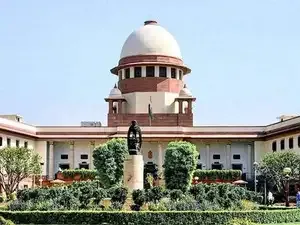
New Delhi: Supreme Court on Wednesday remarked that it has the jurisdiction and the right, via judicial review, to decide whether a religious practice is superstition but what will follow is for the legislature to decide.
The observation was made by a nine-member bench examining legal and constitutional questions touching upon religious practices. The bench headed by CJI Surya Kant resumed the second day (final) hearing of petitions relating to discrimination against women at religious places, including Sabarimala, and on the ambit and scope of religious freedom practised by multiple faiths.
In response, solicitor general Tushar Mehta, appearing on behalf of the Centre, submitted that a secular court cannot determine whether a religious practice amounts to superstition. He said India is a pluralistic society with a variety of beliefs across different regions. He said secular courts cannot sit in appeal over legality, propriety, validity or rationality of attributes of deities. Mehta contended that judges "are scholars in the field of law not in the field of religion".
Speaking for the bench, justice Joymalya Bagchi verbally asked whether they cannot even intervene in cases of witchcraft. The senior judge asked Mehta if a petitioner approaches SC arguing that there is a religious practice of witchcraft and the legislature is silent. "Can the court not use the principle of unoccupied field to give directions for prohibiting such a practice keeping in mind not going into essential religious practice but on the beacons of prohibition like health, morality and public order?" Justice Bagchi said.
CJI Kant orally remarked the court can always declare some practice as contrary to public order, morality or health. He said judges cannot replace themselves with the expertise of subject experts but can always examine matters that can fall within judicial review. Citing practices of witchcraft, cannibalism or human sacrifice, he verbally observed that the "moment there is such a practice, the court will simply say that it is contrary to public order, morality or health".
Justice BV Nagarathna, the sole woman on the bench, verbally remarked that the court's approach can be to determine an essential religious practice from the lens of the philosophy of that religion. As regards the issue of public morality and constitutional morality, Mehta submitted that "constitutional morality cannot be a ground for judicial review". He added that "constitutional morality is subjective morality".
Justice Nagarathna orally remarked that what was once considered to be immoral or obscene in India is no longer regarded as same. "That is the problem now in India. The problem in India is the standards which existed in the 1950s are not the standards today. The standards of the 1950s are (now perceived as) narrow-mindedness. They are not. The criticism now is that it is narrow-minded, myopic, old-fashioned. This is the problem of Indian society today," she observed. CJI called it the struggle of an evolving society.
On Tuesday, the Centre had submitted before the Supreme Court that Indian society not only treats women equally but places them on a higher pedestal. Mehta had argued that the 2018 judgement permitting entry of women of all age groups into the Sabarimala temple was wrongly decided and deserves to be declared a wrong law. He contended that the 2018 ruling requires reconsideration and reversal on legal grounds.
The observation was made by a nine-member bench examining legal and constitutional questions touching upon religious practices. The bench headed by CJI Surya Kant resumed the second day (final) hearing of petitions relating to discrimination against women at religious places, including Sabarimala, and on the ambit and scope of religious freedom practised by multiple faiths.
In response, solicitor general Tushar Mehta, appearing on behalf of the Centre, submitted that a secular court cannot determine whether a religious practice amounts to superstition. He said India is a pluralistic society with a variety of beliefs across different regions. He said secular courts cannot sit in appeal over legality, propriety, validity or rationality of attributes of deities. Mehta contended that judges "are scholars in the field of law not in the field of religion".
Speaking for the bench, justice Joymalya Bagchi verbally asked whether they cannot even intervene in cases of witchcraft. The senior judge asked Mehta if a petitioner approaches SC arguing that there is a religious practice of witchcraft and the legislature is silent. "Can the court not use the principle of unoccupied field to give directions for prohibiting such a practice keeping in mind not going into essential religious practice but on the beacons of prohibition like health, morality and public order?" Justice Bagchi said.
CJI Kant orally remarked the court can always declare some practice as contrary to public order, morality or health. He said judges cannot replace themselves with the expertise of subject experts but can always examine matters that can fall within judicial review. Citing practices of witchcraft, cannibalism or human sacrifice, he verbally observed that the "moment there is such a practice, the court will simply say that it is contrary to public order, morality or health".
Justice BV Nagarathna, the sole woman on the bench, verbally remarked that the court's approach can be to determine an essential religious practice from the lens of the philosophy of that religion. As regards the issue of public morality and constitutional morality, Mehta submitted that "constitutional morality cannot be a ground for judicial review". He added that "constitutional morality is subjective morality".
Justice Nagarathna orally remarked that what was once considered to be immoral or obscene in India is no longer regarded as same. "That is the problem now in India. The problem in India is the standards which existed in the 1950s are not the standards today. The standards of the 1950s are (now perceived as) narrow-mindedness. They are not. The criticism now is that it is narrow-minded, myopic, old-fashioned. This is the problem of Indian society today," she observed. CJI called it the struggle of an evolving society.
On Tuesday, the Centre had submitted before the Supreme Court that Indian society not only treats women equally but places them on a higher pedestal. Mehta had argued that the 2018 judgement permitting entry of women of all age groups into the Sabarimala temple was wrongly decided and deserves to be declared a wrong law. He contended that the 2018 ruling requires reconsideration and reversal on legal grounds.