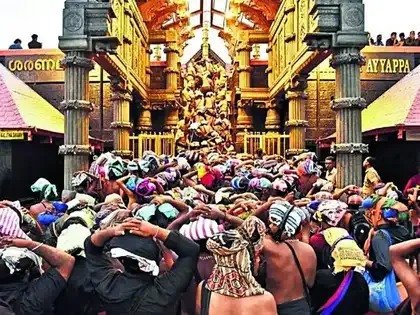
Yesterday, the Supreme Court started what could be the most consequential constitutional deliberations in recent Indian history. Its constitutional bench was convened in the aftermath of the judgment holding that women should be admitted into Sabarimala Temple in Kerala, notwithstanding a traditional ban on women of menstrual age.
But it does more than revisit the Sabarimala case. It starts with the position that freedom of religion means protection to 'essential religious practices', not to other discriminatory practices that have for centuries marked all religions.
The Constitution is crystal clear that no discrimination is permitted on the grounds on religion, caste, gender or place of birth. This provisional is not hemmed in with ifs and buts. Second, the court should not be getting into what are 'essential practices' of different religions, and what are 'non-essential'. That is judicial overreach with a capital O. It will open a Pandora's box that's best kept shut.
Also Read: Woman can't be treated as 'untouchable' for 3 days, says Justice Nagarathna in Sabarimala case
The US pioneered the concept of freedom of religion. Its Supreme Court doesn't go into what is essential in different religions. Secular non-discriminatory laws rule supreme. Mormons, for instance, viewed polygamy as an essential practice sanctified by their founders, but had to give it up. Muslims in the US cannot - and do not - demand Sharia law. Jews cannot demand Jewish law, and Hindus cannot ask for Hindu law on, say, matters of succession.
In India, traditional Hindu practice forbade entry of dalits into temples. Did Supreme Court seek to establish whether banning dalit entry was 'essential' or not 'essential'? Many Hindus, and certainly guardians of temples, would have called it 'essential'. It was established practice for centuries.
Did the Supreme Court study Manu's laws or Dharma Shastras to decide which of their many rules and principles were essential and which not? Reviewing the Sabarimala case opens the door for review of dalit temple entry and similar matters. Please avoid that.
Hindus, Muslims, Sikhs and Parsis follow normal secular law in Europe and North America. They don't argue that freedom of religion entitles them to discrimination in matters such as caste or gender. India should be no different.
India's Constitution and laws are clear that religious laws are irrelevant in criminal matters. Islamic law lays down that a thief should have his right hand and left foot amputated. Even today, in the name of Sharia, Iran cuts off fingers of men convicted of theft. But Indian criminal law is secular and applies to all.
India's Constitution does, on the other hand, permit different religious groups to follow historical traditions in personal law. But this is supposed to be temporary. The Constitution also calls for the creation of a common civil code. It's a shame that this has yet to happen. India should have a single secular law for all citizens for both criminal and personal law.
Sabarimala should not have been controversial at all. Earlier, Haji Ali Dargah in Mumbai had prohibited Muslim women from entering the sanctum on the ground that they may be menstruating, the same concern as at Sabarimala. In 2016, Supreme Court held that women must be allowed into the dargah. Surely, the same rule must prevail for all religious places.
The Constitution bench will be revisiting several cases. These include the Sabarimala temple entry case for Hindus; mosque entry for women in 'Yasmeen Zuber Ahmad Peerzada v. Union of India'; female genital mutilation among Dawoodi Bohras in 'Sunita Tiwari v. Union of India'; exclusion of Parsi women married to non-Parsis from fire temples in 'Goolrokh Gupta v. Burjor Pardiwala'; and broader challenges to practices such as polygamy and nikah halala linked to 'Shayara Bano v. Union of India'. In all cases, the defendants defend discrimination as 'essential religious practices'.
The 'essential religious practices' doctrine, developed in early cases such as 'The Commissioner, Hindu Religious Endowments v. Sri Lakshmindra Thirtha Swamiar of Shirur Mutt', requires judges to determine whether a practice is fundamental to a religion. This has always been wrong, as it forces judges to enter areas outside their remit, making them arbiters of religious doctrine.
The bench needs to affirm that the distinction between 'essential' and 'non-essential' features of religions is neither logical nor practical, and must henceforth be abolished. That will truly clear the decks.
Instead of asking whether a practice is central to a religion, the court should ask whether it violates fundamental rights. If so, it should not be protected, regardless of its religious significance. This will affirm primacy of the Constitution and avoid the need for judges to enter religious doctrine.
Articles 14, 15 and 21 of the Constitution unequivocally prohibit discrimination on various grounds, including gender. These are constitutionally foundational. Any religious practice, however ancient or widely followed, that violates these guarantees must not get protection in the name of the same Constitution.
But it does more than revisit the Sabarimala case. It starts with the position that freedom of religion means protection to 'essential religious practices', not to other discriminatory practices that have for centuries marked all religions.
The Constitution is crystal clear that no discrimination is permitted on the grounds on religion, caste, gender or place of birth. This provisional is not hemmed in with ifs and buts. Second, the court should not be getting into what are 'essential practices' of different religions, and what are 'non-essential'. That is judicial overreach with a capital O. It will open a Pandora's box that's best kept shut.
Also Read: Woman can't be treated as 'untouchable' for 3 days, says Justice Nagarathna in Sabarimala case
The US pioneered the concept of freedom of religion. Its Supreme Court doesn't go into what is essential in different religions. Secular non-discriminatory laws rule supreme. Mormons, for instance, viewed polygamy as an essential practice sanctified by their founders, but had to give it up. Muslims in the US cannot - and do not - demand Sharia law. Jews cannot demand Jewish law, and Hindus cannot ask for Hindu law on, say, matters of succession.
In India, traditional Hindu practice forbade entry of dalits into temples. Did Supreme Court seek to establish whether banning dalit entry was 'essential' or not 'essential'? Many Hindus, and certainly guardians of temples, would have called it 'essential'. It was established practice for centuries.
Did the Supreme Court study Manu's laws or Dharma Shastras to decide which of their many rules and principles were essential and which not? Reviewing the Sabarimala case opens the door for review of dalit temple entry and similar matters. Please avoid that.
Hindus, Muslims, Sikhs and Parsis follow normal secular law in Europe and North America. They don't argue that freedom of religion entitles them to discrimination in matters such as caste or gender. India should be no different.
India's Constitution and laws are clear that religious laws are irrelevant in criminal matters. Islamic law lays down that a thief should have his right hand and left foot amputated. Even today, in the name of Sharia, Iran cuts off fingers of men convicted of theft. But Indian criminal law is secular and applies to all.
India's Constitution does, on the other hand, permit different religious groups to follow historical traditions in personal law. But this is supposed to be temporary. The Constitution also calls for the creation of a common civil code. It's a shame that this has yet to happen. India should have a single secular law for all citizens for both criminal and personal law.
Sabarimala should not have been controversial at all. Earlier, Haji Ali Dargah in Mumbai had prohibited Muslim women from entering the sanctum on the ground that they may be menstruating, the same concern as at Sabarimala. In 2016, Supreme Court held that women must be allowed into the dargah. Surely, the same rule must prevail for all religious places.
The Constitution bench will be revisiting several cases. These include the Sabarimala temple entry case for Hindus; mosque entry for women in 'Yasmeen Zuber Ahmad Peerzada v. Union of India'; female genital mutilation among Dawoodi Bohras in 'Sunita Tiwari v. Union of India'; exclusion of Parsi women married to non-Parsis from fire temples in 'Goolrokh Gupta v. Burjor Pardiwala'; and broader challenges to practices such as polygamy and nikah halala linked to 'Shayara Bano v. Union of India'. In all cases, the defendants defend discrimination as 'essential religious practices'.
The 'essential religious practices' doctrine, developed in early cases such as 'The Commissioner, Hindu Religious Endowments v. Sri Lakshmindra Thirtha Swamiar of Shirur Mutt', requires judges to determine whether a practice is fundamental to a religion. This has always been wrong, as it forces judges to enter areas outside their remit, making them arbiters of religious doctrine.
The bench needs to affirm that the distinction between 'essential' and 'non-essential' features of religions is neither logical nor practical, and must henceforth be abolished. That will truly clear the decks.
Instead of asking whether a practice is central to a religion, the court should ask whether it violates fundamental rights. If so, it should not be protected, regardless of its religious significance. This will affirm primacy of the Constitution and avoid the need for judges to enter religious doctrine.
Articles 14, 15 and 21 of the Constitution unequivocally prohibit discrimination on various grounds, including gender. These are constitutionally foundational. Any religious practice, however ancient or widely followed, that violates these guarantees must not get protection in the name of the same Constitution.
(Disclaimer: The opinions expressed in this column are that of the writer. The facts and opinions expressed here do not reflect the views of www.economictimes.com.)





Swaminathan S Anklesaria Aiyar
Consulting Editor at ET