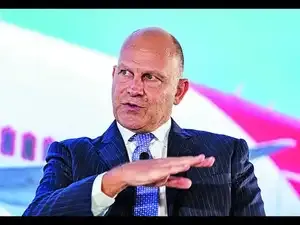
New Delhi: Air India CEO Campbell Wilson Tuesday said he has resigned, leaving the Tata Group-owned airline scrambling to find his replacement by September.
In a statement, Air India said Wilson had conveyed his decision of stepping down to Tata Sons chairman N Chandrasekaran back in 2024, leading many to question why the salt-to-steel conglomerate hasn't been able to set a concrete succession plan yet.
"Usually, the new CEO should be in place 3-6 months prior and work with the outgoing CEO to understand the business in depth and I feel this is important for Air India," said Kapil Kaul, CEO, South Asia at aviation consultancy firm CAPA. "This is more critical given the current situation because of the Iran war and its possible consequences in case the war continues."
Also Read: Two CEOs' exits & crises in the skies
Air India said its board has formed a committee to find a successor to Wilson in the coming months.
Wilson took the job, arguably the most challenging in the aviation sector, in 2022 for a five-year term. Soon after, he began implementing a five-year turnaround plan to increase market share and turnaround the loss-making airline.
Also Read: 'Time is right...': What Campbell Wilson said on his resignation from Air India
A native of New Zealand, Wilson has managed to complete critical parts of the transformation plan including merging full-service airline Vistara-an erstwhile joint venture of Tata Sons and Singapore Airlines-into Air India besides implementing a long-overdue fleet expansion, even surpassing domestic market leader IndiGo on some key metro routes. However, his ambition has been materially constrained by a prolonged global supply chain crisis that delayed the induction of new aircraft while delaying refurbishment of older ones.
Consequently, Air India's service standards and on-time performance have come under pressure, with repeated technical issues affecting its wide-body fleet catering to key markets like Europe and North America.
The airline's operations have also been under heightened scrutiny since a crash last year which killed 260 people though a preliminary investigation hasn't indicated any fault with the aircraft or the airline's engineering practices as a reason for the crash.
Multiple senior officials, including Wilson, have been issued show-cause notices by the Directorate General of Civil Aviation for alleged violations and non-compliance including an incident where the airline operated an aircraft with an expired licence.
"We should have received 28 brand new aircraft by now," Wilson said in January expressing frustration over the aircraft delivery delays. "But the actual number of new aircraft designed by and for Air India that we have received is zero. So, we have been heavily impacted by supply chain challenges."
In a statement, Air India said Wilson had conveyed his decision of stepping down to Tata Sons chairman N Chandrasekaran back in 2024, leading many to question why the salt-to-steel conglomerate hasn't been able to set a concrete succession plan yet.
"Usually, the new CEO should be in place 3-6 months prior and work with the outgoing CEO to understand the business in depth and I feel this is important for Air India," said Kapil Kaul, CEO, South Asia at aviation consultancy firm CAPA. "This is more critical given the current situation because of the Iran war and its possible consequences in case the war continues."
Also Read: Two CEOs' exits & crises in the skies
Air India said its board has formed a committee to find a successor to Wilson in the coming months.
Wilson took the job, arguably the most challenging in the aviation sector, in 2022 for a five-year term. Soon after, he began implementing a five-year turnaround plan to increase market share and turnaround the loss-making airline.
Also Read: 'Time is right...': What Campbell Wilson said on his resignation from Air India
A native of New Zealand, Wilson has managed to complete critical parts of the transformation plan including merging full-service airline Vistara-an erstwhile joint venture of Tata Sons and Singapore Airlines-into Air India besides implementing a long-overdue fleet expansion, even surpassing domestic market leader IndiGo on some key metro routes. However, his ambition has been materially constrained by a prolonged global supply chain crisis that delayed the induction of new aircraft while delaying refurbishment of older ones.
Consequently, Air India's service standards and on-time performance have come under pressure, with repeated technical issues affecting its wide-body fleet catering to key markets like Europe and North America.
The airline's operations have also been under heightened scrutiny since a crash last year which killed 260 people though a preliminary investigation hasn't indicated any fault with the aircraft or the airline's engineering practices as a reason for the crash.
Multiple senior officials, including Wilson, have been issued show-cause notices by the Directorate General of Civil Aviation for alleged violations and non-compliance including an incident where the airline operated an aircraft with an expired licence.
"We should have received 28 brand new aircraft by now," Wilson said in January expressing frustration over the aircraft delivery delays. "But the actual number of new aircraft designed by and for Air India that we have received is zero. So, we have been heavily impacted by supply chain challenges."