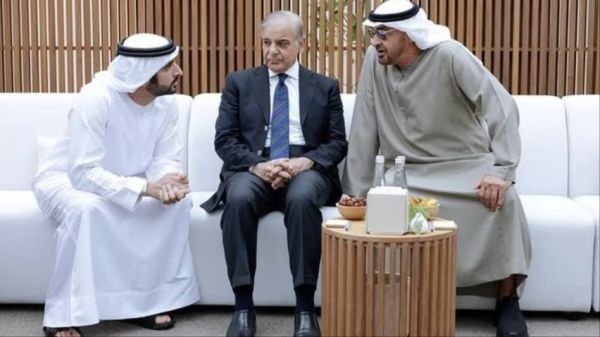
New Delhi: The United Arab Emirates (UAE) has further strained Pakistan’s financial situation by demanding its funds from it. Amid the ongoing Gulf War, the UAE has demanded Pakistan’s billions of dollars as soon as possible. Due to pressure from the UAE, Pakistan will have to repay its $3.5 billion loan this month.
This money has been rolled over since 2018, meaning the repayment period for this loan has been increasing. However, for the first time in seven years, Pakistan has failed to reach an agreement with the UAE to roll over a $3 billion loan. A Pakistani government official stated that another $450 million loan from the UAE has been outstanding for several years, and the UAE claims it needs that money immediately. This has increased pressure on Pakistan, which will have to repay a total of $3.5 billion in debt to the UAE.
For the past seven years, Pakistan has been paying approximately 6% annual interest to the UAE on this $3 billion loan. However, this interest is now being charged monthly instead of annually, leading Pakistan to feel it should repay the UAE. According to a Pakistani official, Pakistan will make this loan payment to the UAE by April 23rd.
This debt represents approximately 18% of Pakistan’s foreign exchange reserves. Pakistan will have to repay this money to the UAE this month, putting significant pressure on its external financial balance and threatening its currency. This comes at a time when high crude oil prices are further weakening its economic situation. According to the State Bank of Pakistan, the country’s foreign exchange reserves stood at $16.4 billion as of March 27, enough to cover approximately three months of imports.
It’s unclear why the UAE has suddenly demanded the repayment of the loan at this time. However, Pakistani news broadcaster Geo News recently quoted sources as saying, “Given the current situation in the Middle East following the US-Israeli war against Iran, the UAE has immediately demanded the repayment of the loan to Pakistan.” On April 4, Pakistan’s Foreign Ministry described the UAE’s demand for the money as a “normal financial transaction” and said there were no political differences between the two countries. However, local media reports stated that negotiations with the UAE over the terms of the rollover had failed.
Over the past few years, Pakistan has attempted to shore up its economy with loans from allies like the International Monetary Fund (IMF), the UAE, China, and Saudi Arabia. This has improved its foreign reserves and stabilized its currency, which was trading in the range of 278-282 against the dollar before the Iran conflict. The rupee has remained relatively stable since early March, but the country’s main stock index, the KSE-100, has fallen 15%.
Speaking to local media, Mohammad Sohail, CEO of Pakistani brokerage Topline Securities, said, “We didn’t anticipate the UAE asking for its money back, and there were no pre-arranged arrangements for this. We believe Pakistan’s central bank could borrow from commercial banks through dollar swaps, although the IMF doesn’t approve of this and there are limitations.”
Pakistan also has to make $1.3 billion in bond payments to international investors, including the UAE, this month. In these difficult times, Pakistan is awaiting the next installment of $1.2 billion from the International Monetary Fund. On the verge of default, Pakistan is relying on an IMF bailout package, where it is forced to operate its economy under IMF conditions.
Debt rollovers with allies have been a common practice for Pakistan over the past decade, but the UAE’s refusal this time signals a shift in its stance. This is also noteworthy because Pakistan is strengthening its ties with Saudi Arabia, a rival of the UAE, which the UAE dislikes.
Sajid Amin, deputy executive director of the Islamabad-based Sustainable Development Policy Institute, said that the UAE’s assistance came at a time when Pakistan was unable to meet the minimum financial conditions for the IMF program. Pakistan is now waiting for Saudi Arabia to help. Returning the UAE’s money will cause a significant drop in Pakistan’s foreign exchange reserves. Now, Pakistan is looking to Saudi Arabia to shore up its foreign exchange reserves through a loan.
When issuing a bailout package for Pakistan, the IMF stipulated that its central bank’s foreign exchange reserves should not fall below a certain level. If the loan to the UAE is not repaid, the State Bank of Pakistan’s foreign exchange reserves will fall below the target level, which would violate the IMF program.
-
Newlywed Bride in Gorakhpur Disappears with Valuables

-
India's U20 Women's Team Secures Victory Against Chinese Taipei in AFC U20 Women's Asian Cup

-
Tragic Domestic Dispute Leads to Shooting Incident in Gujarat

-
LPG quotas are set for everyone! Industries will not be allowed to act arbitrarily, and discounts will be available on PNG connections.

-
Atlas Nets $6 Mn To Scale Its Accounting-Focused AI Platform