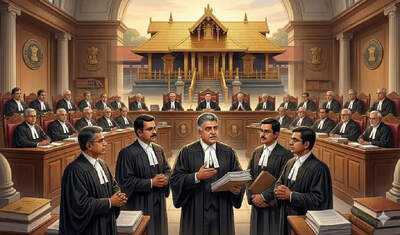
The Supreme Court's nine-judge bench is set to conduct the final hearing on petitions concerning discrimination against women at religious sites, including the Sabarimala temple, starting April 7. Chief Justice Surya Kant is presiding over the constitutional bench. This case is linked to the 2018 ruling where the Supreme Court, by a 4-1 majority, allowed women aged 10 to 50 to enter the Sabarimala temple, declaring the ban unconstitutional. In 2019, a separate five-judge bench referred broader questions regarding women's entry and religious freedom across various faiths to a larger bench. Both the central and Kerala governments have supported petitions seeking a review of the 2018 decision.
Religious Practices Not Always Linked to Dignity or Personal Choice Religious Practices Not Always Linked to Dignity or Personal Choice
Solicitor General Tushar Mehta informed the Supreme Court that not all religious practices should be viewed through the lens of dignity or personal choice. Citing examples from other religions, he emphasized the need to respect all religious practices, stating that not everything is related to dignity or physical freedom. He argued that if he visits a shrine or gurdwara and is required to cover his head, he cannot claim that his dignity, rights, or choices are being violated. He contended that the Sabarimala issue is intrinsically linked to the nature of the deity involved, questioning how judicial scrutiny could be applied to such matters.
Government's Stance on Gender-Based Issues Government's Stance on Gender-Based Issues
During the proceedings, Solicitor General Tushar Mehta argued that not all constitutional issues should be interpreted through a gender perspective. He defended the controversial ban on women's entry at Sabarimala, stating that a jurisprudence has developed over the past decade that attempts to view every constitutional provision from a gender standpoint. However, he asserted that not all provisions serve this purpose. He maintained that there is no discrimination in this case, referencing the constitutional guarantee of equality. Article 14 ensures equality for all, while Article 15 prohibits discrimination on various grounds, including gender. Fundamental rights are equally accessible to everyone.
Limits of Government in Religious Matters Limits of Government in Religious Matters
Continuing his arguments, Solicitor General Tushar Mehta raised the question of whether courts possess the expertise to determine what constitutes an essential religious practice. He stated that identifying essential practices would require an in-depth study of religious texts and evolving belief systems. He questioned how the court could assess the necessity of such practices. Expressing concerns about institutional limitations, Mehta noted, "This court will have to decide on several matters - the issue is whether the court has the expertise on this subject." He pointed to the diversity of religions, which includes various sects and sub-sects, suggesting a more structured approach. There may be a need to investigate what the practice entails and whether it violates public order, morality, or constitutional rights.
-
Exploring the Mystical World of Naga Sadhus

-
Shocking Daylight Robbery in Baghpat: Widow Targeted by Intruders

-
Yatra Is Building AI Agents That Don't Just Plan Your Trip—They Complete It

-
Saba Azad Dazzles In Gucci's Vintage Sequin Gown From 2004 After Hospitalisation
-
Chinese SUV that looks like Range Rover but costs £14k less becomes UK's best-selling car