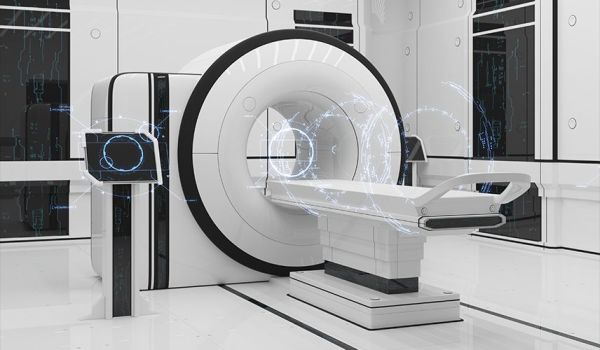
MRI scanning in Antoni van Leeuwenhoek Hospital in Amsterdam is significantly sped up thanks to an innovation in technology.
Scanning procedures, which previously took 23 minutes, now only take about 9 minutes because of AI software used to convert the scanned data into images more quickly.
It is a welcome development because it resolves a problem typical of MRI scanning. The procedure requires a patient to remain motionless in a claustrophobic tunnel in order to produce quality images. Faster scanning allows for avoiding any movement and producing sharper images.
How AI is Transforming Radiology Workflows?
How the AI system works was clarified by radiologist Doenja Lambregts. He explains that the AI software predicts the picture based on partial data and completes it. As a result, less time is spent building the final picture while its clarity remains unaffected.
Not only does it allow making a picture faster, but also increases its quality. In fact, staying motionless for prolonged periods of time can be difficult. Any movement caused by respiration, heartbeat, and even body motions affect the quality of the produced image.
It is not only about patient comfort; it influences their treatment too. More precise pictures provide more information, which allows making more effective decisions. In addition, it saves time, as repeat scans are not required anymore. Both staff and patients will benefit from it.
The hospital is already enjoying the improvements in its work schedule because of the new system. Lambregts said that it allows doing approximately eighteen more scans every week. Before, all extra procedures had to be conducted after working hours or even on the weekend. Now they may be performed during work time.
It also positively affects the employees who work in the radiology department. They work on an everyday basis, but long-lasting procedures result in backlogs, making their tasks harder. As scanning takes less time than before, it will be easier for the employees to distribute their duties evenly and to spend enough time on every person. It will also allow organizing their break periods and improve their focus.
The Role of AI in MRI Image Reconstruction
Before introducing the system to the routine work, the hospital organized some testing procedures to examine it properly. For this reason, the staff became test patients who had to undergo procedures with the use of both systems.
The findings indicated that there was no significant drop in the quality of images, and in some instances, there was an improvement. With this information, the hospital felt secure about continuing with implementation. Medical imaging is sensitive to quality because even minor issues might interfere with the interpretation of the images. Therefore, the testing period ensured that the system was subjected to stringent standards.
The technology operates through enhanced image reconstruction. In a traditional MRI process, the scanner creates massive volumes of data. Such raw information must be reconstructed before creating an image. The procedure takes time, especially when detailed images are required. Through the use of past images, the AI algorithm learns the pattern, enabling it to reconstruct the image efficiently.
In contemporary radiology practice, the application of AI has become common in several aspects, such as analyzing images, managing work processes, and controlling image quality. In the current technology, the primary focus of AI is on the reconstruction of images, not their interpretation.
Enhancing Patient Care and Hospital Efficiency
Patients are served in multiple ways. The duration of the scan is reduced, making it seem more manageable. Repeated scans are less likely to be necessary. Time spent waiting for appointments may decrease due to increased capacity. This improvement will benefit patients whose conditions require regular imaging scans.
Institutions also stand to gain from this development. Higher efficiency when using MRI devices will maximize their effectiveness. This development is important in ensuring the demand is met. MRI scans are critical in treating cancers and many other illnesses. With increasing demand, there is an urgent need to develop strategies that increase efficiency while maintaining quality.
The decision by Antoni van Leeuwenhoek Hospital to implement the new system demonstrates the potential of AI technology. It is not intended to displace human employees. Instead, the innovation complements human effort in solving practical challenges.
In other words, the scanner continues to perform the same function; it acquires information about the patient’s body. The only difference is how the information is processed into an image. AI makes this process quicker and easier.
It is an obvious case where the application of technology helps advance both clinical outcomes and operational processes. Patients undergo MRI scanning for shorter periods, staff have more flexibility in organizing their work schedules, and hospitals can treat more patients without extending their working hours.
If other hospitals start implementing similar solutions, shorter MRI scanning will likely become the standard practice.
-
DDA Recruitment 2026: New Recruitment at the Delhi Development Authority—Salary of ₹76,000 Plus Housing Allowance..

-
MP Police Recruitment 2026: 12th-Pass Male Candidates Can Become Constables in the MP Police; Over 600 Vacancies Announced..

-
LPG Cylinders Now Easily Available at This Location: Just Show Your ID—No More Hassle of Standing in Queues

-
Delhi RTO Reopening 2026: Major Update Regarding Driving Licenses—Introducing the DL-14 Series; Learn About the New Changes..
-
Instagram Update: Instagram is introducing its paid version, offering users a range of premium and exclusive features..