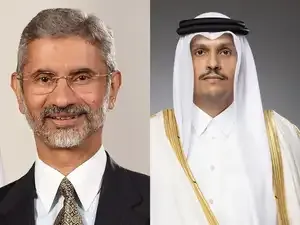
External Affairs Minister Dr S Jaishankar spoke to his Qatar counterpart on Monday to discuss developments in the Israel-Iran war, navigation safety and energy security in the region.
Jaishankar has held multiple rounds of diplomatic conversations with leaders of the Gulf region since the onset of the war in the Middle East, which began on February 28 with joint US-Israel strikes on Iran.
Prime Minister and Minister of Foreign Affairs Sheikh Mohammed bin Abdulrahman bin Jassim Al-Thani stressed the need to halt the unjustified Iranian attacks on Qatar and other countries in the region and emphasized the need for ceasefire.
In a post on X, the Ministry of Foreign Affairs of Qatar said that the two leaders reviewed the developments of the military escalation in the Middle East and its "serious repercussions" on regional and international security and stability, as well as ways to resolve all disputes peacefully.
Jaishankar and Thani also emphasized the importance of ensuring freedom of navigation. Qatar's leader warned against the irresponsible targeting of vital infrastructure, particularly that related to water, food, and energy facilities.
In conversation with Jaishankar, he also highlighted the "need to strengthen coordination, intensify joint efforts, return to the negotiating table, and prioritize reason and wisdom to contain the crisis, thereby ensuring global energy security, freedom of navigation, environmental safety, and preserving regional stability."
As per the Ministry of Foreign Affairs of Iran, Araghchi briefed Jaishankar on the latest situation resulting from the acts of aggression and atrocities committed by the US and the Israeli regime against Iran, as well as the consequences for regional and global stability and security.
He also highlighted the necessity for regional and international bodies and organizations to condemn the military aggression against Iran.
In his conversation with Iran, Araghchi highlighted the importance and position of BRICS and deemed it essential for the institution to play a constructive role at the current juncture in supporting regional and global stability and security.
Jaishankar expressed India's readiness to expand bilateral and multilateral cooperation within regional and international forums. He also emphasized the importance of finding a path to strengthen sustainable stability and security in the Gulf region as a collective necessity.
Jaishankar has held multiple rounds of diplomatic conversations with leaders of the Gulf region since the onset of the war in the Middle East, which began on February 28 with joint US-Israel strikes on Iran.
Prime Minister and Minister of Foreign Affairs Sheikh Mohammed bin Abdulrahman bin Jassim Al-Thani stressed the need to halt the unjustified Iranian attacks on Qatar and other countries in the region and emphasized the need for ceasefire.
In a post on X, the Ministry of Foreign Affairs of Qatar said that the two leaders reviewed the developments of the military escalation in the Middle East and its "serious repercussions" on regional and international security and stability, as well as ways to resolve all disputes peacefully.
Jaishankar and Thani also emphasized the importance of ensuring freedom of navigation. Qatar's leader warned against the irresponsible targeting of vital infrastructure, particularly that related to water, food, and energy facilities.
In conversation with Jaishankar, he also highlighted the "need to strengthen coordination, intensify joint efforts, return to the negotiating table, and prioritize reason and wisdom to contain the crisis, thereby ensuring global energy security, freedom of navigation, environmental safety, and preserving regional stability."
India-Iran talks
Jaishankar held a telephonic conversation with his Iranian counterpart Seyed Abbas Araghchi on March 15, wherein the two leaders discussed regional and international developments amid the US-Israel war with Iran.As per the Ministry of Foreign Affairs of Iran, Araghchi briefed Jaishankar on the latest situation resulting from the acts of aggression and atrocities committed by the US and the Israeli regime against Iran, as well as the consequences for regional and global stability and security.
He also highlighted the necessity for regional and international bodies and organizations to condemn the military aggression against Iran.
In his conversation with Iran, Araghchi highlighted the importance and position of BRICS and deemed it essential for the institution to play a constructive role at the current juncture in supporting regional and global stability and security.
Jaishankar expressed India's readiness to expand bilateral and multilateral cooperation within regional and international forums. He also emphasized the importance of finding a path to strengthen sustainable stability and security in the Gulf region as a collective necessity.