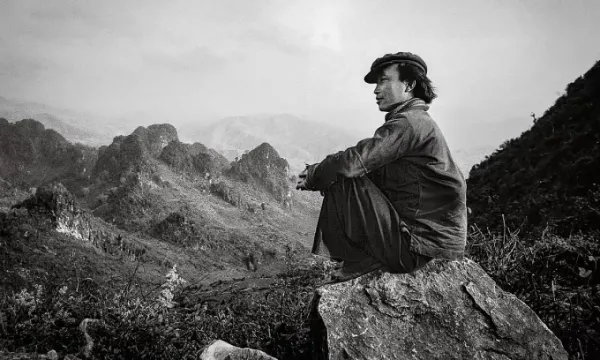
In October 1992 Andy Soloman visited Hanoi with plans to travel for a few months. But what he describes as “the beauty of poverty and hospitality among people” persuaded him to stay.
Vietnam became his second home, and he lived in Hanoi for seven years, working for newspapers, magazines and news agencies.
He married a Vietnamese woman and they have two sons.
During those years he journeyed from northern mountain villages to the Central Highlands, documenting the country.
When he left Vietnam in 1999, he carried rolls of black-and-white film capturing his journey and the people he met along the way. For years the negatives remained untouched in his archive in the U.K.
It was only during the Covid-19 pandemic that he revisited these relics, and thought that many of the people he had photographed had possibly not seen their younger selves.
The idea for a journey of “return and restitution” took shape in 2020.
He named the project Continuum, a return to Vietnam to find those people and reconnect them with their past through the images he had preserved.
When recalling Vietnam in the 1990s, Soloman speaks of roads that no longer exist on maps. For his first cross-country trip, he rented a UAZ469 in Hanoi, the rugged Soviet-era off-road utility vehicle used at the time to navigate red dirt roads.
“The car was slow and bumpy,” he says.
It carried him through places where, in 1992, electricity, clean water and healthcare were luxuries.
Hanoi was a city of yellow walls, filled with the ringing of bicycle bells.
In 1993, Soloman was among the first foreigners to reach the Dong Van karst plateau in Ha Giang Province. He remembers the road as terrifying, with slopes and jagged rocks. He stayed in government guesthouses with no running water or proper toilets, surrounded by mosquitoes and dim generator light.
“I met children with goiter from iodine deficiency, and ethnic minority communities that went hungry for months each year. Yet they offered a stranger their best place to sleep.”
This contrast between hardship and generosity became the force behind his photos. He shot on film, with no way to review or share images.
He photographed everything from Black Thai weddings and highland children to daily life in the leprosy village of Quy Hoa and firecracker-making villages in the former Ha Tay Province.
Decades later, returning the photos proved difficult. Time was the biggest challenge. Borders had changed, and many people had moved or passed away. His only clues were handwritten notes like “65 kilometers southwest of Pleiku” or “leprosy village near Quy Nhon.”
In 2022 he and his wife rode a motorbike through the Central Highlands, and in 2024 traveled to Bac Ninh City and villages around Hanoi.
Using social media and local groups he found more people than expected. By the end of 2025 he had reconnected with 57 individuals, creating paired images of past and present for his exhibition Continuum: Vietnam.
Returning to these places, Soloman is struck by how much Vietnam had changed. The once-barren hills of the Central Highlands are now covered with forests, coffee plantations and wind farms.
“In the past it took a full day to travel from Pleiku to nearby villages on dirt roads. Now there are smooth highways, and people travel by motorbike or car. Everyone has a smartphone.”
He chose to photograph people again in black and white, just as he did 30 years ago. For him, it removes distractions and focuses on people.
“The wrinkles may be deeper, but the warmth in Vietnamese eyes remains the same.”
One of the most moving moments was finding Y Yon of the Ba Na ethnic group in the former Kon Tum Province (now part of Quang Ngai Province).
On Dec. 8, 1992, Soloman photographed her as a child playing with a green grasshopper near a Nha Ronga communal house used by ethnic groups in the Central Highlands.
Thirty years later, on Dec. 1, 2022, he returned to find the village transformed, with concrete houses replacing wooden ones. But he found Y Yon again, now 42.
He says: “The reunion was full of laughter. She held the photo of her younger self and showed it to everyone. The rong house is still there. and so is her smile.”
In another village in Gia Lai, he once met Kpa Ieng, a 65-year-old village chief who welcomed him into his stilt house filled with jars of rice wine and the smoke of a cooking fire. Soloman still remembers the chief showing him a crossbow and the skull of a wild buffalo, objects tied to the community’s hunting traditions.
 |
|
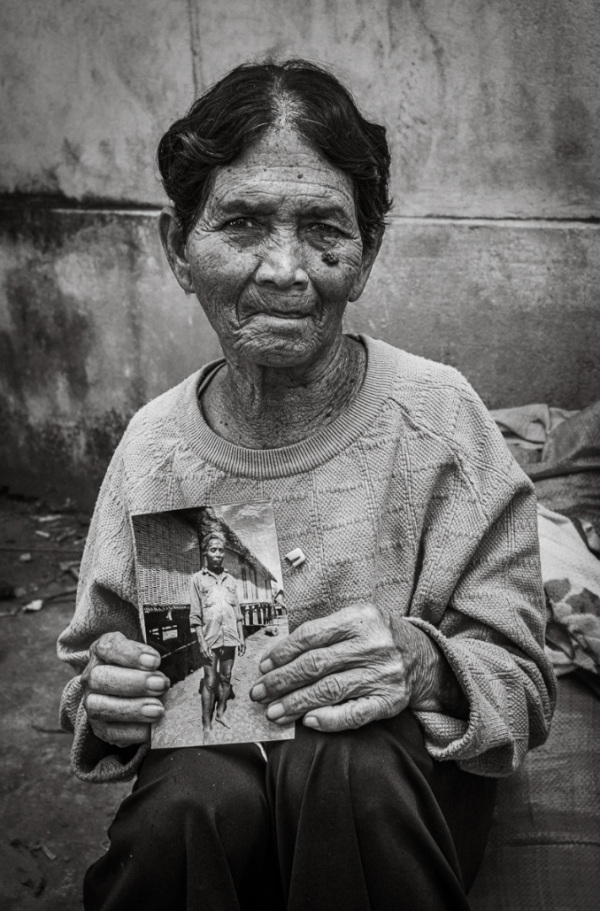
Ro Lan Lat holds a photo of her deceased husband. Photo by Andy Soloman |
When Solomon returned to the village in 2022, he learned that the chief had passed away, but was welcomed by the chief’s wife, Ro Lan Lat.
“When she held the photo of her husband taken 30 years ago, she sat quietly for a long time,” Solomon says. The image is a rare memory of a life now gone, he adds.
His journey has moved many people. At his exhibition at Premier Village Phu Quoc in February, visitors were touched by his effort to find strangers just to return a photograph.
One visitor, Thu Ha, says: “I admire how he recorded each story and remembered every name. It’s amazing he could reconnect these memories so accurately.”
He plans to return to Cao Bang and Ha Giang in northern Vietnam to continue searching.
Today he spends about five months a year in Vietnam working on the project.
After opening in Hanoi, his exhibition traveled to Phu Quoc Province in February and Ho Chi Minh City in March.
“My journey in Vietnam is still ongoing. I hope there will be many more reunions.”
-
PAN Application Rules Revamped: New Forms Replace 49A & 49AA from April 2026

-
FD Rates: Which Government Bank Offers the Highest Returns on Deposits?

-
Under this Post Office scheme, you will earn ₹4.40 lakh solely in interest—creating a total fund of ₹15 lakh..
-
Repo Rate Unchanged... Experts Identify 5 Stocks Set to Deliver Substantial Returns..

-
Where can you access free medical treatment worth ₹5 lakh using an Ayushman Card? Here is how to find the names of hospitals in your city.