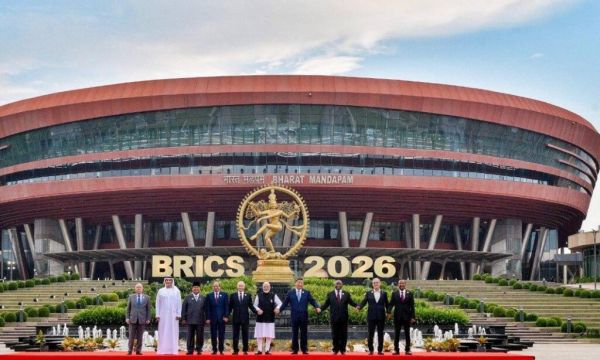
India pulled off a diplomatic feat at the BRICS summit in New Delhi, getting the grouping to agree on a joint declaration despite deep divisions over the war in West Asia.
After intensive negotiations that went on until Saturday (September 12) morning, members including Iran, Saudi Arabia and the UAE signed off on a consensus document at a time when the three countries are on opposing sides of a rapidly escalating regional conflict.
For New Delhi, the agreement is a significant feather in the cap. But the carefully negotiated language of the Delhi Declaration also underlines the limits of what BRICS can achieve.
‘A milder language’
“Getting consensus on a declaration is an achievement for the chair. However, the language on West Asia is much milder than what we saw in Bishkek,” ambassador KP Fabian told The Federal. “There is another point. The UAE, Saudi Arabia, and Iran did agree to a set of words, also because the GCC (Gulf Cooperation Council), Iraq, and Iran will be meeting in Oman on Monday.”
What Fabian was referring to was the paragraph on the West Asia conflict. As the aggrieved party, Iran wanted the US and Israel to be mentioned as the two that started the war. The UAE, which is aligned closely with the US and Israel, objected and said Iran had to be named, as its counter attack led to destruction and loss to infrastructure in the region.
Iran maintained that it had retaliated in self-defence as US troops were stationed in the region.
Finally, after much persuasion, the two agreed not to name any country. The watered down version spoke instead of “…respect for the sovereignty and territorial integrity of the States”, and called for “increasing efforts, through dialogue and diplomacy, towards a long-term understanding that will contribute to lasting peace, security and stability in the region.”
War and talks of peace
The language on West Asia is clearly the biggest diplomatic achievement of the summit because Iran and the UAE have sharply opposed positions. The declaration may paper over differences and allow the bloc to speak as one, but it’s unlikely to change the realities on the ground, where the war continues to reshape the region.
There was concern over the impact of the war on regional stability, energy security and global trade.
Also read | Modi-Putin meet: Why India won’t walk away from Russia, even under US pressure
The Delhi Declaration placed strong emphasis on freedom of navigation and the safety of commercial shipping, seafarers, given the disruption around the Gulf and Hormuz. With many Indian seafarers killed in the conflict, there was also a proposal to ensure a seafarers’ support network.
Two-state solution
The communique supported the two-state solution to the Palestinian crisis, on the basis of the 1967 borders, with East Jerusalem as its capital. Members also called for humanitarian access and protection of civilians in Gaza.
There was no mention of Israel’s constant breach of the ceasefire in the enclave, while members supported the ceasefire in Gaza and the presence of the UN Relief and Works Agency for Palestine Refugees in the Near East, which Israel opposes.
There was a call for dialogue and diplomacy for resolution of all conflicts, though there was no mention of Russia and Ukraine.
Apart from the differences over West Asia, the rest of the 45-page declaration was passed without a hitch.
Modi’s 10-point proposal
Earlier, speaking at the opening session of Inclusive Global Governance, Prime Minister Narendra Modi spoke of a 10-point proposal for reform and preparing a road map for delivery.
“The Global South is today in the front row of global crises, but in the back row of decision-making. We must transform this ‘pyramid of privilege’ into a ‘platform of partnership’, where every country has a voice, every member has a stake, and the advancement of humanity remains at the heart of every endeavour,” Modi said.
Watch/Read | Is China hijacking BRICS? Ex-diplomat TS Tirumurti interview
“The message of the BRICS Summit being hosted by India should be loud and clear: if our future is shared, then the right to shape that future must also be shared,” the Prime Minister said in conclusion.
Pahalgam is paper
The Delhi Declaration condemned terrorism in all forms and manifestations. India made sure the Pahalgam terror attack was also condemned. Terrorism and the reform of the UNSC and its expansion were New Delhi’s top priorities in the declaration.
On the economy, there was emphasis on building resilient supply chains and reducing vulnerability to global economic shocks, use of national currencies in trade, work on cross-border payment mechanisms and strengthening of the New Development Bank.
Also read | Why India’s electronics boom in BRICS comes with a concentration risk
Undeniably, the Delhi Declaration gives India diplomatic muscle at the summit. But beyond the carefully negotiated language and reaffirmation of multilateral principles, the document does little to bridge the deep geopolitical differences within BRICS.
The grouping’s economic and trade initiatives are significant and potentially useful, but progress on these fronts has been crawling.
For now, the declaration has given BRICS a common voice. But whether that voice, or the grouping’s economic ambitions, can translate into meaningful action is another question.
-
Packaged Foods May Soon Carry Warning Labels For High Sugar, Salt And Fat Contents

-
Arrival of world leaders for BRICS summit intensifies: Foreign Minister of Belarus and Prime Minister of Vietnam reach Delhi

-
Second season of Archery Premier League from October 8, 12 foreign stars will face 36 archers from India.

-
Wasim Akram became a fan of Vaibhav Suryavanshi: Gave great advice to Pakistan to improve club cricket Sports – Gamat – REVOI
-
Aryna Sabalenka and Elena Rybakina Set for US Open Women’s Final Saturday