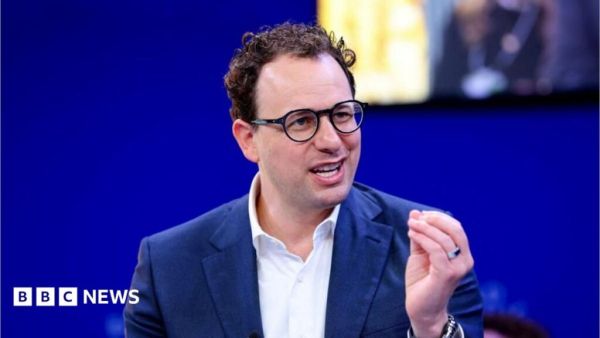
The head of leading AI company Anthropic has called for the pace of development of artificial intelligence models to slow down and to be closely monitored.
In an essay on Saturday, Dario Amodei said developing AI was not in question, but the risks associated with it were “serious” and companies and governments must be given time to address them.
He proposed a three-point plan that includes independent monitoring of AI models as they are developed, industry-wide regulation and global regulation.
There have been growing concerns recently about the technology’s potential risks, the most serious of which suggested there is a greater than 10% chance it “could kill all humans” within the next decade.
Anthropic previously said it had identified and disrupted attempts to use its AI model for “malicious activity” which could support the development of biological weapons.
But the starkest warning came from two employees from Anthropic’s safety team who have resigned in the last two weeks saying humanity may not survive, external the race among AI companies to develop machines that are smarter than humans.
And in a new interview with Fortune Magazine, OpenAI CEO Sam Altman said safety standards were “not at a place” to push AI capabilities much further.
Altman added he believed AI beyond human control is “absolutely” possible.
The warnings have prompted calls to action, but US President Donald Trump has so far rejected such fears, saying on Thursday he was concerned “if we don’t win AI, we’re going to be put in a very bad position”.
Reaction to Amodei’s post has poured in from across the tech world, with Elon Musk saying the Anthropic boss was “right”.
However some observers suggested that Amodei’s post was less about safety than about consolidating control over AI technology.
In his essay, called We Must Pace the Frontier, Amodei pointed out that AI had advanced “drastically faster” including its “ability to build the next generation of AI” – and mentioned an incident involving rival OpenAI which has revealed that agents conducted cybersecurity attacks, external on targets they were not asked to attack in July.
The OpenAI agents had “essentially acted as a fanatically devoted collective”, Amodei said.
OpenAI has said “the significance of the inter-agent communication activity was not apparent to the leaders” until July and the company was slowing down training of certain advanced AI models and tools as a result, noting that there was now an increased risk of AI tools spiraling out of control.
In his essay, Amodei called for “building AI at a balanced rate that aims to ensure its safety while still achieving its benefits”.
This would not mean “halting model training or technical progress, but ensuring companies take adequate time to align and safeguard their models, and for third party evaluators to confirm this”.
He was committing Anthropic to this “unilaterally” – as well as calling on governments “to require other frontier companies to match”.
Amodei said he recognised that regulation might not be able to keep up with the pace of AI, and therefore called on AI companies to “voluntarily work together to set standard” in parallel with regulation.
The Anthropic CEO went on to address the impact that a slowdown would have on the industry and competition with leading developers worldwide, particularly China.
“I believe that if slowing down bought us even an extra year or two before models reach critical levels of capability, and we used that time to advance alignment, we could greatly reduce the risk that something goes seriously wrong,” Amodei said.
This would have to be done in a co-ordinated manner “without sacrificing commercial advantage or the United States’ lead in AI”. Any slowdown would have to be limited, he said, to avoid allowing China to pull ahead.
He urged the US government to take measures so that US companies’ AI chips could not be sold to China – or the technology shared with authoritarian countries.
Amodei’s post has prompted a wide range of responses.
Clement Delangue, the CEO of the AI platform Hugging Face, said he was launching a new project called the Open Alignment Initiative, adding he wanted to be among “embedded evaluators” that Amodei proposed could be part of a solution.
Hugging Face was hacked by OpenAI agents earlier this year prompting an outcry over AI safety.
“Let’s make AI safer by making it more transparent.” Delangue wrote on X.
Elon Musk also voiced his support, writing that “Dario is right”.
Musk, whose SpaceXAI makes the controversial chatbot Grok, once called Anthropic “evil” but has changed his tone since signing a $15bn deal to sell compute capacity to Anthropic in May.
However some observers suggested that Amodei’s post was less about safety than about consolidating control over AI technology.
“Dario makes the case to stop open source and concentrate enormous technological and economic power with Anthropic,” wrote Chamath Palihapitiya, investor and co-host of the tech podcast “All-In”.
Notions of slowing down or even pausing AI development have long been met with such cynicism in certain corners of Silicon Valley, with critics accusing leading AI developers of hyping their technology as a marketing ploy.
Anthropic and OpenAI are both reportedly preparing for potentially record-setting initial public offerings.
-
78-year-old scrap collector returns 19 pieces of gold jewelry found in trash

-
Alesha Dixon to host upcoming season of The Voice UK
-
Ganeshotsav special – This time offer Sondhe Besan-Mawa Modak to Bappa, number-1 in both taste and purity.

-
Only One Ford Mustang Works As A Good Family Vehicle

-
iPhone on Sale: This iPhone is available 18 thousand rupees cheaper, check offers now…