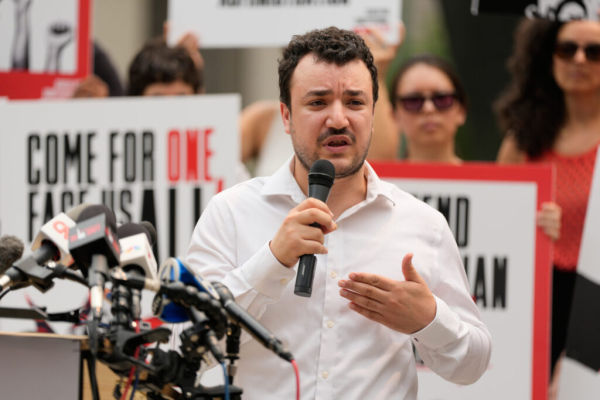
Mahmoud Khalil Sues Columbia Univ. Over Failure to Protect Pro-Palestinian Activists/ TezzBuzz/ WASHINGTON/ J. Mansour/ Mahmoud Khalil and a pro-Palestinian campus organization sued Columbia University, alleging it failed to address harassment and retaliated against activists who reported it. The lawsuit links Columbia’s alleged inaction to the exposure of students’ personal information and Khalil’s subsequent immigration detention. Columbia declined to discuss the litigation but said it remains committed to protecting its community from discrimination and harassment.
Quick Look
- Khalil filed the civil rights lawsuit Monday in federal court in New York City.
- A pro-Palestinian campus group and its president, Mohammad Zubairi, are also plaintiffs.
- The complaint accuses Columbia of ignoring harassment and retaliating against activists.
- Khalil was arrested by ICE in March 2025.
- He spent 104 days in a Louisiana immigration detention facility.
- Khalil’s deportation proceedings remain active.
- The lawsuit seeks restoration of his campus access.
- It also asks the court to end the campus group’s suspension.
- The plaintiffs are seeking damages to be determined at trial.
- Columbia declined to comment specifically on the allegations.
Deep Look
Khalil files civil rights lawsuit against Columbia
Palestinian activist Mahmoud Khalil sued Columbia University on Monday, accusing the institution of failing to respond adequately to harassment targeting him and members of a pro-Palestinian campus organization.
The complaint also alleges that Columbia retaliated against the activists after they reported the harassment.
Filed in federal court in New York City, the civil rights lawsuit names Khalil, the campus organization and its president, Mohammad Zubairi, as plaintiffs.
The allegations have not been adjudicated, and Columbia has not filed its formal response to the complaint.
Lawsuit alleges ‘deliberate indifference’
The lawsuit claims the university’s “deliberate indifference” allowed multiple members of the pro-Palestinian organization to be doxed, meaning their identities or personal information were publicized without their consent.
It also seeks to connect Columbia’s alleged failure to respond with Khalil’s eventual detention by federal immigration authorities.
The complaint contends that university officials did not take sufficient action to protect activists when they reported threats, harassment and misleading claims about their campus activities.
Columbia responds to the allegations
Columbia declined to comment directly on the pending litigation.
In an emailed statement, however, the university said that “creating a campus environment where every member of our community feels welcome, supported, and safe is fundamental to who we are as a University.”
The university did not address the lawsuit’s individual allegations concerning Khalil, the other plaintiffs or the pro-Palestinian group’s suspension.
Khalil previously sued over student records
The new complaint is not Khalil’s first lawsuit involving Columbia.
That earlier litigation challenged Columbia’s handling of government demands for information to pro-Palestinian campus activities and student disciplinary proceedings.
Khalil became a prominent protest spokesperson
Khalil is a former Columbia graduate student who gained national attention as a spokesperson and negotiator for students protesting Israel’s actions in Gaza.
Those demonstrations were part of a broader campus protest movement that spread to universities across the United States.
Participants called on schools to disclose or withdraw investments connected to Israel and objected to its military operations in Gaza. Critics of some demonstrations raised concerns about antisemitism, campus safety and disruptions to university activities.
Khalil and other activists have said their advocacy was focused on Palestinian rights and opposition to Israeli government policy.
ICE arrested Khalil in March 2025
US Immigration and Customs Enforcement agents arrested Khalil at his campus apartment in March 2025.
His detention became one of the most prominent cases arising from the Trump administration’s effort to deport noncitizen students and academics involved in pro-Palestinian demonstrations.
Khalil is a lawful permanent resident, commonly known as a green-card holder. He was not charged with a crime in connection with the campus protests.
The administration argued that his presence in the United States could create adverse foreign-policy consequences. Officials also alleged that he failed to disclose information on his permanent-residency application.
Khalil has denied the government’s allegations and maintains that he was targeted because of his political expression.
Khalil spent 104 days in detention
Khalil was held for 104 days at an immigration detention facility in Louisiana.
He missed the birth of his first child while detained.
A federal judge in New Jersey later ordered his release, finding that the government’s principal justification for keeping him in custody was likely unconstitutional.
A federal appeals court subsequently ruled that the district judge did not yet have jurisdiction to decide that question because Khalil first had to complete the immigration-court process.
The appeals court did not decide whether the administration’s attempt to deport him because of his activism and criticism of Israel violated the Constitution.
Deportation proceedings remain active
Khalil’s immigration case has not been resolved.
An immigration judge previously ruled that he could be deported, but separate court orders and appeals have prevented his immediate removal.
His attorneys have continued challenging the government’s actions through the immigration and federal court systems.
The current lawsuit against Columbia concerns the university’s alleged conduct toward Khalil and other activists, rather than directly resolving the government’s deportation case.
Lawsuit disputes Columbia’s public response
Khalil’s complaint says Columbia “refused to correct disinformation” concerning him during his immigration detention.
These statements represent the plaintiffs’ allegations. Columbia has not publicly responded to those specific claims.
Activists accuse university of retaliation
The plaintiffs allege that Columbia did not properly investigate the harassment reports they submitted.
Instead, according to the lawsuit, university officials retaliated by labeling events associated with the pro-Palestinian organization as security threats.
The complaint also alleges that Columbia revised its disciplinary rules in a way designed to penalize criticism of the Israeli government.
The university has not addressed those specific allegations in its public statement.
Lawsuit alleges civil rights violations
The complaint accuses Columbia of violating federal civil rights protections through its treatment of Khalil and the other plaintiffs.
It argues that the university failed to protect Palestinian, Arab and Muslim students—or students perceived to share those backgrounds—from discriminatory harassment.
The plaintiffs also claim that Columbia’s subsequent actions improperly restricted their campus activities and political expression.
A court will determine whether the alleged conduct violated applicable civil rights laws after Columbia has an opportunity to respond.
Plaintiffs request campus access and damages
Khalil is asking the federal court to restore his access to Columbia’s campus.
The complaint also seeks an order ending the suspension of the pro-Palestinian organization involved in the case.
In addition to those forms of relief, the plaintiffs are requesting financial damages “to be determined at trial.”
No specific monetary amount was included in the report.
The case adds another legal dispute to the continuing debate over how universities responded to Gaza- demonstrations, allegations of discrimination and pressure from the federal government.
More on US News
-
India vs Afghanistan 2nd T20I: Weather, Pitch Report, Playing XI & Live Streaming Details

-
BMW i5 LWB Review: Is This The Luxury EV That Could Take BMW To No.1?

-
Repo Rate Hike On The Cards? RBI May Shift From 5.25% Amid Rising Inflation

-
Trump Dials Nvidia CEO Jensen Huang Live On Stage, Says AI Takeover Claims Are A ‘Hoax’: WATCH

-
US Supreme Court Blocks Trump Bid To Restrict Mail-In Voting Ahead Of November Midterms