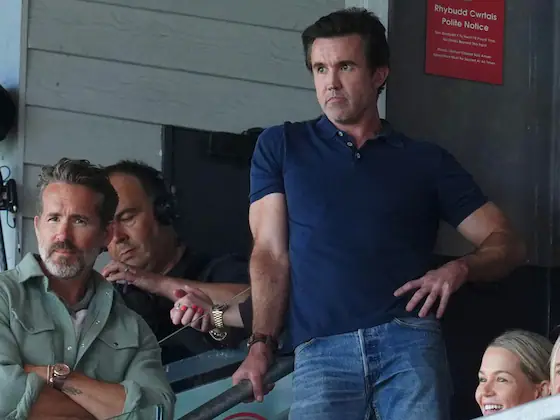
If someone were creating a TV series aimed at making Americans fall for football, the plot would look a lot like Wrexham’s story.
A forgotten club from the fringes, an underdog trying to challenge the established powers; Philadelphia-born co-owner Rob McElhenney once likened it to Rocky, the most famous fictional hero linked with his city.
The club got past Apollo Creed in the shape of promotion from the National League. Clubber Lang came in the form of overcoming League Two, and League One promotion was the equivalent of Ivan Drago.
But just as the fifth Rocky film was widely criticised for, among other things, lacking any real plot, Wrexham are now discovering that the next chapter of their own tale does not yet have a satisfying conclusion.
The fairytale version of the Welsh club’s rise is that they produced three straight promotions, becoming the first side in English league history to achieve that. A more cynical, or perhaps more realistic, reading is that Wrexham’s budget was significantly bigger than that of most of the teams they were competing against.
The ideal ending would have been clearing the final barrier and reaching the Premier League, the one division that most Americans had even heard of. But football rarely cares about how anybody wants a fairytale to finish.
The Championship was always going to be Wrexham’s real examination. If McElhenney and Ryan Reynolds were able to buy their way towards success in the lower divisions, they were now stepping into a league filled with clubs boasting much deeper resources, much stronger pedigree at this level and much greater experience of earning promotion. Ten Championship owners are estimated to be worth more than $1bn; McElhenney and Reynolds together are worth close to $500m.
Even so, while it was not a fourth promotion in a row, their first campaign back in the second tier was an unexpectedly strong one. They ended up seventh, which under the new format would have been enough for a play-off place. They also finished above fellow promoted club Birmingham, who had been rated much more highly before the season started.
Now, though, the difficult second season has arrived. On Friday night, with no Premier League football on, a large audience watched Wrexham being thrashed 6-0 by West Ham, in a match that served as a blunt reminder of the club’s current place in the hierarchy.
Playing in front of what was reportedly the biggest crowd Wrexham had ever appeared before, they were picked apart by a West Ham side facing a team that looked disorganised and out of its depth.
If all three had come from Jarrod Bowen, a player who clearly belongs in the Premier League, it might have been possible to dismiss it as a few moments of class from a superior footballer. But West Ham’s six goals were scored by six different players.
Wrexham were undone from set-pieces, from crosses, from quick combinations inside the box, on the counter-attack and from a long ball played over the top.
Many sides will lose to West Ham this season, but the manner of this defeat suggests that Southampton, Wrexham’s next opponents, could find similar openings. Middlesbrough as well.
At this stage of the season, Wrexham have just one win from seven matches and sit 19th in the table. If the target is promotion to the Premier League, it is difficult to argue, based on the evidence available so far, that Wrexham are one of the eight strongest teams in the division.
The inquest has already started and attention is turning towards the manager. During Wrexham’s impressive climb, one man has led the team throughout: Phil Parkinson. He is the fourth-longest-serving active manager in English league football, having been in charge at the club for more than five years. There is no doubt he has been a success, but has he now arrived at the edge of his capabilities? If he were out of work, would any Championship club in the top half be looking to appoint him?
Parkinson can fairly be criticised for failing to respond effectively during the trip to the London Stadium. He set Wrexham up in a 5-4-1 system, hoping to hurt West Ham on the counter, but West Ham had too much quality and simply passed through it. He made four substitutions in the 67th minute, but by then the contest had already gone.
Wrexham now seem to be in the awkward position of having a manager who symbolises their past triumphs but may not be the right figure for what comes next.
Many other owners would have acted ruthlessly over the manager’s future, but whether it is loyalty, commitment or misplaced romanticism, the Wrexham board appear determined to keep Parkinson in place.
The manager has also not been helped by disappointing recruitment across the past few transfer windows. Their biggest outlay this summer was Sunderland goalkeeper Antony Patterson. He made only three saves in Friday night’s match and stops fewer than 60% of the shots he faces.
More broadly, there are only a small number of genuinely high-quality players in a squad that has the oldest average age in the league. No player has managed more than two goal involvements after seven games. Wrexham are missing Max Cleworth and Ben Sheaf through injury, but the decline in level should not really be this severe.
So what happens next? Dismiss the manager? Accept that promotion is unlikely this season, at least? Hold on until January and spend heavily again?
There is no obvious solution, but it is becoming harder to ignore the sense that Wrexham’s Hollywood story has run into the glass ceiling of reality.
-
Why this is Xabi Alonso’s biggest week so far as Chelsea manager
-
Big 4 Employee Spends Rs 7000 Food Allowance To Feed Security Guards

-
Rishi Panchami Wishes: Rishi Panchami, the holy festival of faith and devotion! Send special wishes to loved ones

-
Slogans of 'trophy thief' raised in Dubai Stadium, Naqvi is no longer worthy of showing his face anywhere

-
Amol Muzumdar breaks India's silence on not accepting Asia Cup trophy from Mohsin Naqvi. Read