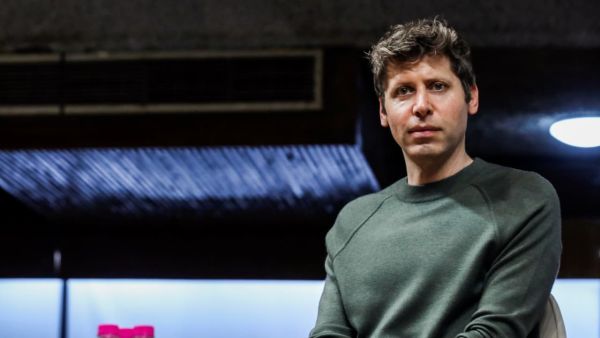
OpenAI CEO Sam Altman warns of AI's dystopian potential and losing control, advocating for slowing development. He backs a federal framework for safety and calls for industry collaboration to ensure AI always serves humanity and avoids concentrated power.
Altman's Two Major AI Concerns
After endorsing Anthropic CEO Dario Amodei's call to slow down the pace of AI development amidst fears of losing control, OpenAI CEO Sam Altman on Monday advocated for AI always serving the people and companies acting responsibly. In a series of posts on X, Altman says that if AI is used to impose a view on everyone else the results could be 'extremely dystopian'.
"There are two ways AI progress could go very badly and that we must avoid. First, we could lose control of the future to AI. This is unacceptable; we are unapologetically on Team Humanity, and AI must always serve people. To ensure that, we need ways to ensure that alignment and safety techniques stay ahead of progress in model capabilities. Second, we could end up in a world with too much concentration of power. If an extraordinarily powerful AI is used by one person or company to impress their worldview onto everyone else, the results could be extremely dystopian. Avoiding these two threats requires walking a narrow middle path; for example, one country could gain too much power. Another example is one lab ending up with too much power," he wrote.
Call for Federal Framework and Industry Standards
Altman further backed the idea of enforcing rules to manage AI frontier risk, a concept that was suggested by Dario Amodei and backed by Microsoft CEO Satya Nadella as well. "The world deserves confidence that American companies developing increasingly capable AI will act responsibly, especially as the trajectory of progress has steepened. Every frontier lab must deliver on this, and there is no reason any of us should come to work if we cannot. We welcome a federal framework that sets consistent safety requirements for frontier AI. But we do not believe we need to wait for an anti-trust exemption or legislation to begin the work of providing this confidence. Consistent rules to manage frontier risk so that we can maximize the benefits are a good idea (and we are excited by ideas like independent auditors)," Altman wrote.
Evolving Safety Protocols
Altman, who had welcomed suggestion of sitting together with other tech bosses to evolve a framework that could ensure responsible AI development says he looks forward to collaborating on a way forward. "Years ago, companies like ours developed things like Responsible Scaling Policies and Preparedness Frameworks. Those were good for that moment, and focused primarily on the deployment of completed models, not what happens during their development process. Today's shift to focusing on safe development and evaluation will need new tools. For example, at OpenAI we now formulate explicit safety cases in advance of frontier reinforcement learning runs we expect to significantly increase capability, in addition to the safety work we have long done in advance of model releases. We hope that other companies will learn from our approaches and propose their own; we think shared standards for misalignment, monitoring, and safety will lead to better outcomes. We look forward to collaborating with our colleagues across the industry to formulate the best version of these," he said.
'Pacing, Not Stopping': A Deliberate Approach
Altman had earlier endorsed Amodei's suggestion to slow the pace of AI development down and now says that pacing development is well worth the cost. "When we talk about “pacing”, we do not mean “stopping”. Progress has been rapid and will continue to be. But it should be slower than it otherwise could be; interventions like safety cases and monitoring have significant costs. Pacing will be well worth this cost; no amount of American competitive pressure should justify recklessness, or let capabilities get ahead of alignment and monitoring. Where we will need the help of our government is for international coordination. But first we should do what we can ourselves," he said.
Broader Industry Echoes on AI Risks
Over the weekend, Amodei advocated slowing down the pace of AI model development saying that if unchecked this could outrun human ability to control such systems. "We must slow the pace at which we improve the capabilities of AI models...My first concern is that, since roughly this summer, AI has been advancing drastically faster, driven primarily by AI’s growing ability to build the next generation of AI. This dynamic is called recursive self-improvement, and it is starting to happen across the industry, including at Anthropic, as we and others have described. Left unchecked, it could outrun our ability to understand and control these systems, and so must be pursued very carefully, if at al," he wrote in a detailed essay.
Microsoft boss Satya Nadella also indicated his support for embedded evaluators in AI systems, a suggestion also mooted by Amodei and Altman. The Microsoft Chairman and Chief Executive Officer (CEO) said that advanced artificial intelligence systems must remain strictly under human supervision while creators pursue measured progress to guarantee safety.
Researcher's Resignation Highlights Urgency
The flurry in the artificial intelligence sector follows an announcement by Jacob Coxon, a researcher associated with Anthropic, who publicly declared he was quitting the industry over fears that the company and its competitors were racing to build systems they would be unable to control. (ANI)
(Except for the headline, this story has not been edited by Asianet Newsable English staff and is published from a syndicated feed.)-
Important Tips for Care of Tiles Grout

-
Those who take morning walk or run on the road must pay attention, take care of these things right from wearing clothes to walking.

-
Snakes Milk Myth: Do snakes really drink milk? Know the real truth of these 5 myths related to snakes

-
Royal Mail message for anyone posting envelopes

-
Hong Kong singer pays $62,000 yearly for daughters’ schooling