Edited by: Srinivas Mazumdaru
Iranian authorities have launched a clampdown on cafes in the capital, Tehran, in recent months, suspecting them of fostering anti-government sentiment and facilitating protests.
According to the human rights organization HRANA, at least seven cafes and restaurants were shut down on July 19 alone for allegedly failing to comply with mandatory hijab rules.
Previously, some media outlets, including Javan, a newspaper affiliated with the Islamic Revolutionary Guard Corps (IRGC), have described cafes as "gathering places for protesters" who, in their view, pose a threat to "national security."
Most recently, the "Vanak Park" cafes in Tehran were sealed, resulting in at least 200 people losing their jobs.
Crackdown on cafes
Authorities believe cafes, because of their widespread presence and popularity, could play a role in organizing mass protests.
The government's fears are rooted in the latest wave of protests in Iran, which began on December 28, 2025, and grew into the country's largest uprising since the 1979 Islamic Revolution.
Saediniya, a well-known cafe chain with 10 branches in Iran, closed its branches on this day in support of calls for strikes. It was subsequently accused of engaging in "propaganda against the state."
Iran's Supreme Court has now upheld the sentence of Sadegh Saedinia, the owner of the cafe chain, to 12 years and six months in prison, along with the confiscation of his assets.
He was arrested over his support for the protests, and all branches of his cafe chain were confiscated and shut down by judicial order.
Other cafes, including "Lamiz" and "Voria," faced a broadly similar fate. Voria is owned by a prominent Iranian footballer. Both were sealed by judicial order because of their indirect support for calls to protest. Cafe closures have not been confined to periods of protest, however, and the practice continues.
The rise of the cafe culture
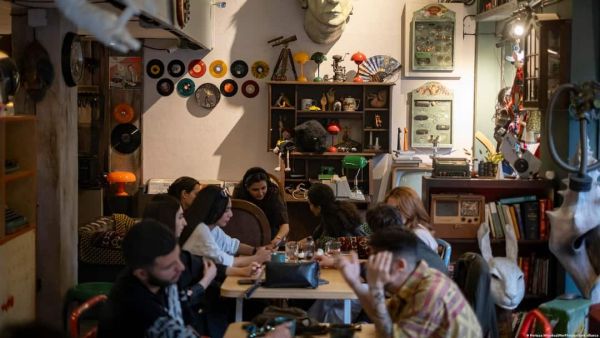
Tehran has seen a surge in the number of cafes over the past decade, rising from around 300 in the early 2010s to as many as 4,000 now, according to various estimates.
Some experts attribute the growing number to changes in urban lifestyles in recent years. They see this as more than the expansion of a particular type of business and describe it as a sign of wider social and cultural changes within Iranian society.
"The explosive growth of cafes in society can, to some extent, be seen as a social response to living in a state of chronic crisis," Saba Alaleh, a clinical psychologist and psychoanalyst whose work focuses on political and social issues, told DW's Persian service.
"In such circumstances, people are not simply looking to consume or be entertained. They are looking for a place to temporarily distance themselves from the pressures of everyday life," she said.
"In this sense, the cafe becomes a third space. It is neither home nor the workplace, but a space between the two where people can briefly step away from their everyday roles and pressures, connect with others, and feel that life is still somewhat manageable and normal."
The cafe trend has become particularly popular among Gen Z, who are bearing the brunt of runaway inflation and steep living costs in Iran.
"The young people who gather in these cafes do not necessarily come from affluent backgrounds," Nasser, a cafe owner in Tehran, told DW. "In many parts of Tehran, young people from the middle class also meet at cafes, and many of our customers belong to this group."
The political role of cafes
Even before the latest bout of nationwide protests that began at the end of last year, shutting down cafes was common practice for the Iranian government.
Most of these crackdowns and closures, however, were carried out under the pretext of enforcing compulsory hijab.
The protests that began in late December 2025 changed that, with cafes becoming the target more often and for varied reasons.
"They shut down our cafe on the pretext that we had served customers who were not wearing the hijab, but that is only an excuse," Nasser said.
"Outside, on the streets of Tehran, women and girls have effectively abandoned the compulsory hijab, yet the government expects us not to allow them into the cafe," he added.
Maintaining control over social spaces
Alaleh said the issue is no longer simply about cracking down on women for not wearing the hijab.
"Authoritarian governments generally seek to control the flow of information, social interactions and the organization of citizens," she pointed out. "Any space beyond the direct supervision of those in power that allows trust, dialogue and social ties to develop can weaken part of the government's monopoly over the social sphere."
The expert said the crackdown on cafes and cafegoers is part of the government's efforts to preserve its monopoly over social spaces.
She underlined that to a security apparatus, even a group of young people casually sitting together can represent the emergence of an independent social network outside the formal structures of power.
"The broader and more deeply rooted these independent networks become, the more difficult it is for the government to maintain exclusive control over the public sphere," added Alaleh.
Disclaimer: This report first appeared on Deutsche Welle, and has been republished on ABP Live as part of a special arrangement. Apart from the headline, no changes have been made in the report by ABP Live.
-
Apple's first-ever foldable phone iPhone Duo to be available for Rs 2.99 lakh apiece from Oct 23

-
Kejriwal re-elected AAP national convener at party's 15th National Council meeting

-
Govt land along river banks worth Rs 100 crore cleared of encroachments in Indore

-
Ladakh groups 'disappointed' as MHA meeting fails to produce draft on elected UT body

-
Mann must get Cheema to resign, ensure impartial probe: Rahul on Punjab villager 'suicide'