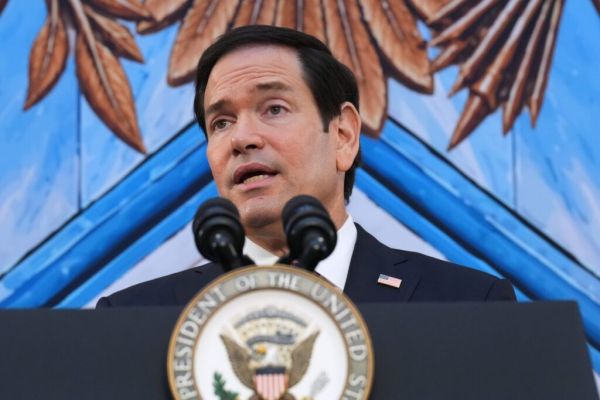
Rubio Tours Colombia, Ecuador and Peru to Advance US Counter-Drug Strategy/ TezzBuzz/ WASHINGTON/ J. Mansour/ Secretary of State Marco Rubio began a three-country Latin American tour focused on counternarcotics operations, migration, energy and trade. Rubio is meeting the conservative presidents of Colombia, Ecuador and Peru as the Trump administration expands its regional military partnerships. The trip follows another U.S. maritime interdiction and comes shortly after Washington completed a major oil agreement with Venezuela’s leadership.
Quick Look
- Rubio is visiting Colombia, Ecuador and Peru.
- His agenda includes drug trafficking, migration, energy, trade and regional security.
- The first meeting is with Colombian President Abelardo de la Espriella.
- Colombia recently joined the Americas Counter Cartels Coalition.
- Rubio will sign civil nuclear cooperation and critical-minerals agreements in Colombia.
- Ecuador has expanded counternarcotics cooperation with the U.S. military.
- Rubio will meet Peruvian President Keiko Fujimori in Lima.
- U.S. forces recently intercepted and sank an Ecuadorian vessel.
- People aboard that vessel were removed and transferred to Ecuadorian authorities.
- Rubio said a future visit to Venezuela remains possible.
Deep Look
Rubio begins three-country regional tour
MIAMI — Secretary of State Marco Rubio began a three-nation tour of Latin America on Tuesday as the Trump administration seeks greater cooperation on drug trafficking, migration, energy security and trade.
Rubio’s itinerary includes meetings with conservative leaders in Colombia, Ecuador and Peru whose governments have strengthened relations with President Donald Trump’s administration.
The administration also hopes to finalize additional trade arrangements with governments in the region.
Venezuela oil agreement precedes trip
Rubio traveled to Colombia about a week after the United States completed a major oil agreement with Venezuela’s leadership.
The agreement followed the January U.S. military operation that removed Nicolás Maduro from power. Rubio defended the oil arrangement, arguing that Venezuelan fields previously associated with China, Russia and Iran had not been fully developed.
Asked why Venezuela was not included in the tour, Rubio said that “we’ll get there eventually,” adding that the schedule did not allow another stop.
US expands maritime counternarcotics operations
Rubio’s trip follows an expansion of U.S. military operations targeting vessels that Washington alleges are involved in drug trafficking in the Caribbean Sea and eastern Pacific Ocean.
U.S. forces intercepted and sank an Ecuadorian vessel Monday that the administration accused of connections to Los Choneros, an Ecuadorian criminal organization.
The operation was the fifth U.S. action against a vessel in the region in less than two weeks. U.S. Southern Command separately described its Sept. 7 action as an interdiction of a floating refueling station allegedly supporting maritime drug-trafficking operations.
Unlike earlier lethal strikes, personnel aboard Monday’s vessel were removed and transferred to Ecuadorian authorities before the boat was destroyed.
That approach could represent a tactical shift after a year of strikes in which at least 227 people were killed. The administration described those killed as “narcoterrorists,” although the report said Washington had not publicly provided evidence supporting that characterization in the individual cases.
Colombia seeks to rebuild US alliance
Rubio’s first destination was Colombia, where he planned to meet President Abelardo de la Espriella in Barranquilla.
Bula said the discussions would cover security, drug trafficking, trade and what the government describes as shared values.
De la Espriella took office in August after campaigning on stronger counternarcotics enforcement and closer relations with Washington. His approach represents a departure from the policies of progressive former President Gustavo Petro, whose relationship with the United States was frequently strained.
New Colombian government adopts harder security policy
De la Espriella has pledged to intensify action against drug-trafficking organizations and deport thousands of migrants living in Colombia without legal residency, many of whom are Venezuelan.
He argues that changes to immigration enforcement will reduce crime. That is the Colombian president’s stated rationale for the policy.
After taking office, De la Espriella brought Colombia into the Americas Counter Cartels Coalition and increased military operations against illegal armed organizations.
His administration has conducted at least three bombing operations. Several minors reportedly died, prompting criticism from opposition leaders.
The opposition and Colombia’s state-run Ombudsman’s Office also criticized the government after the president publicly displayed the covered bodies of alleged criminals alongside seized ammunition.
Peace negotiations end as military operations grow
De la Espriella designated several leaders of illegal armed groups as military targets following his election.
His government said police killed Naín Andrés Pérez Toncel, known as “Bendito Menor,” a leader of the Self-Defense Forces of the Sierra Nevada.
The president has also ended peace negotiations initiated by the Petro administration, arguing that the process failed to reduce violence.
Colombia continues to confront armed organizations competing for territory used in drug trafficking and illegal mining, despite the government’s historic peace agreement with the Revolutionary Armed Forces of Colombia approximately a decade ago.
Nuclear and minerals agreements planned
During Rubio’s stop in Barranquilla, the United States and Colombia are expected to sign a civil nuclear cooperation agreement and a separate critical-minerals accord.
The agreements reflect the broader economic and energy dimension of the secretary’s visit, alongside the administration’s security and migration priorities.
Critical minerals have become strategically important to the United States because they are used in batteries, defense systems, electronics and other advanced technologies.
Ecuador expands cooperation with US military
Rubio will next make a brief visit to Quito for talks with Ecuadorian President Daniel Noboa.
Noboa’s government has steadily expanded counternarcotics cooperation with the U.S. military. Ecuador has also assisted with recent maritime operations targeting vessels that Washington alleges are connected to drug-smuggling networks.
The U.S. Southern Command said some of its recent interdictions were conducted in coordination with Ecuador’s government.
Peru completes Rubio’s itinerary
Rubio will conclude the tour in Lima with Peruvian President Keiko Fujimori.
Fujimori, the daughter of former President Alberto Fujimori, leads another Latin American government that has moved toward closer relations with the Trump administration.
Her inclusion alongside De la Espriella and Noboa underscores Washington's focus on working with regional governments that support expanded security cooperation and the administration’s approach to counternarcotics enforcement.
More on US News
-
Women are architects, not mere witnesses of change: Haryana CM Saini
-
Telangana: Arrest of BRS MLCs over Speaker remark sparks political row
-
IFL 2026-27 season to kick off on October 30 with new venues

-
Delhi Dy Mayor inspects Gharoli ward, orders action on encroachments
-
Gardener dies of electric shock at Delhi University’s South Campus