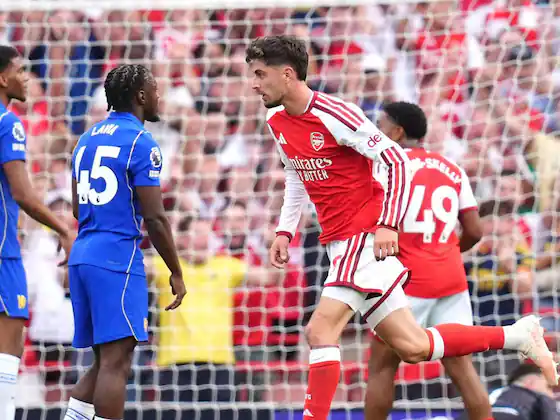
Arsenal have struck the first major early blow in the title race after defeating likely challengers Chelsea 2-1 in a high-class and thoroughly entertaining contest at the Emirates.
That came despite Chelsea once again producing one of their trademark flying starts this season and, beyond that, turning in a strong performance.
Even in defeat, Chelsea looked every bit like a serious side for this campaign. That only makes Arsenal’s victory look more impressive and more meaningful. It is still extremely early, but this felt extremely significant.
1. It hardly felt like a match in September, did it? This had the feel of a title showdown carrying far more weight and consequence than any fixture at this stage of the season really should. How decisive it will ultimately prove to be is impossible to say – and it is worth remembering that last season’s supposedly crucial title decider in April ended up meaning nothing at all.
But with the two most impressive teams of the new season going head to head, and the standard staying so high throughout, it is difficult to imagine this will not stand as a hugely important early chapter in the story of the 2026/27 Premier League season.
2. And you know a game matters, and has burst into life immediately, when there are three Gary Neville Noises inside the first 15 minutes. First came Morgan Rogers’ opener, then the scramble inside Chelsea’s six-yard box that ended with Emi Martinez taking a stray boot to the head, and then Arsenal’s disallowed goal from another goalmouth melee.
This always looked like the sort of game guaranteed to generate Gary Neville Noises. Before kick-off, we would probably have put the expected xGNN at around 2.5; clearing that mark in the opening moments was beyond even our most optimistic hopes.
3. This was clearly the standout fixture from the opening three rounds of the season, and it was always going to be one of those days when the result mattered more than anything else. In the final reckoning, it could mean everything. So for Arsenal to get both the result and the level of performance they produced made it a landmark day for the Gunners.
Already this season they have shown they can win matches in different ways. They have overpowered a promoted team, outlasted a top-four side from last season, and now recovered from going behind to eventually outclass a team that could very well turn out to be their nearest rival this term.
4. There was also a freedom to Arsenal that was hugely compelling. There was none of the Horlicks FC feel about this display. Nothing dull. Nothing one-dimensional. Yes, set-pieces still played a major role. Chelsea’s goal came from one, and so did those two early Neville-inducing moments at the other end.
The influence of Nicolas Jover and Austin MacPhee was obvious, because of course it was. But at no stage did it feel as though that was the only thing this match had to offer.
5. Chelsea’s method of trying to deal with Arsenal’s notorious set-piece murderball threat remains an enjoyable one to observe, with several players left upfield and Arsenal forced to react to that. The result is a strangely undercrowded penalty area whenever Arsenal have a corner.
It is a high-risk ploy, and we are not entirely convinced it is a particularly good one overall given the amount of room it leaves for Arsenal players if they happen to win the first contact. It certainly appeared to leave Chelsea open to the deep corner aimed at a free player beyond the far post, who could then head it back into the danger zone.
But it undoubtedly makes Arsenal think, and it introduces a genuine counter-attacking threat if the corner is properly cleared.
And, at the very least, it is refreshing to see a team attempting something different to combat Arsenal’s set-piece superiority – something they first tried, to be fair, under the much-mocked Liam Rosenior last season – rather than just endlessly moaning about it.
6. But it is equally clear that set-pieces do not need to be such a huge part of Arsenal’s attacking equation this season anyway. A major reason Arsenal feel so different to watch is the revived influence of Martin Odegaard, who looks like a player whose confidence and energy have been fully restored by an outstanding World Cup with Norway.
7. Yet while Odegaard was essential and a deserving man of the match after dictating the contest and scoring the winner, we would be kidding ourselves and, more importantly, kidding you if we claimed he was our favourite player on the day. That was Kai Havertz, and it was not especially close.
Havertz is a fascinating footballer. At times he can seem almost, for me Clive, if anything too clever. He sometimes appears to see too many possibilities in a given moment, and that can leave him looking guilty of choosing the wrong one. On other occasions, he can almost seem to overheat and choose no option at all.
This match contained the full Havertz experience. His equaliser was taken superbly, even if it was helped by Chelsea’s defenders turning into static training cones for 10 crucial seconds and Emi Martinez choosing a deeply unfortunate moment to go all Robert Sanchez on us.
But the real Havertz moments were the two dummies he tried in an effort to create chances for Odegaard. The first, in the opening half, was frankly baffling. He was in a better position to shoot than Odegaard, and in that situation the simplest and most obvious choice – just put your f*cking foot through it, man – was unquestionably the right one. Instead, he attempted something much more elaborate and much more ridiculous, prompting a familiar collective groan.
Unfazed, he tried it again early in the second half. This time it was absolutely the correct call, taking Chelsea’s entire defence out of the move and giving Odegaard the time and space to smash in what proved to be the winner.
The confidence required to try the same idea again after getting it so badly wrong earlier in the game was impressive in itself. And it sums up the bargain you have to accept with Havertz. If you cannot cope with him at his stupid dummy to try and set up Odegaard, you do not deserve him at his genius dummy to try and set up Odegaard.
8. It was also a textbook case for the ongoing Make Dummies An Assist campaign, and for that we are grateful to him. Havertz does not let convention dictate how he plays, and neither should we. He made that goal happen in every meaningful sense. The idea that a player must physically touch the ball to be awarded an assist is reductive and outdated. We will die on this hill.
9. What made Arsenal’s win even more impressive – and why Chelsea should not be too downhearted – is that the visitors genuinely played well. The league table might not say it right now, but we are still fairly comfortable saying Chelsea remain the second best team we have watched this season. Apologies if that offends, Man City/Hull/etc.
Chelsea began brilliantly, as they have done all season. Morgan Rogers’ goal inside the opening 90 seconds means Xabi Alonso’s side are the first team ever to score within five minutes in each of their first three matches of a Premier League season, and Arsenal needed their best and most complete display of the campaign so far to overturn that situation.
Chelsea’s approach was sound. They pushed Arsenal to their highest level and, on another day, might still have taken a different result. They used Pedro Neto as a highly effective outlet on the counter, most notably right at the end of the first half when Joao Pedro’s excellent vision released him for a chance that he eventually struck against the base of David Raya’s post.
10. We have already seen that Chelsea are a side comfortable without the ball, but here it all drifted a bit too far in that direction at times. Arsenal were simply too relentless and too secure. It is one thing to have 40 per cent possession and make it work; here Chelsea had to try to execute their plan with something closer to 20 per cent for long stretches. That was always going to be a huge ask.
Chelsea may well be the second best team in the league, and this method may work consistently against almost everybody else. But the gap to Arsenal still looks enormous.
11. There is going to be plenty of focus on Emi Martinez this season. There is no question he is a huge upgrade on Robert Sanchez and makes Chelsea a much stronger team. But he remains, at times, an erratic goalkeeper. We have previously described him as Heurelho Gomes with good PR, which was definitely a bit much, but only a bit.
His best moments are outstanding, but we suspect his mistakes will come under even greater scrutiny now that he is at Chelsea rather than Aston Villa. Automatic criticism of any near-post goal always winds up our resident Goalkeeper365 correspondent Ian Watson, but Havertz’s shot came from a fair distance and was not exactly thunderous. It did feel very much in the Should Do Better There category for the Argentina goalkeeper.
12. That said, David Raya’s first Premier League goal conceded this season felt similar. Again, Morgan Rogers’ volley had placement rather than power, and came from a slightly untidy connection. Raya, like Martinez, had taken a key step in the wrong direction as he set himself, leaving him unable to get down and across enough to keep the ball out.
13. Which leaves Hull City’s Konstantinos Tzolakis standing alone as the only goalkeeper in the Premier League with a perfect record of three clean sheets, exactly as we all predicted before a ball was kicked. Raya is the only other keeper to have managed even two. Martinez and Chelsea are still waiting for their first. The fact that only Ipswich and Crystal Palace have conceded more goals than a Chelsea side that pretty much everyone rightly views as title contenders is one of those early-season oddities, right up there with the fact that three entire teams still have not bothered scoring even once.
14. Before Havertz got his Martinez-assisted equaliser, Riccardo Calafiori believed he had brought Arsenal level from the second penalty-area scramble in quick succession.
It took Gary Neville an awkwardly long time to work out why it was obviously going to be ruled out, with Ezri Konsa both clearly offside and clearly making contact with the ball.
But Neville became so caught up in whether Konsa was interfering with Martinez that, for far too long, he overlooked the far simpler and more basic way in which a player can interfere with play.
Neville corrected himself and admitted he had got it wrong once he realised, but it felt revealing. Any of us can miss the wood for the trees now and then, but it seemed that Neville’s first instinct was to search for controversy. His starting point appeared to be that there was bound to be a major VAR incident, so what possible angles could make it contentious? That, perhaps, is why he missed the obvious point that made it not remotely controversial.
This is not really about Gary Neville specifically, but rather a reminder to all of us that we might keep our heads a little cooler if we do not begin every VAR discussion from a place of hostility. Let us at least try to wait until it actually f*cks something up before instinctively reaching for the pitchforks.
15. There were also a couple of notable moments involving Rogers and former team-mates that we rather enjoyed.
The first came during a promising Chelsea counter in the second half which broke down when Rogers’ slightly heavy touch allowed his old Aston Villa colleague Konsa to step in with a firm and timely challenge, the sort of intervention that is certain to win over a mildly sceptical new fanbase. That was all good clean fun.
16. The second was far naughtier and therefore even more enjoyable, when Rogers’ England team-mate Declan Rice rather blatantly tripped him as Chelsea chased an equaliser with another dangerous counter. After Cole Palmer eventually failed to convert the chance, there followed plenty of pointing and finger-wagging between Rice and Rogers, with the final outcome, once everything had calmed down, being only a yellow card for Rogers.
For what it is worth, that did not feel quite right. Playing advantage because the ball had run through for Palmer to get a shot away was fair enough, but we were surprised the referee did not bring play back for the foul. Rice was certainly fortunate that Chris Kavanagh kept his name out of the notebook.
-
SIR: In Charminar, 23,000 people with Muslim names 'absent' at home

-
Nepal floods: Death toll hits 1,356, nearly 5,000 missing

-
One attack, many Americas: Why 9/11 grief lands differently

-
Alarming spike in NDPS cases: SC orders 419 special courts

-
On way to school, 5-year-old boy run over by lorry in Bengaluru