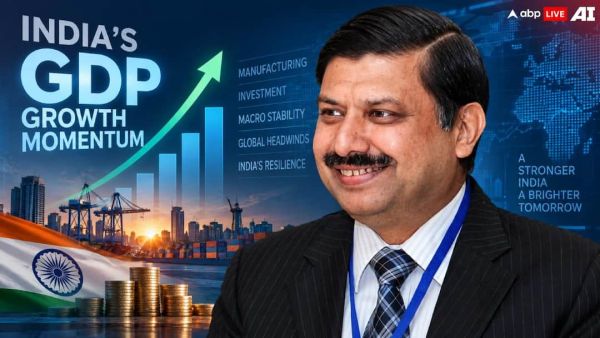
India's 7.8 per cent GDP growth in the first quarter of FY27 has surprised many, arriving in the middle of a West Asia conflict that rattled crude supplies and lingering uncertainty over US tariffs. Nagesh Kumar, Director of the Institute for Studies in Industrial Development and external member of the RBI's Monetary Policy Committee, tells ABP Live English why the numbers reflect sound macro management, what the manufacturing surge signals for jobs and investment, and how Europe-focused FTAs could reshape India's export map.
Q: There is speculation on 7.8 per cent GDP for Q1FY27. Do you agree that it is above expectations? Any change in interest rates ahead as growth firms up?
Kumar: Actually as everybody is saying the 7.8 per cent GDP growth logged by the Indian economy in the first quarter of this year is very impressive, no doubt about that. Especially because this was a period of very big disruptions caused by the West Asia war which disrupted the crude oil and natural gas supplies. India is heavily dependent to the extent of 80 per cent and above on imported crude.
So two effects were there of the crisis: one was crude prices going through the roof and the other was the supply itself which was affected. Despite those challenges, and mind you we were not out of the Trump-tariff-related trade policies and uncertainty which was there already on the background, India achieving this 7.8 per cent growth in the first quarter is truly impressive and shows the resilience of the Indian economy.
In the monetary policy committee meetings, we always look at the trends, the incoming data of that time and we arrive at a collective decision between us based on the numbers. So it is premature to say anything about what the numbers look like in October when we meet, but the Q1 numbers have given everyone some confidence given the very difficult circumstances amidst which the Indian economy has shown such resilience.
It is positive news but I really cannot say anything about interest rates because it is done on the basis of the numbers at that point so we really will have to wait and look at the trends, the projections and in the light of that, a consensus and decision is arrived at.
Q: To what do you attribute this remarkable growth? What is your forecast on next quarters?
Kumar: This performance also speaks volumes about the macro-economic management as well as the management of supplies after the war erupted. There were shortages of gas and the Government quickly stepped in and managed it very well, prices were kept in check and only a marginal passthrough was allowed from May '26.
For a very long time the rising crude prices were not allowed to be transmitted to the domestic economy or the domestic market. Management of prices and supplies was efficient and all those policymakers in the government really deserve credit for handling the situation so competently that we could still manage to grow at 7.8 per cent in the first quarter which sets the tone for the rest of the year.
Though I must say that there is no time for complacency because the crisis is still one and the West Asia war has not ended, in fact the strikes have again revived. We don’t know how long this will continue and how much it will become a challenge for us to continue to get our crude oil supplies but India has done a remarkable job in diversifying the basket and getting crude from different sources. So hopefully rest of the year will be managed that well.
The second thing that I want to highlight is that while 7.8 per cent growth is impressive, what is more interesting is that it has been backed by very high and very robust manufacturing growth of 9.2 per cent which is encouraging because when manufacturing grows well, it also encourages job creation.
We need to do something about pulling people out of the low productivity jobs they are locked into, in the informal sector. Growth rate is one, but the position of that growth, where it is coming from also matters. So for me the manufacturing sector showing very robust performance is very healthy and good.
We have just seen the Q1 numbers and having done better than what was being talked about, a wide view is that we should be able to do 7 per cent. Projection on quarter by quarter has to factor in cyclical trends but on the whole year, given this kind of momentum, it should not be too difficult to achieve 7 per cent kind of growth for FY27 but there should be greater clarity when the next quarter results come. As of now, the Q1 numbers give us scope for being cautiously optimistic about the prospects for the Indian economy.
Q: Have the numbers allayed worry over investments?
Kumar: The third thing I want to flag is that we have been concerned about direct investment picking up momentum but this quarter shows, that seems to be happening now. Gross fixed capital formation (GFCF) rate was 34.3 per cent in the first quarter of FY27 compared to 31.4 per cent in the same quarter of previous year.
So that is a massive jump of 2.9 per cent. If it sustains it would be very good for the Indian economy as that paves way for investment cycle to gain momentum which will drive industrial growth and that will drive overall expansion of the economy. The indications that we are getting from offtake of credit by industry gives some early indication that the private investment cycle may finally be taking off the ground. So I am quite happy with this performance of the first quarter which has many positives.
At the same time, the EL Nino factor which is affecting monsoon progress in parts of the country has not yet receded, so there are hurdles but the first quarter numbers are comforting and we hope we can continue this trend in the rest of the year.
The latest PMI index for manufacturing, however, shows dip in the sector contrary to GDP data. How is this sector really performing?
The PMI numbers say something up and something down. I don’t think one should be taking too much cognisance of that. They are helpful like all other numbers are. What I am looking at is the capital goods output.
For the last four months consecutively, it has been posting double digit growth in the range of 16-17 per cent. When your capital goods sector which is machinery, is expanding at that kind of rate, I feel optimistic about industry because machinery is going to be getting into gross fixed capital formation and as I pointed out earlier, credit offtake is showing very positive sign.
I feel that manufacturing sector is finally showing a promising momentum for the future but these are early signs.
As for the PLI, it is highly successful for some sectors like mobile, electronics but not so successful for some. In some areas it has certainly done a very good job. My point on PLI is that it is something which is given post facto. You deliver something, it is given on incremental output. In the worst case situation, if it has not been so successful in some sectors, the money stays with the Government, it does not get wasted.
Like in some policies, you give incentives upfront. In upfront if you give incentives and it does not take off, then the incentive is wasted but in the case of PLI, if this time it is not picking up for one sector, then next year maybe it can work. So it is performance based. That is the very great part of PLI. Some sectors are shaping up, the value addition is also increasing as in mobile phone manufacturing, the electronics ecosystem is slowly and gradually coming up and the number of semi conductor plants are shaping up and a number of them have started production.
Besides, a slew of proposals of data centres are coming up by big IT majors/global tech companies and GCCs are increasing their presence. So there are a lot of positive trends, We should look at all of them together rather than be upset and disturbed by one or two indicator which is not looking up. I am quite optimistic though there are serious conditions so one has to be observing and remaining cautious.
Kumar: The context for India’s new trade pacts, the UK, EU, and the European FTAs, is very important to understand. Last year, when we were hit by very heavy tariffs by the US, the one thing those tariffs exposed was very high dependence of India’s exports on one single market, that is the United States. About 20 per cent of our exports go to the US but within the 20 per cent, labour intensive exports like textiles, garments, footwear and gems and jewellery: 33 per cent of the exports were going to one single country.
So we had very high level of dependence on one country which is not healthy. So efforts were made by Government and I must say that the Government really got into action.
There were a number of things which were done like export promotion mission which includes diversification of export markets. The other thing was completing long pending negotiations in other major markets like the EU which was done on January 27, 2026. The FTA will get into force by the end of this year, maybe early next year.
That alongwith UK and EFTA, gives India for the first time duty free access to the entire Europe which gives us level playing field vis a vis Bangladesh and Vietnam in labour intensive products. So our garments being exported to UK or EU, faced before the onset of the FTA, 16 per cent kind of tariffs. Our competitor from Bangladesh or Vietnam faced zero. Vietnam has an FTA with EU and Bangladesh gets quota free from EU. So we were paying tariffs and they were not.
Now with this new FTA, we will have zero per cent, that is duty free access to the European market. It will neutralise the advantage that our peers in these sectors had over us. I hope Indian companies, producers in labour intensive sectors, particularly, as they also have an impact on job creation, will get their act together, scale up their production capacities, enhance their R&D, design capability and quality performance, get more and bigger orders from European companies. Thus exports will grow and we will also become an important driver of industrial growth over the years. This is something very important and interesting.
Q: Do you see reforms facilitating India’s growth roadmap?
Kumar: I think reforms are work in progress and a number of reforms are being undertaken, for instance we have done a lot of work in ease of doing business and India’s EODB rankings have also improved a lot before the index was abandoned by the World Bank. The GST reforms and tweaks in the GST rates last year, recall of quality control orders (QCOs), implementation of labour codes alongwith repealing of outdated laws/ requirements/compliance are part of Government’s constant efforts to make life easier for investors and producers.
A lot has been done on diversification of markets and as part of this exercise we should increase our penetration into African and Latin American markets for instance.
The other thing which is very important and is being addressed is that we have FTAs with Japan and South Korea but our producers have not been able to take advantage of these deals, especially the labour intensive units, so the Government has spoken to partner countries and there is now an agreement to review these FTAs.
In the review, hopefully we can take steps to make FTAs more attractive and fix the barriers that stop Indian industry from exploiting these trade deals.
(Mukherjee is a contributing writer for ABP Live English. A business journalist for more than 15 years, she has written extensively on the economy, policy, and international relations in Indian newspapers and magazines)
-
Telangana BJP chief detained over fee reimbursement protest

-
Kavitha holds dharna with students over fee reimbursement
-
Homes lost, hungry babies: Nepal’s mothers struggle post floods
-
Satya Niketan collapse exposes Delhi’s unsafe PG crisis
-
Uttarakhand: 20 madrasas shut since abolishment of Madrasa Board