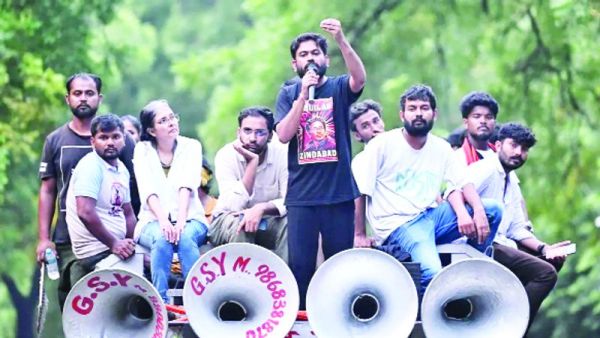
The biggest achievement of the Cockroach Janata Party (CJP), online outfit deservedly turned into a pressure group after it successfully led Gen Z protests at Delhi’s Jantar Mantar, is that it created a new notion of how to devastate hackneyed electorally-loaded narratives of a political party and its leaders. More importantly, and part of this achievement, is turning attention of the nation towards real issues- most important being education and employment- from the poll context.
How could they do it, without any organizational set-up, financial sustenance and above all a leader to act as a pivot or center of attraction. Nevertheless, not only have they succeeded in catching imagination of people who were mostly under a spell during the last over a decade and had lost their zest to stand up and ask questions.
All these shortcomings, instead of proving to be an impediment, proved to be a boon not only for the CJP but the nation. The cause visibly was NEET and other paper leaks but impliedly it was a combination of many factors biggest being the disillusionment- primarily of Gen Z- with the ruling dispensation. Ostensibly, it flowed from the total mismatch between promises made and ground reality and a cover up of the failures through attempted communal polarization and hyper-nationalism.
No doubt, this agenda of the current rulers magnificently paid electoral dividends for nearly a decade with a parallel mechanism constantly at work to discourage criticism, debate and dissent. Till the CJP was suddenly born thanks to the topmost judicial functionary of the country and within weeks landed at the Jantar Mantar, to change direction of the wind.
While educationist-environmentalist Sonam Wangchuk lent a high-profile, if not leadership, to the movement by sitting on an indefinite hunger-strike and was joined by a group of Gen Z student activists, what ultimately carried the show and score a victory in the shape of ouster of Education Minister Dharmendra Pradhan was the grit, determination and innovative ways of countering might of the state in a Gandhian way.
Yes, the protesting students and youth had a reason to celebrate Mr Pradhan’s exit from Union Cabinet as it was an act never seen since 2014. Editor turned politician Mr M J Akbar, then Minister of State for External Affairs quit in 2018 under pressure from the “Me Too” syndrome in view of serious charges levelled against him by a group of women journalists alleging sexual harassment at his hands with the matter finding resonance in courts. The circumstances of his resignation did not directly impact the authority of Prime Minister Narendra Modi. In fact, his strategists used Mr Akbar’s resignation to place him at a high moral pedestal for having secured the MoS’s resignation.
Gen Z creating circumstances through a nationwide cry which reverberated internationally, to force the PM in removing his Minister, was something never seen since 2014 and in view of Defence Minister Rajnath Singh’s famous statement, “resignations do not happen in this government”. No one can take away from CJP or the Gen Z the right to celebrate on this count, but scenarios have a broader context in a democratic polity.
Such situations, peaceful public protests or demonstrations, cannot and should not be viewed in terms of victory or loss, or loss of face particularly the political party in power. Accepting a public demand certainly does not lower prestige of a leader or a Government. On the contrary, accepting legitimate demands of protesting groups, sometimes to diffuse the situation, should be viewed as creditworthy for the powers that be.
A narrative has been cast that resignation of Mr Pradhan is a set back and dented Mr Modi’s strong image. It might be true to some extent but it is the way he takes it or feels about it. Ever since 2014 a new political thought germinated whereby foundation of a strong-leader was embedded in “victory at any cost without budging an inch”.
That itself is a fallacious strategy in an electoral democracy where people are supreme. Their demands might be right or wrong but the powers that be must deal with the situation with an open mind rather than entering into arena with a mindset to uphold supremacy at any cost. This factor was missing in the Government’s dealing with the CJP protest, till it dawned on them to deal with the protestors on realistic terms.
In simple terms PM Mr Modi responded to protesting Gen Z’s call for Mr Pradhan’s resignation and accepted it, though, belatedly. If it is considered as a challenge to his authority, this impression could have been dispelled altogether had the political authorities acted in time rather than prolonging it and ultimately attempting to muzzle it by force.
From here on the CJP has a long way to go. Its victory remains largely symbolic in policy terms, but it has significantly raised public awareness on the issues faced by India’s aspiring youth. No doubt, it will be incumbent upon its activists and Gen Z in general to maintain this tempo but, shaken out of their slumber the other sections of the society should also see urgency in backing the CJP movement to its logical end whereby tangible results are achieved on vital issues facing the country.
The question still hangs fire; Should CJP convert itself into a political party? Its leaders are well within their right to do so. Forming a political party at such an early stage of CJP’s existence will come with lot of encumbrances. Acting as a pressure group to take cudgel with the Government on public issues is the right approach till an appropriate time for taking the electoral route.
For CJP to become a political party the Gen Z consolidation has to be on firm footing. That can only be a driving force as it would need an all-encompassing effort including key opposition parties and people of all generations, to take on the might of the Narendra Modi-led Bharatiya Janata Party.
The CJP’s demonstrations should be viewed on broader parameters apart from the national impact it has made in a short span of time. The fact that these happened after a wave of youth-led protests in South Asia leading to change in political power structure in Sri Lanka in 2022, Bangladesh in 2024 and in Nepal in 2025.
Although the circumstances and ethos vary from country to country, the common thread was that the protests were fuelled by anger over youth unemployment, inequality, corruption and the exclusion of young people from policymaking. Another commonality was that the social media played a catalytic role and many new dimensions of it were seen during Jantar Mantar protests.
The Indian context is entirely different from the other South Asian nations with prime reason being the firm-footing of the democratic structure despite efforts to weaken it. The ballot, EVM in the modern context, has always played an important role, which has become a strong means for people to vent out their anger by peacefully bringing a change. Despite aberrations that context still strongly stays.
-
AC Milan salaries 2026-2027: Goncalo Ramos the highest-paid, Chukwueze level with Pulisic, Loftus-Cheek earning more than Rabiot, Cisse on 500 thousand

-
Tottenham Hotspur’s unsponsored stadium leaves transfer spending under pressure in the new financial era
-
The smell is not coming from the lunch box? These easy home remedies to get rid of it in minutes

-
Your Zodiac Sign’s Horoscope Is Here For Wednesday, September 9, 2026

-
Asian Games 2026: PT Usha confident in well-prepared Indian athletes