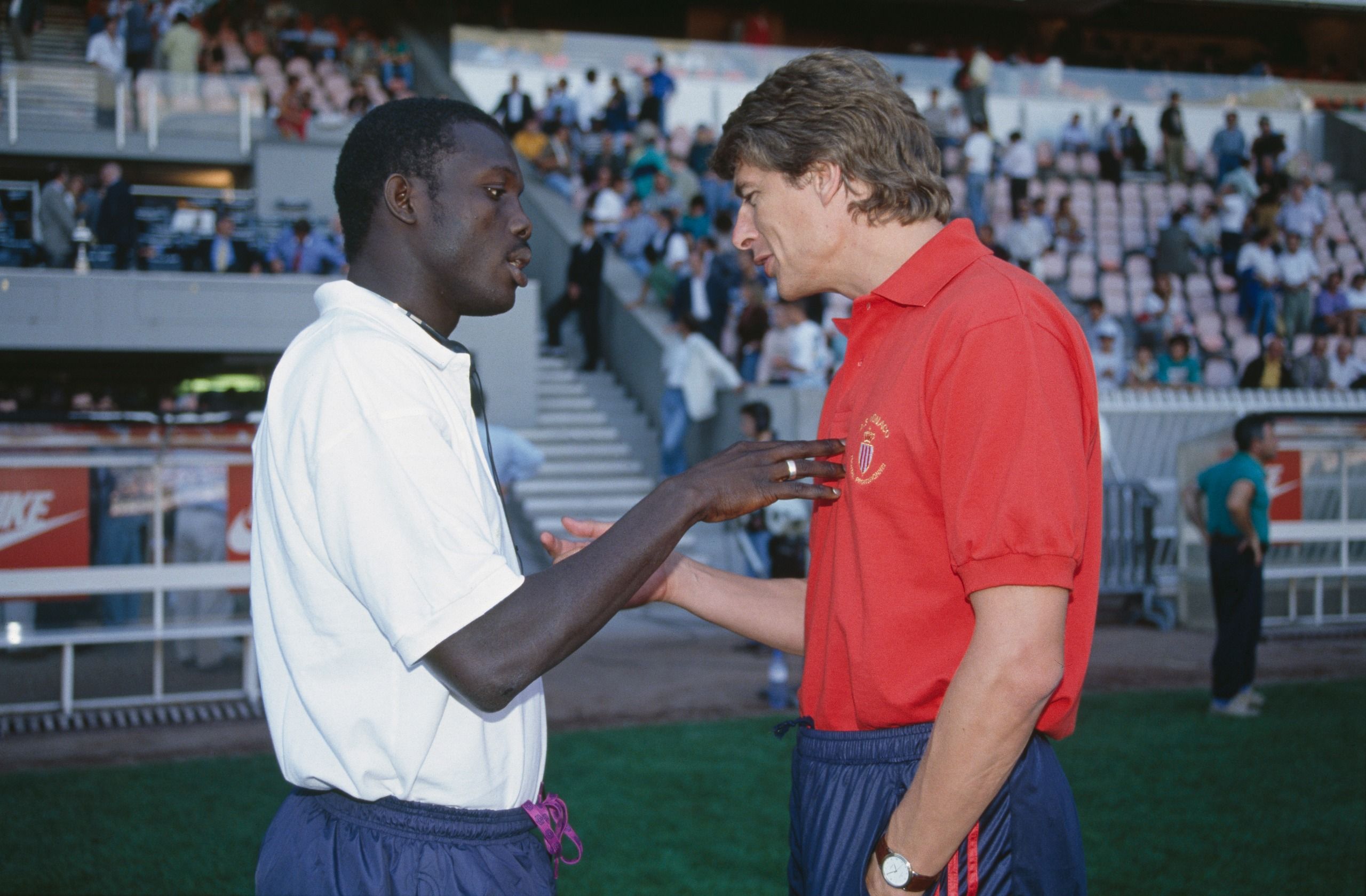
Three decades ago, FourFourTwo described George Weah as Liberia’s future head of state, shortly after he had been voted the world’s best player for 1995. We look back at the interview he gave us 30 years ago, when he made it clear that politics was not for him.
This was a man at the peak of his powers. Already the reigning African Footballer of the Year and the first Ballon d’Or winner from outside Europe, George Weah had also just been named by FIFA as the finest player on the planet.
As soon as he collected the award, he called his mentor Arsene Wenger up on to the stage and handed it to him. In Weah’s case, excellence on the pitch was matched by generosity away from it.
After all, how many footballers would personally carry the financial burden of supporting their own country’s struggling football federation? Weah was a boy from the riverside in Monrovia who, but for the fame and wealth football brought him, might have ended up working as a telephone technician.
The Lone Stars, the nickname of the Liberia national team, were especially close to his heart. He paid the air tickets of his Europe-based team-mates so they could take part in important matches, bought their kit and even covered win bonuses. In effect, Weah was the man who made Liberia’s first Africa Cup of Nations appearance possible.
He may well have been football’s best-value signing of the previous decade. Strikingly, the £6 million fee Milan paid Paris Saint-Germain in the summer already looked a bargain for a forward of his quality. Yet Monaco had signed him from Cameroonian side Tonnerre Yaounde for only £12,000 back in 1988.
But Weah’s rise into a globally celebrated goalscorer, who finished last season at the top of the Champions League scoring charts despite PSG not reaching the final, had not been an easy ride. He had to map out his success while living with the haunting fear that his parents, trapped amid Liberia’s civil war, might have suffered the same fate as so many others.
Under Wenger at Monaco, Weah was able to refine and expand his game. If his delicate touch and instinctive awareness were not enough to terrify defenders, then his powerful physique made him almost impossible to mark.
Milan president Silvio Berlusconi had no hesitation in bringing in the striker. He even sent in a team of lawyers for an all-out, no-expense-spared battle that reached the European Court in Strasbourg in an effort to have Weah recognised as a French citizen, so that Milan would not breach Italy’s quota of two non-EU players per club. The Rossoneri already had Zvonimir Boban and Dejan Savicevic, but coach Fabio Capello needed someone capable of filling the void left by Marco van Basten’s retirement. Roberto Baggio had also arrived from Juventus.
It had been a remarkable European journey for Weah. Here, the striker looked back on that path.
After helping Liberia qualify for the Africa Cup of Nations, what do you say to those who describe your side as a one-man team?
That isn’t true. Perhaps people say that because I personally sponsor the team without any help from the government or anyone else. I have committed my own money because I want Liberia’s image in the world, which has been badly damaged by the civil war, to be restored through football.
In what ways do you spend your own money on the national team?
I buy all of the playing kit and pay return international air fares for some of the country’s Europe-based players, so that they can report for Liberia’s matches in different countries. I also pay match bonuses to team-mates who are less well off financially, to keep them happy and motivate them to give their very best for the country.
Have you kept a record of how much you have spent on the Lone Stars?
A lot of money. It would not be right for me to reveal the amount I have spent so far. When you willingly spend money on your country, as I do, the figure itself does not matter. But I can say this much — it has been a major responsibility and it has run into tens of thousands of dollars.
Only a few days ago, Liberia’s sports minister came to see you in Milan to seek more financial assistance. Does spending so much ever trouble you?
No, because I believe I am doing something that can improve the lives of my younger team-mates who are still in Liberia. I also want to use the exposure they gain from high-level tournaments such as the Africa Cup of Nations to help them earn professional contracts in Europe.
What was it like when you first arrived in Europe to play for Monaco?
It was not easy. I had to adjust to the cold European climate and to the business-like approach to football, which you do not find in Africa. I was very fortunate to meet Arsene Wenger. His coaching played a huge role in making me what I am today. He treated me as though I were his own son.
Has living in France and Italy, so far away from your friends and family in Liberia, been lonely?
Yes, because there is no place like home. European team-mates can call their families at a reasonable cost or travel easily to see them, but I cannot simply go to Monrovia whenever I feel like it because of the distance and the time involved. So the only option is to speak to them regularly on the phone. By the time I have spoken to my parents and members of my extended family, my monthly phone bill comes to around $5,000 to $6,000. Thankfully, my very supportive wife and children are here with me, and that helps me think less about home so I can focus on playing well.
The Liberian Civil War was still going on while you were with Monaco and PSG. Did what was happening back home affect you?
It affected me very badly. I did not know whether my parents were dead or alive because at that time it was impossible to call Liberia. Sadly, people found it hard to understand the suffering I was going through here. Europeans often struggle to appreciate what we Africans endure when we worry about home. As far as they are concerned, we are paid to do a job and simply have to do it. But if they were in my position, they would have been in an even worse mental state than I was.
How have you found settling into life and football in Italy so far?
As far as football with Milan is concerned, everything has gone very well. It is extremely important that my wife and children are happy in Milan, because if they were not, I would have to send them back to live either in New York — where I have two houses in the United States — or in Liberia. That would leave me living alone here in Italy, which would be very lonely.
You have met Marco van Basten, the man you were signed to replace after his retirement through injury. What do you make of him?
From our regular conversations at the Milan dining table, I have discovered that he is a very nice person. It is unfortunate that he had to leave the game, because I had always dreamed of playing alongside him.
What is it like playing in attack with Roberto Baggio?
It is very rewarding. He is an intelligent footballer with virtually no technical weaknesses. When we play together, we have a very good understanding. I am also trying to learn new tricks from him.
Learning a new language can be difficult. How has that experience been for you?
[Smiles] Quite good. I hired a tutor who comes to my house on Mondays and Fridays. I am very keen to learn so that I can communicate with my team and understand all of Mr Capello’s instructions. Even though football has a universal language, it is important for me to have a working knowledge of Italian as well. For the moment, though, things are not too difficult because many of my new team-mates here can speak English or French.
Since you started playing in Europe, what has been your worst experience with a coach?
It would be with Paris Saint-Germain’s Portuguese coach, Artur Jorge. He used to leave me on the bench even when I was playing well, and I found that very frustrating. I never asked him why he did it because, from my point of view, I was doing well enough in training to be a regular in the first team and I believed the situation would sort itself out. In the end, it did.
A Nigerian magazine, Complete Football International, quoted you as saying, “Artur Jorge is a racist – he doesn’t say it, but it’s glaring that he is.” Was that quote accurate?
Well, I cannot remember saying that, but I do know that he made things very difficult for me when he was PSG’s coach.
Are you tempted by the glamorous lifestyle so often associated with Italy — fast cars, fashionable clothes and beautiful women?
I am not interested in those ordinary distractions. Business is business — I am in Milan to play football. [Pauses] Well, I must admit I do like good clothes and I sometimes choose a nice pair of shoes, but that is all. The job comes first and everything else is secondary.
Are there any other footballers you especially admire?
All black players, but if you want me to name a few, I would choose Ian Wright of Arsenal, Tony Yeboah of Leeds, Jay-Jay Okocha of Eintracht Frankfurt, Rashidi Yekini of Sporting Gijon and Abedi Pele of Torino. When I see other Africans doing well, I feel proud. Players from countries such as Nigeria and Ghana paved the way. Their hard work has given African footballers a good image and encouraged European clubs to trust our ability.
Italian calcio is still relatively new territory for African players. Do you see yourself as the man who will open the door for more Africans to move to Serie A?
No. It was Roger Mendy — the Senegal international who played for Pescara — and Abedi Pele who opened Italy to African players. When Milan saw how well they performed, they moved for Marcel Desailly — a France international who was born in Ghana — and he did not disappoint them. I think that encouraged them to come for me as well.
Has Liberia’s earlier failure to qualify for the Africa Cup of Nations affected you?
Very much. It was extremely frustrating because we had always had the talent to qualify, but poor preparation kept letting us down until now. Only recently have I been in a position to give the team financial backing. Liberian players have the talent to compete with Nigeria and Ghana in African football, but our attitude towards preparing for competitions has long been a major issue. However, now that several Liberian players have had exposure in Europe and have seen how football teams should be run, I am convinced things can improve for the national team.
Do you ever wish you had been born in another country, which might have made your path in football easier?
That is a very difficult question, but I believe that whichever country God places you in, there is a purpose behind it. In spite of all the problems that have engulfed Liberia, I am proud to be Liberian. I can never be ashamed of my country because of the difficulties we have faced. What matters most now is finding ways to put things right so that we can once again become a peaceful nation.
How did you feel when you were named the 1995 African Footballer of the Year, after losing out to Nigeria’s Emmanuel Amunike in 1994?
Very happy. I was not expecting it, but I suppose my performances for Paris Saint-Germain in last season’s Champions League, along with my current form for Milan, must have helped me win the award.
You are the most famous Liberian in the world. Do you feel pressure because of that spotlight?
Being the focus of attention does put pressure on me because I am seen as my country’s ambassador, both on and off the pitch. But when I see the appreciation the Liberian people have shown me for the little I have done, it pushes me to do even more for the country I love so much.
Four Liberian postage stamps were recently issued in your honour. What does it mean to be the first Liberian sportsman, and perhaps the only African footballer, to receive such recognition?
It was overwhelming. I never realised people held me in such high regard. To think that I would be honoured in that way feels almost unbelievable.
You fund Junior Professional FC, who recently won the Liberian First Division. Tell us about them.
I have been financing the team since October 1993. They won the Second Division title last season and then went on to win this season’s First Division at the first attempt. That came as a major surprise in Liberia, because when I first started sponsoring the team, many people laughed at me and said I would never be able to compete with Mighty Barrolle and my former club Invincible Eleven, who were the leading clubs in Liberia. When the Liberian Football Association took the title away from them on questionable grounds, it made me angry. My players were deeply upset after the title was taken from them so unfairly, but I told them not to worry because I was very pleased with the way they had performed. I backed the team because I wanted to show my fellow Liberians that the youth are the future of Liberia.
There have been widespread rumours that you want to become president of Liberia after retiring from football, given that you are the country’s most popular figure. Is that your ambition?
No, it is not my wish to become the president of Liberia. My mission is simply to use football to present Liberia in a positive light to the rest of the world. I understand the weight of such responsibility. But I do hope true democracy comes to Africa, so that citizens can speak freely about what they like or dislike about their governments. I really admire the way politics is practised in Europe and I hope African politicians can learn from that in future.
Have leaders from the different factions in Liberia ever tried to persuade you to support their views on how peace should be achieved?
Not exactly. The leaders of the various factions involved are my friends, but they are politicians and I am a sportsman. They should do everything they can to find a lasting solution to Liberia’s crisis and bring the peace ordinary Liberians need, while my Lone Star team-mates and I continue doing what we can to improve the country’s international image through football.
What kind of life do you see for yourself after you stop playing?
I could become a coach, or I would like to help the Liberian Football Association in some way. Whatever I do after retirement, I think it will definitely have to be something that helps raise the profile of sport in Liberia.
There is no doubt that your years in Europe have made you a very wealthy man. Many people believe you must be a millionaire in any currency to sponsor both your national team and a Liberian league club…
[Laughs] A millionaire? I wish I were a millionaire. A large part of what I earn goes to people who are in need. As long as hunger stays far from my door, I am happy. I would estimate that I have spent close to 20 per cent of my earnings from European football on my extended family, my friends and even fellow Liberians I do not know personally. Perhaps if I were selfish and kept all my money to myself, then maybe I would be a millionaire by now. [Laughs]
This feature first appeared in the March 1996 issue of FourFourTwo.
-
Player Ratings: Ainsley Maitland-Niles hits a stunner as Everton snatch late draw against Manchester United

-
Are you troubled by heartburn and sour belching after eating? These 3 daily habits can provide relief

-
Sanya Malhotra Wants To Treat Her Friends To Matcha Tiramisu, Shares Recipe
-
US Ambassador Gore met Karnataka CM Shivkumar, discussed initiatives like Pax Silica and Trust
-
Ishan Kishan played captaincy innings before Afghanistan series, scored a century in the final