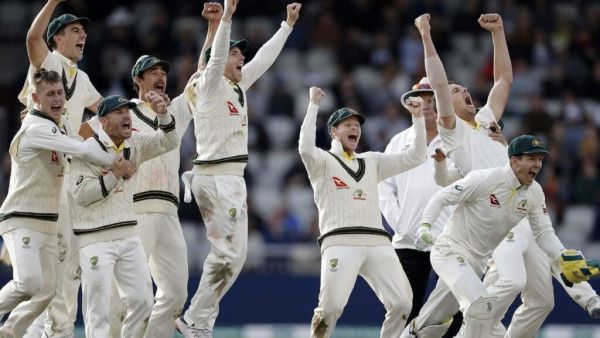
Test Cricket: Test cricket is constantly changing. Now teams do not play to draw matches, but to win at all costs, because now every Test match is a part of the ICC World Test Championship (WTC). This is the reason why in today's modern Test cricket, batsmen adopt an aggressive stance from the very first ball, so that the result of the match can be determined. Now even in Test format, batsmen do not hesitate to play like T20. However, even though today's Test cricket has changed and the results of almost every match are coming, there is still a record which Test cricket may have to take a 'rebirth' to break. Between the years 1999 and 2008, such a history was created, which is still considered to be the biggest and almost 'impossible' record of Test cricket. During this period, Australia had made a world record of winning 16 consecutive test matches. Till date no team in the world has been able to come even close to this figure. Will this great record of Australia ever be broken? And if yes, what kind of circumstances would be responsible for this? Let us know in detail in this article.
Will Australia's record of 16 consecutive wins in Test cricket ever be broken?
Test cricket is considered to be the toughest test in the history of more than 150 years of cricket. In this game which lasts for 5 days, along with the physical strength of the players, their mental courage is also tested. In such a difficult game, winning two or three consecutive matches is also considered a big thing. But there was a period in history when the Australian team ruled the entire world by winning 16 consecutive test matches. In today's time, when the two-year cycle of WTC is going on, a question comes in everyone's mind that can any team of today win 16 or 17 Test matches continuously and remain invincible in the entire championship journey? If we look at the reality and the methods of the game, it is almost impossible for this to happen.
Steve Waugh's Invincible Chariot (1999–2001): This historical record of Australia started in October 1999 against Zimbabwe in Harare. After this, under the captaincy of Steve Waugh, the Australian team defeated Pakistan, India and West Indies on home ground. This sequence continued for 16 consecutive Test matches, which was finally stopped by India in 2001 on the basis of memorable innings of VVS Laxman and Rahul Dravid in the historic Eden Gardens Test in Kolkata. At that time Australia included great players like Matthew Hayden, Ricky Ponting, Adam Gilchrist, Shane Warne and Glenn McGrath.
Ricky Ponting's golden era (2005–2008): A few years later, the 'invincible' Australian team captained by Ricky Ponting repeated this feat again. This journey started against South Africa in December 2005 and continued till the Sydney Test in January 2008. This time too, after 16 consecutive wins, his victory chariot was stopped by the Indian team itself at the WACA ground in Perth.
WTC structure and challenge in today's Test cricket
If a team today dreams of winning 16 or 17 Test matches in a row, it would mean that it would have to win all its matches in the entire World Test Championship cycle. According to the rules of WTC, every team has to play 6 different series within two years. 3 have to be played at home and 3 have to be played abroad. Including all this, a team has to play a total of 12 to 22 test matches. Now think for yourself that no team should lose a single match for two whole years nor let any match be drawn. In today's era, where all the teams are giving tough competition to each other, it seems impossible to think like this.
Why is this record 'almost impossible' to break?
Home ground advantage: In today's era, all the teams are strongest at home. Turning tracks are available in India, swing in England, bounce in Australia and fast pitches in South Africa. Today any weak team can defeat the strongest team in the world at home. In such a situation, it is almost impossible for any team to go abroad and win all the matches of the series.
Temperament of pitches and role of luck: During the era of Steve Waugh and Ponting, matches often lasted for five days and were also drawn. But today the pitches are made in such a way that the matches end within 3 or 4 days. At this pace of the game, just one bad session or losing the toss can make you lose the match. In such an environment, it is not possible to get luck and good performance for 16 consecutive matches.
Baseball' and Offensive Sports: England's 'baseball' strategy has completely changed Test cricket. Today's teams do not play to draw matches, but to win at all costs. The risk is very high in this aggressive game, due to which teams either register big wins or lose badly. When there is so much risk in the game, it becomes impossible to remain invincible for 16-17 consecutive matches.
Player fatigue and injuries: With the advent of T20 cricketToday's cricket schedule is very busy. Players are given rest to prevent injury. During the era of Steve Waugh, only one strong team played continuously for years. But today it is impossible to play 16 consecutive Tests without giving rest to the main bowlers or batsmen. When teams change frequently, it becomes difficult to win consistently.
Techniques and Video Analysis: Today every team has an entire army of analysts. With the help of cameras and data, the weaknesses of any big player can be caught within a few matches. Opposition teams immediately find the solution to your strategy. In such a situation, it is no longer possible to keep winning matches continuously with the same plan for a long time.
-
Rio Ferdinand disagrees with Michael Carrick’s call on Man Utd defender as Gary Neville labels back line a ‘liability’

-
SIR: In Charminar, 23,000 people with Muslim names 'absent' at home

-
Nepal floods: Death toll hits 1,356, nearly 5,000 missing

-
One attack, many Americas: Why 9/11 grief lands differently

-
Alarming spike in NDPS cases: SC orders 419 special courts