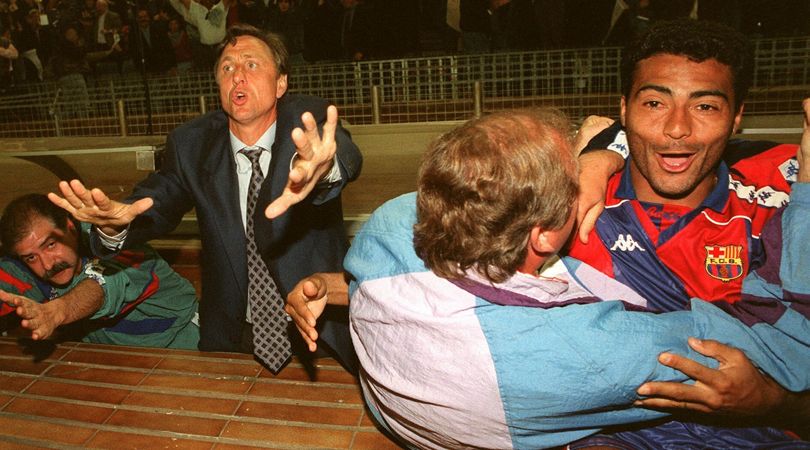
They formed one of the finest strike pairings ever witnessed, but their volatile relationship pulled both them and Barça apart after only a year.
For once, there were no excuses, even if one did exist. There was no outburst about the referee, no complaints about misfortune, no anger over the foreigner rule that had forced Peter Schmeichel to stay on the bench. On November 2, 1994, Manchester United were torn apart by Barcelona in a display of such ruthless beauty and brilliance that there was simply nothing to protest about. There was only acceptance. The better team had won, and won magnificently. “We have been well and truly slaughtered,” admitted Alex Ferguson. “In the end, it was a humbling experience for us.”
So humbling, in fact, that Paul Parker still will not go inside Camp Nou. He continues to be haunted by the 4-0 thrashing his team suffered. His United teammate Gary Pallister recalls it as “the one time in my career when I came off the pitch and just had to accept that I hadn’t been able to get anywhere near my opponent. I was completely shell-shocked afterwards.”
Barcelona’s display was breathtaking, with La Vanguardia calling it a “recital”. “Barcelona humiliate United,” wrote The Times. At the centre of that footballing world were the two most dazzling forwards on the planet, the standout stars of that summer’s World Cup – Romario and Hristo Stoichkov. Romario had been Brazil’s best player, while Stoichkov finished as the top scorer at USA 94 as Bulgaria made an astonishing run to the semi-finals. A month after the United game, Stoichkov was named European Footballer of the Year. Together, they were arguably the finest partnership Camp Nou had ever seen. They were certainly among the most combustible, as quick with their words – and at times even their fists – as they were with their feet.
That night, the Brazilian scored once and the Bulgarian twice – the second being his 100th goal for the club. “We just couldn’t handle the speed of Stoichkov and Romario,” Ferguson admitted. “The suddenness with which they attacked was a new experience.”
“United had no answer to the skill, speed and imagination of Stoichkov and Romario, at times moving through their defence with an ease as impudent as it was embarrassing,” wrote David Lacey. “Pallister and Bruce were both auditioning for the role of Juliet: Romario, Romario, wherefore art thou Romario? And nobody had a clue about Stoichkov’s whereabouts.” “When Barcelona are on their game, their superiority is insulting; they leave the opposition looking utterly ridiculous,” said former Barcelona player Lobo Carrasco. “Tonight, Barcelona took revenge for what happened to them in Athens.”
What had happened in Athens six months earlier was Barcelona’s shock defeat to Milan in the European Cup final. Not merely a loss, but a 4-0 collapse. Now, they seemed to have learned. Now, the four-time Spanish league champions and European Cup runners-up, the greatest side in the club’s history, appeared ready to go one better, driven by this incomparable attacking pair. The destruction of United felt like a warning, a glimpse of a future in which Stoichkov and Romario, Romario and Stoichkov, would rule the world.
Only it did not turn out that way. Instead, it was the last waltz, a brilliant closing act from a once-great team. Two months later, Romario was gone. Six months after that, Stoichkov had gone too. So had Andoni Zubizarreta. So had Michael Laudrup. Soon, coach Johan Cruyff would also leave. The trophies disappeared as well – Barcelona would wait three years before winning anything again. Athens would prove to be a turning point, not a lesson. The dream partnership had overseen the death of the Dream Team.
It had all lasted such a painfully short time. Romario played alongside Stoichkov for the 1993/94 season and the opening months of 1994/95, including the demolition of United, and that was all. They had barely shared a year together.
But what a year it was. A kidnapping. Fistfights. Arguments. Tears and tantrums. A proud father. An even prouder Godfather. A scandal. A mistress. Or five. Paparazzi. Betrayal. Red cards. A league title won in the final minute of the final day. A historic battering of the eternal enemy. A European Cup final. And goals. Plenty of them: more than 50 between the pair, with Romario ending the 1993/94 league campaign with 30 in 33 matches, including an astonishing five hat-tricks – one on the opening day, another against Atletico Madrid despite having two goals disallowed – and completing his Barcelona career with 53 goals in 82 games.
Ask supporters to list the 10 greatest Blaugranas in history and almost all of them will include Stoichkov and Romario. Their impact was so immense, the reverence with which they are remembered so powerful, that the unavoidable fact they only played together for a year somehow feels absurd. Surely it must have been longer. But it was not. They packed an extraordinary amount into those 12 months and then fell out, each heading in a different direction, never to speak again. Together, Romario and Stoichkov experienced everything. They became legends.
In March 1995, Stoichkov went on Spanish radio and declared: “It’s Cruyff or me.” The tensions that had been simmering beneath the surface were suddenly exposed; in one sentence, Stoichkov made clear that he was preparing to leave.
Real Madrid goalkeeper Paco Buyo was quick to try to take advantage. “If it’s true that Cruyff doesn’t want him, and I can’t for the life of me believe it can be, then I will talk to whoever I have to make him join us. I’ll do whatever it takes.” “Stoichkov,” said Jorge Valdano, former general director at Real Madrid, “is a predator – a beast who is only satiated by the flesh of his victims.” “He is the best forward in the world,” added Carrasco. “He can do everything. He has talent and class, he can run like Carl Lewis, play passes like Ronald Koeman, and finish every bit as well as, or better than, Gary Lineker – and on top of it all, he’s got mala leche.” Mala leche literally means bad milk; in practice, it means edge, a terrifying temper, aggression, competitiveness, and a touch of madness.
That, in truth, was exactly the point: Cruyff had focused on Stoichkov as much because of his temperament as his ability. “I could talk about Stoichkov forever. He came to Barcelona because we needed him,” Cruyff recalled. “He had speed, finishing and character. We had too many nice guys, we needed someone with mala leche.”
Stoichkov had it in abundance. In his very first game against Real Madrid, he was sent off for stamping on the referee, an act that brought a six-month suspension, later reduced to two. Another red card came after two yellow cards – in just six minutes of a game. During a pre-season friendly, yet another referee went over to the Barcelona bench to warn Cruyff: “Either calm that bull down or I’ll send him back to the corral.” Cruyff replied: “What am I supposed to do?”
He was, according to the man who received that infamous stamp, “an angel off the pitch but the devil himself on it”. “If he’d been an actor, Stoichkov could have been Mel Gibson in Mad Max, Clint Eastwood in Unforgiven or Harrison Ford in Blade Runner,” wrote one Catalan columnist – and the supporters adored him for it.
It was his personality that made him such a favourite; his capacity to embrace barcelonismo; the fact that he lived every match with such intensity; the way he displayed a hatred of Real Madrid so raw and so public that, while in charge of the Bulgarian national team, he once threw a seven-year-old boy out of training because the child had arrived wearing a Madrid shirt. “Every game against Madrid was life and death for me,” he says. “The injustices of the past [against Barcelona] became mine, too.”
La Vanguardia captured it perfectly when it wrote: “We’re all Stoichkov; his story could be the story of the millions of Barcelona fans who are transformed when they come to the Camp Nou.”
Romario’s appeal was different. With his broad hips, heavy low-slung frame and powerful thighs, he was unlike anyone else; electric, exact, completely unpredictable. Nobody had seen a footballer quite like him. Technically flawless, he was unstoppable in tight spaces. He produced things that looked barely believable and had never really been seen before – from back-heels to flicks to impossibly delicate lobs known in Spain as vaselinas. Valdano famously called him a “cartoon footballer”. “He is a juggler, a magician, a penalty area artist, a virtuoso,” declared the Catalan daily Sport. “He does what others can’t – and does it with alarming ease.” “I always regretted not wearing a hat so that I could take it off to him after he left the Osasuna goalkeeper covered in vaseline and solitude,” wrote the intellectual Manuel Vazquez Montalban. “He has feet as sensitive and soft as Dali’s clocks. His finishing should provoke ridicule and hatred in goalkeepers but Romario inspires a kind of religious feeling instead. It would not surprise me if goalkeepers carried a notebook and pen around with them so that they could ask him for an autograph after every goal. He bends space and time. We have been lucky enough to see him out on the turf and unlucky enough not to have a poet like William Wordsworth around to describe him.”
Not that Stoichkov was especially impressed at first. When Barcelona signed Romario from PSV, the Bulgarian made his feelings very clear in the press; league rules meant only three foreigners could play at one time and Barça already had Stoichkov, Koeman and Laudrup. “Signing a fourth foreigner is plain stupid,” Stoichkov snapped, “but if the board think it is absolutely necessary and they asked for my opinion, I would tell them to sign [Bulgarian Lubo] Penev. How much does Romario cost? 600m Pesetas? I’d take 200m from my own pocket and sign Penev.” It was classic Stoichkov: loud, emotional, outspoken. It also threatened to create trouble – especially with Romario, a man whose reputation he did nothing to disguise. “If saying things to people’s faces and saying what I think without holding my tongue, if having a strong character and not accepting impositions is controversial,” Romario told the Spanish media, “then yes I am controversial.”
It looked like a recipe for disaster. Romario and Stoichkov had contrasting personalities but, in Cruyff’s words, shared the “same problem”: both believed the team was there to serve them, not the other way around. “They constantly battled to see who would get more goals,” remembers former Barcelona director Josep Maria Minguella, who represented both players.
Neither could bear being left out. “When Stoichkov was on the bench,” one teammate recalls, “he could start a fight with his own shadow. And when Hristo’s angry, he’s dangerous.” “Hristo was peculiar,” says Minguella. Another teammate describes him more bluntly as “a bit dense”.
“I remember one time that Romario was left out and I couldn’t even talk to him; he was in such a funk,” remembers Stoichkov. The problem was that being left out was unavoidable. With four foreigners in his squad – and four outstanding ones at that – Cruyff adopted a rotation policy that pleased nobody, least of all his two front men.
It seemed certain to end badly. And yet, strangely, Romario and Stoichkov became the closest of friends. “Romario basically never spoke to anyone in the squad,” one teammate recalls, “he did his own thing on his own terms all the time.” The one person he did speak to was Stoichkov. “It seems bizarre and I ask myself even now how it was possible,” Stoichkov says. “He was introverted and I was the reverse. He likes to sleep, I like to live. We were night and day. But we became good friends right from the start. We were inseparable.”
Their children went to the same school, and their wives, Monica and Mariana, became best friends. They looked after one another; when Romario was sent off for punching Diego Simeone, Stoichkov remarked admiringly: “It was worthy of Mike Tyson.”
And Stoichkov knew a thing or two about punching people himself. He even did it in defence of Romario’s honour. The Brazilian was in Rio on international duty when his wife gave birth to a baby boy, imaginatively named Romarinho. He was determined not to see his son for the first time through the media and asked journalists not to get too close. Stoichkov acted as Romarinho’s bouncer to ensure that happened – and one photographer at the hospital received a Bulgarian right hook for his trouble. When Romario arrived – “two flights late, which was typical Romi”, as Stoichkov recalls – it was the Bulgarian who picked him up from the airport and drove him to the hospital. When Romario learned that his father had been kidnapped, it was Stoichkov who was with him and offered support. When he heard that his father had been freed, it was Stoichkov whom he covered in relieved kisses. And when it came time to choose a Godfather for his son, Stoichkov was the obvious choice.
Together, they were devastating on the pitch as well. “Hristo enjoyed that year with Romario more than any other,” says Minguella. The goals prove it. So does the league title, and some of the most glorious nights in Barcelona’s history, none more memorable than a 5-0 victory over Real Madrid in which Romario scored a hat-trick and produced a move that, Stoichkov insisted afterwards, “would go down in history”.
He was right. Almost turning a full circle, Romario dragged the ball with him, never losing contact with it, pulling it across the turf, gliding like a bowling ball on a polished lane before finishing. Nobody had seen anything like it before. It became known as the cola de vaca – the cow’s tail – and would forever be linked to the Brazilian. “I have never known a player able to do the things in the area that he did,” Stoichkov recalls. From that day on, Barcelona seemed unstoppable. They took 28 of their final 30 points to win the league after Miroslav Djukic missed a last-minute penalty for challengers Deportivo de La Coruna on the final day. Barcelona’s cracks had done it again. “We silenced those who said the Dream Team was dead,” Stoichkov declared.
In truth, the critics had been right. Other cracks were opening up – both in the club and in their brilliant partnership. The defeat in Athens had been humiliating and unexpected, but it had not been an accident.
Cruyff’s rotation policy had angered even such calm figures as Michael Laudrup and Ronald Koeman, even if the results were often spectacular. Stoichkov missed four Champions League matches and was substituted in 15 of his 30 league appearances. The fact that Stoichkov himself points that out says plenty. Laudrup missed the European Cup final. Worse still were Cruyff’s public attacks on them. “When we win it’s down to Cruyff, when we lose it’s the players’ fault,” Stoichkov snapped. Goalkeeper Zubizarreta was told he would not continue; Laudrup decided he couldn’t continue.
Meanwhile, Stoichkov was becoming increasingly worried about Romario’s lifestyle and the people around him. “People came between us, and I tried to warn him,” Stoichkov says. Romario did not appreciate the interference. He had ignored Stoichkov’s advice and chosen to stay in a suite on the 17th floor of the Hotel Reina Sofia rather than move into a house next door. Later, he moved to a hotel in Sitges but kept his room at the Princesa Sofia – for, according to the gossips, his mistresses. The wives remained close, but the footballers drifted apart; Stoichkov sided more with Mrs Romario than with Mr Romario.
“Romario’s lifestyle, his constant coming and going, caused problems with his wife,” Stoichkov recalls, with some understatement. The Brazilian did not drink alcohol, but he had other vices. One teammate put it bluntly: “Romario was only interested in two things: football and fucking.” A few years later, Romario himself said: “If I don’t go out at night, I don’t score goals.”
Increasingly, he did not seem all that interested in football. One former Barcelona player remembers training sessions when the Brazilian “could hardly move” and was “practically falling asleep” after the previous night’s activities. Cruyff sent him home from one session and had another confrontation with him after he overslept and turned up an hour late for a team meeting. Cruyff had already warned that Romario’s attitude in Holland had been: “If I don’t want to train, I won’t train.” Used to be? It still was. “He lacked discipline,” a weary Cruyff later admitted. Romario did not care. “It’s not the first time I’ve had an argument with Cruyff, and it won’t be the last: I say what I think and no one will ever change me,” he said.
One night, Romario was caught with a girl. A week later, she appeared on the cover of the magazine Interviu. Some charitable soul slipped a copy under his hotel room door. The first person to see it was Romario’s wife. “Romario’s skill on the pitch was in lying with his body,” Valdano says. “In the end it was his undoing off it too: he lied to his president to go off with two blondes.” For Stoichkov, the magazine under the door summed everything up: “Someone had,” the Bulgarian insists, “taken advantage of their ‘friendship’ with Romi and sold him out.”
The final straw came after the World Cup, a tournament dominated by the Barcelona forwards. Romario failed to return to the Catalan capital. In the Camp Nou dressing room, the rest of the squad took it out on Stoichkov, taunting him: “Some friend you’ve got!”
By then, though, the friendship was already close to dead. Sad and desperate, the Bulgarian had tried calling the Brazilian to beg him to return to Catalonia. But the calls went unanswered and the messages ignored. This time, it was Romario who felt wronged. Stoichkov and his family had been due to travel to Brazil after the tournament for Romarinho’s baptism, before the two families went on holiday together. Hotels and flights had been booked. But the Bulgaria squad was summoned to a reception with president Jelei Jelev, and Stoichkov did not make it to Brazil.
When Romario eventually appeared in Barcelona, two weeks late, everything had changed. “He trained alone, and we hardly spoke,” says Stoichkov. “Then we had another argument because I didn’t like his friends at all. I tried to split him from them, but I failed. It was never the same again.” Apart from the United match, the Bulgarian was right: in the following season Romario scored only four goals before leaving. Stoichkov managed just nine. Barcelona finished fourth. “Romario never came back after the World Cup. His body was there, but his mind was still in Rio,” Stoichkov says. “Some joked that the man in Barcelona was a lookalike; his performances were so bad.”
It had been good – very, very good – while it lasted, but it was over. There was time only for one final dance for old times’ sake; one last flash of glory that, beneath the flawless surface, felt like a sad lament for what might have been. It was a virtuoso performance, just like the old days. A performance so brilliant that even Alex Ferguson had no complaints.
This feature originally appeared in the February 2010 issue of FourFourTwo.
-
Pundits rule Chelsea out of Premier League title race after narrow defeat to Arsenal

-
First ever Coke Studio song to cross 1 billion views on YouTube
-
WATCH: Rinku Singh In Party Mode! Dances With Teammates During UP T20 League Title Celebrations

-
Maharashtra Forms High-Level Panel To Review And Reform Recruitment Exams, Aspirants Await Key Changes

-
Air India Express Flight To Abu Dhabi Turns Back To Kochi After Engine Oil Drops At 36,000 Feet