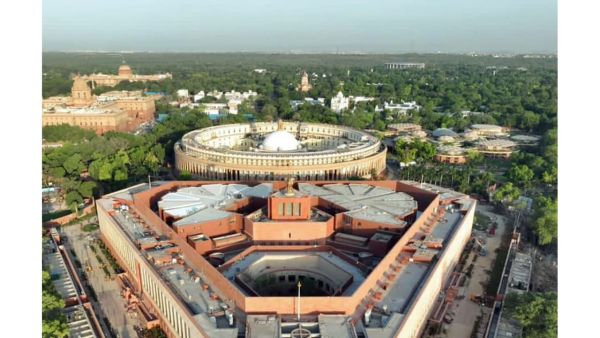
The Parliamentary Standing Committee on Chemicals and Fertilisers will meet on September 7 to discuss urea diversion to the wood panel industry, fertiliser subsidy schemes, and the debate between generic and branded medicines.
The Parliamentary Standing Committee on Chemicals and Fertilisers is set to hold three separate meetings next week on a case study of the Indian wood panel industry, evaluation and monitoring of fertiliser subsidy schemes as well as fertiliser innovation schemes, and generic versus branded medicines with special reference to awareness and trust deficit.
Focus on Urea Diversion in Wood Panel Industry
The committee is scheduled for September 7 and will take up a case study on the Indian wood panel industry during the first meeting beginning at 11 am in the Parliament House premises.
There will be a half-hour presentation of Pahlè India Foundation (PIF) in the first meeting of the committee on "Diversion of Subsidised Agricultural Urea into the Industry in India: A Case Study on the Indian Wood Panel Industry".
The meeting is scheduled almost three months after the PIF, on June 9, released a white paper and presentation titled "Diversion of Subsidised Agricultural Urea into the Industry in India: A Case Study on the Indian Wood Panel Industry".
In the white paper, the PIF highlighted how heavily subsidised, neem-coated agricultural urea meant for crop nutrition is illegally siphoned off into a parallel black market for industrial use. It also mentions how the Indian wood panel sector--including manufacturers of plywood, particle boards, and medium-density fibreboard (MDF)--relies heavily on urea-formaldehyde (UF) resins as a primary binding adhesive. It also pointed out that the vast price gap between cheap, government-subsidised agricultural urea (sold to farmers at a fraction of the cost) and market-priced technical-grade industrial urea drives the unauthorised diversion. The practice strains the national exchequer via subsidy leakages, creates unfair competition for compliant MSMEs, and exposes vulnerabilities in the supply chain monitoring of chemical inputs.
Other Key Agendas
The second meeting of the committee is scheduled at 11.30 am onwards, and it focused on a briefing by the representatives of the Ministry of Chemicals and Fertilisers, Department of Fertilisers on the subject "Evaluation and monitoring of Fertiliser Subsidy Schemes as well as Fertiliser Innovation Schemes".
However, the third meeting scheduled at 2.30 pm onwards comprises a briefing by the representatives of the Ministry of Chemicals and Fertilisers, Department of Pharmaceuticals on the subject "Generic versus branded medicines with special reference to awareness and trust deficit."
The meetings are expected to provide an opportunity for detailed deliberations on the functioning of the respective sectors and issues requiring policy attention.
About the Standing Committee
The Standing Committee on Chemicals and Fertilisers is one of the 24 departmentally related standing committees. It is serviced by the Lok Sabha Secretariat.
The Committee consists of 31 Members, 21 members from Lok Sabha, nominated by the Lok Sabha Speaker, from amongst the members of Lok Sabha; and 10 members from Rajya Sabha, nominated by the Rajya Sabha Chairman, from amongst the members of Rajya Sabha.
The term of office of the Committee is one year from the date of its constitution.
The three Departments of the Ministry of Chemicals and Fertilisers are within the jurisdiction of the Standing Committee on Chemicals and Fertilisers: Department of Fertilisers, Department of Chemicals and Petrochemicals, and Department of Pharmaceuticals.
All India Trinamool Congress (AITC) MP Kirti Azad is the chairman of the committee. The Committee have been entrusted with the functions to consider the Demands for Grants of the three Departments of the Ministry of Chemicals and Fertilizers and make reports on the same to the Houses; to examine the bills referred to the Committee by the Rajya Sabha Chairman or the Lok Sabha Speaker as the case may be relating to the above Ministry, and make report thereon; to consider the Annual Report of the Ministry and make reports thereon; and to consider national basic long term policy documents presented to the Houses, if referred to the Committee by the Rajya Sabha Chairman or the Lok Sabha Speaker as the case may be and make reports thereon. (ANI)
(Except for the headline, this story has not been edited by Asianetnews Editorial staff and is published from a syndicated feed.)-
EPF Account: Add a nominee from home in just 2 minutes to avoid claim issues. Follow these simple steps to complete the process easily.
-
Post Office Scheme: Turn small savings into a ₹35 lakh fund with government-backed security and added insurance benefits. Check the details.
-
No more agent tricks! IRDAI’s ‘Know Your Agent’ initiative aims to curb mis-selling and help customers compare insurance policies.

-
8th CPC Salary Calculator: Grade Pay ₹1,800 to ₹2,800… What will the salary of central government employees be? Check the calculation structure.

-
'Mirzapur The Movie' Advance Booking Crosses Rs 3 Cr Before Release; Over 80,000 Tickets Sold