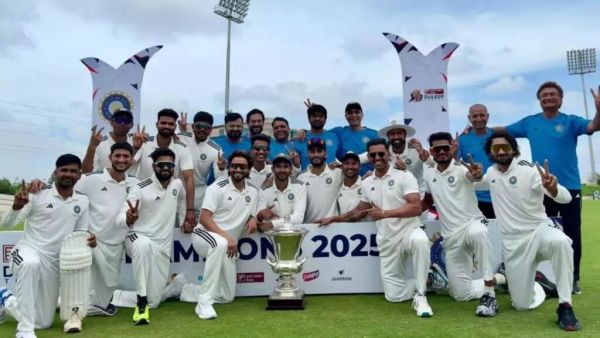
Duleep Trophy: Duleep Trophy is one of the most prestigious domestic tournaments in India. A total of 6 zonal teams play in this. It is organized by BCCI in its traditional zonal format. This tournament is played under single-elimination knockout format. In this, the winning and runner-up teams of the previous season get a direct place in the semi-finals, while the remaining 4 teams play quarter-final matches among themselves. So, let us know in this article how the teams participating in Duleep Trophy are decided? Also, how many states are included in a zonal team?
How are teams formed in Duleep Trophy?
In Duleep Trophy, 6 zonal teams play based on different regions of India. These include Central Zone, East Zone, North Zone, North East Zone, South Zone and West Zone. Each zone has its own selection committee, which consists of representatives from different state cricket boards of that region. For example, selectors from Mumbai, Maharashtra, Baroda, Gujarat and Saurashtra come together to choose the West Zone team. These committees meet every year in late July or early August and select 15 main players as well as some standby players for the tournament. The BCCI appoints a state association as 'Host or Converter Association' for each zone. The Secretary of that state calls the meeting of the Zonal Selection Committee and monitors the entire process.
In the Duleep Trophy, 6 zonal teams are formed on a geographical basis by combining a total of 38 Ranji teams from a total of 28 states, union territories and reputed sports boards (such as Railways and Army) of India. In Duleep Trophy, the states have been divided on the basis of geographical location as follows:
| Zone | Involved states and cricket associations (Ranji teams) | total teams |
|---|---|---|
| 1. North Zone | Delhi, Punjab, Haryana, Himachal Pradesh, Jammu and Kashmir, Chandigarh and Services (Army) | 7 |
| 2. South Zone | Karnataka, Tamil Nadu, Andhra Pradesh, Hyderabad, Kerala, Goa and Puducherry. | 7 |
| 3. West Zone | Mumbai, Maharashtra, Baroda, Gujarat and Saurashtra | 5 |
| 4. Central Zone | Uttar Pradesh, Madhya Pradesh, Rajasthan, Chhattisgarh, Uttarakhand, Vidarbha and Railways | 7 |
| 5. East Zone | Bengal, Jharkhand, Bihar, Odisha, Assam and Tripura | 6 |
| 6. North East Zone | Arunachal Pradesh, Manipur, Meghalaya, Mizoram, Nagaland and Sikkim | 6 |
| grand total | Representation of states and institutions across India | 38 Ranji teams |
Ranji Performance Quota:
During zonal selection, the selectors from each state put the names of their best performing players (e.g. highest run scorer or wicket taker in the previous Ranji season) on the table. After mutual consent and comparison of statistics, the best 15 players are included in the squad of the zonal team.
How is the tournament format and schedule decided?
The Duleep Trophy is organized by the BCCI in a short knockout format at the beginning of its domestic season, usually in the months of August–September. In this tournament, all the matches are played in 4-day format, while its final match lasts for 5 days. According to the rules of the tournament, the winning and runner-up teams of the previous season get a direct place in the semi-finals, while the remaining 4 teams secure the semi-final tickets by playing quarter-final matches among themselves. Currently, high-tech venues like 'BCCI Center of Excellence' in Bengaluru are chosen to organize these matches, so that all the players can get equal pitches and best modern facilities to play.
Many experiments were conducted from time to time in Duleep Trophy.
In the history of Duleep Trophy, BCCI has done many big experiments with its format from time to time. The identity of the tournament has seen frequent changes to improve the level of play and find the best talent for Team India.
Traditional zonal format (since 1961): Since its inception, the tournament has been played between 5 different regions (zones) of India. Later, 'North East Zone' was also included in it, making a total of 6 teams. Playing in this system, players have a different pride in playing on behalf of their region or region.
India Red, Blue and Green (2016-2019): BCCI had discontinued the zone system for a few years. Instead, three teams were formed by selecting the best players of the country, India Red, India Blue and India Green. A new experiment was conducted between these teams to have day-night and pink ball matches at night.
India A, B, C and D format (2024-25): In view of the consecutive Test matches of the Indian team this season, the selectors adopted a new approach. He formed four teams, Team A, B, C and D, by combining the best players of the country. This was done so that by having matches between these teams, new and strong backup players could be found for the senior Indian Test team.
Return of zonal system (from 2025-26): BCCI decided to improve the standard of domestic cricket as a whole and increase the pride of playing for their zone instead of players focusing only on their own individual games. Therefore, they resumed the old method, in which the same traditional 6 zonal teams of the country play among themselves. In simple words, the players for Duleep Trophy are selected entirely on the basis of their game, excellent records, fitness and the needs of the Indian cricket team. Its real objective is to always keep India's national test cricket team strong.
In the first semi-final of Duleep Trophy 2026, the East Zone team has confirmed its place in the final by defeating the Central Zone. Under the captaincy of Ishan Kishan, East Zone has made its place in the final. This match was played from 30 August to 1 September and the result of the match came within 3 days.
-
Deepak Hooda Ends 2021 Dispute With Krunal Pandya, Set For Baroda Return After 5 Years
-
S J Poddar Academy Hosts Robotronix 2026; 170+ Students Showcase Robotics & Coding Skills
-
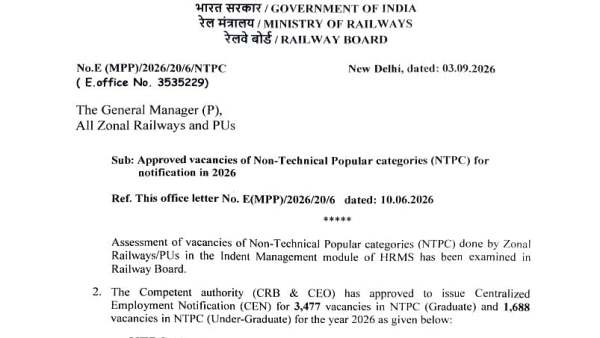
RRB NTPC 2026: Railway Board Approves 5,165 Vacancies For Graduate And Undergraduate Posts; Check Details Here
-
Who Is Nitish Rajput? Controversial YouTuber Reportedly Participating In Salman Khan's Bigg Boss 20

-
Uttam Kumar At 100: Kolkata Celebrates The Enduring Legacy Of Bengali Cinema’s Mahanayak