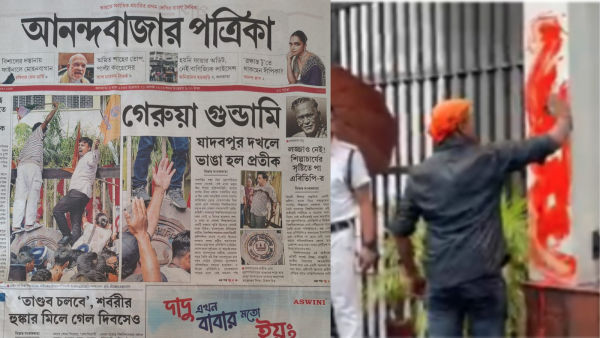
Kolkata: A group of Hindutva workers painted the walls of Anandabazar Patrika office saffron on Tuesday, September 1, after an FIR was filed against its journalists, and Chief Minister Suvendu Adhikari demanded an apology from the newspaper for describing violence at a university as “saffron hooliganism”.
Videos from outside the daily’s office in Kolkata show two men dressed in saffron clothing painting two white pillars at the entrance while police officers stand by without intervening. Several other men in saffron turbans at the site raised slogans such as “Bhagwa ka apmaan, nahi sahega Hindustan” (Hindustan will not tolerate the insult of saffron) and “Anandabazar Patrika haye haye.”
The demonstrations, which reportedly went on for nearly an hour, also had Hindutva workers telling a crowd, “This land belongs to Shyama Prasad Mukherjee. This land belongs to Swami Vivekananda. This land is Saffron.”
On August 21, Anandabazar printed the headline “gerua gundami”, or “Saffron Hooliganism: Logo broken during raid on JU campus” on its front page. The report referred to the violence at Kolkata’s Jadavpur University between members of the Akhil Bharatiya Vidyarthi Parishad and Left-affiliated student groups.
A first information report was registered on August 28 at the Bowbazar police station based on a complaint against senior journalists of Anandabazar Patrika, including editor Ishani Dutta Roy and chief reporter Soma Mukherjee.
The complaint, filed by spiritual leader Sanjay Shastri Maharaj, said the colour saffron is a religious symbol to Hindus, and not a political one. Linking the colour to hooliganism went beyond criticism of any particular political organisation or ideology, Maharaj told The Wire.
He alleged that the headline “hurt Hindu sentiments and disturbed public peace,” and that it was “highly objectionable, derogatory, misleading and offensive”.
Chief Minister Adhikari demanded the Bengali daily apologise within 24 hours and print on the first page that the phrasing was wrong. “Otherwise, there will be a protest by those wearing saffron,” he said on August 25.
Without naming the newspaper, Adhikari added, “I will ask a news outlet in West Bengal to do political campaigns and political criticism. But don’t attack saffron. The result will be terrible. You will not be able to handle the terrible consequences.”
In a rally on August 28, he said an apology “will have to be made,” warning that thousands of sadhus in saffron robes are getting ready, only needing his consent.
Press bodies condemn FIR
The FIR was highly condemned by press bodies, with the Indian Women’s Press Corps and the Press Association in a joint statement saying it “criminalises the journalist and shows disrespect for the role of a free press”.
“Journalists work to uncover the truth that can be unpalatable or even offensive to some, but it constitutes the core of our democracy. The increasing incidence of registration of FIRs against journalists is disturbing. It criminalises the journalist and shows disrespect for the role of a free press,” the statement said.
The press bodies said the complainant sought a thorough police investigation into “who proposed the expression, who approved it and who was involved in editing the report and determining the headline and whether any of them had any intention or knowledge that this could cause serious injury to religious sentiment”.
“To ask for names and positions of people involved in the use of specific terms smacks of targeting journalists and their bona-fide work,” the statement said.
“It is disconcerting to note the baseless accusations of a right-wing Hindu monk and the language of the highest office in the state is the same. It certainly does not bode well for pursuit of free and fair journalism, the very life breath of our democracy,” the statement said.
‘Where the head is held high’
Anandabazar has yet to issue an apology or remove its earlier reports with the “saffron hooliganism” phrasing.
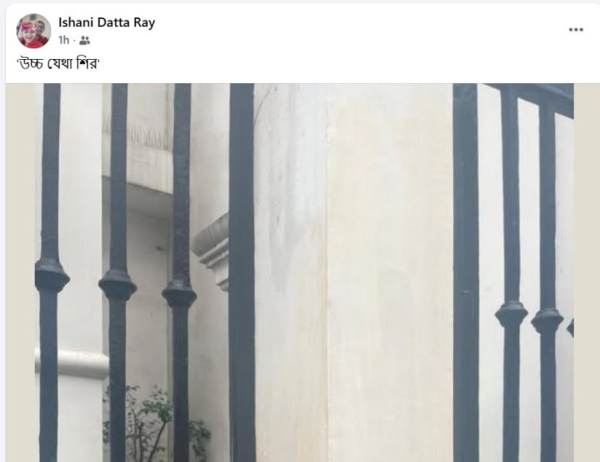
Its editor Ishani Datta Ray Hours shared an image after the protest of the repainted wall of the office with the caption, “ucch jetha shir,” translating to “Where the head is held high,” taken from Rabindranath Tagore’s poem ‘Where The Mind Is Without Fear.’
Anandabazar Patrika is a widely circulated Bengali newspaper first issued in 1922 as a four-page evening paper and was known for writing against British colonial rule.