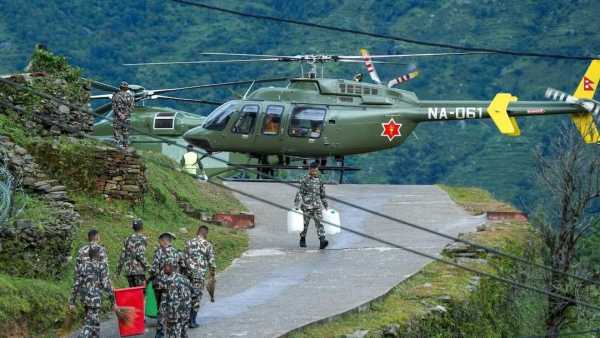
A saree turned into an improvised rescue rope for a group of 21 pilgrims from Tamil Nadu caught in Nepal's devastating flash floods. The pilgrims were travelling through Nepal on August 26 as part of the Kailash Mansarovar pilgrimage when a massive flash flood hit the Rasuwa region near the Nepal-Tibet border. Their bus was caught amid surging water, mud and falling rocks.
The disaster has become one of Nepal's deadliest recent floods, with more than 900 people reportedly killed and 4,247 still missing, according to the BBC.
Against the backdrop of the devastation, the survival of the 21 pilgrims was marked by quick thinking, luck and remarkable courage.
The pilgrims were part of a 57-member group travelling in three buses operated by a Kumbakonam-based travel agency. Most of those who survived were above 50 years old.
The group had left Syabrubesi at around 8 am and was heading towards the Chinese immigration point. Their bus was the second in the convoy and had briefly stopped after getting stuck in mud.
'Floodwater Came Rushing In As Though A Dam Had Opened'
Survivor Navu Kabirdas told The Indian Express that the group suddenly heard a loud and frightening noise.
“Suddenly, we heard a loud noise like a bomb explosion, and stones began falling on the van,” Kabirdas said. “Then the floodwater came rushing in as though a dam had been opened.”
Another survivor, Sathya, compared the scene to something she had previously seen only in movies. “Rocks and mud were rolling towards us like a tsunami wave, rising to a height of about 70 to 80 feet,” she told The Indian Express. “We had seen things like this only in English films.”
The Nepalese driver realised the seriousness of the situation and immediately instructed the passengers to get out of the bus and move towards higher ground.
The pilgrims escaped through the driver's side and attempted to climb the slope. However, the route was covered in mud and the embankment they needed to scale was roughly as high as a one-storey building.
“There was no path to climb the mountain. If we climbed four feet, we would slide down five feet,” Sathya said.
Saree Used As Makeshift Rope
While the men in the group managed to reach higher ground, several women struggled to climb the slippery slope. Each attempt to move upwards ended with them sliding back.
That was when Poongodi, who had already made it to the top, came up with a solution. She changed into a sweater and removed her saree before lowering the long fabric towards the pilgrims stranded below.
The survivors used the saree along with a cable at the site to pull themselves to safety. Vijaya Bhuvaneswari, another survivor, recalled how they held on to both the saree and the cable while climbing.
“Finally, one woman alone was unable to climb. We told her to tie the saree around her waist, and the people in our group held on to it and lifted her straight up,” she said. A similar account was reported by Hindustan Times, citing PTI, involving Mayavaram residents Ratnakumar and his wife Poonguzhali.
After reaching safety, Ratnakumar reportedly went back towards the slope after noticing four or five women struggling to climb. Using a saree secured as a makeshift rope, he helped pull the stranded women up one by one, while Poonguzhali assisted from above.
Sivaranjani, who recounted the incident, said Ratnakumar returned despite the danger because others needed help.
'God Saved Us By Five Feet'
For another survivor, the difference between escaping the flood and being swept away came down to just a few feet.
Sivaranjani told PTI that their vehicle had become trapped near the Indian Embassy checkpoint. Since the vehicle was positioned at a bend, the floodwater flowed around it instead of directly hitting the bus.
“If our vehicle had gone five feet this way or five feet that way, we would definitely have been swept away. I have to say that God saved us by five feet,” she said.
She explained that the vehicle's position near the turn caused the floodwater to move in another direction, leaving a gap through which the group managed to escape.
The pilgrims eventually reached an Armed Police Force camp, where they were given water and biscuits. Once mobile connectivity returned, they managed to send a photograph to Tamil Nadu, confirming to their families that they were alive.
-
Toxic Box Office Day 6: Yash Film Crashes 68% — Can It Still Collect Rs 500 Crore?

-
PNB AI Summit 2026: How AI, GenAI, Quantum Could Reshape India's Banking Sector

-
Vijay Backs Rahul Gandhi As INDIA Bloc's PM Face, Says Congress Leader

-
Who Was Neeraj MP? Kerala Muay Thai Fighter Tragically Passes Away In Alleged Suicide

-
Mumbai: World No 1 Padel Duo Arturo Coello And Agustín Tapia Make India Debut Before Thousands Of Fans