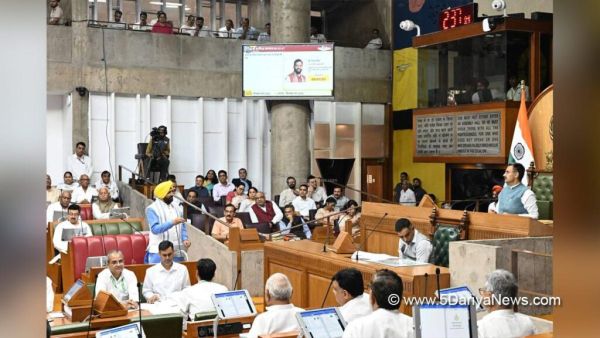
Haryana Chief Minister Nayab Singh Saini said that through the Haryana Kaushal Rozgar Nigam, the State Government has ended the role of contractors and middlemen in the decades-old contractual employment system and replaced a system marked by middlemen, commissions, exploitation and lack of transparency with a transparent, accountable and employee-centric framework.
Under the earlier contractor-based arrangement, young employees were subjected to large-scale exploitation. Employees often did not receive their full wages, with contractors making deductions. In some cases, employees were paid for only 11 months instead of 12 on the pretext of renewal of their engagement.
The government has eliminated the role of contractors and middlemen and linked the system with rules, merit and social security, he said.The Chief Minister was speaking in the Vidhan Sabha during a discussion on a Calling Attention Motion concerning the Haryana Kaushal Rozgar Nigam.
The Chief Minister said that while the Opposition is viewing the issue through the prism of political charges and counter-charges, the government looks at it from the perspective of the interests of the State’s youth, employees and their families. He said the Opposition is indulging in politics by presenting only incomplete pages of history.
Once the complete record is placed before the House, it will become clear that the temporary and contractual employment system was not introduced by the present government. What the government has done is to eliminate contractors, middlemen, commissions, exploitation and opacity from the system and make it transparent, accountable and employee-centric.
*Opposition Leads in Spreading Falsehoods and Misleading People; Their Lies Travel Faster than the Wind– Chief Minister*
The Chief Minister said the Opposition is ahead of everyone when it comes to speaking falsehoods and creating confusion. They spread lies faster than the wind. The people of the State are watching everything and clearly understand the difference between truth and falsehood.
He said that whenever elections approached, Congress would begin running the government based on electoral calculations. Votes were calculated with an eye on the elections, and the government as well as the system was run accordingly, said Sh. Nayab Singh Saini.
The Chief Minister further said that what concerned him is that Congress MLAs are today expressing concern over a system that had collapsed and become mired in a quagmire during their own rule. The present government, he said, has worked to set that system right.
He further said that what also concerned him is that they went and sat outside the very office where the government had worked to restore the system.The Chief Minister urged the Opposition to hear his reply in full, saying that he would respond to all the questions raised and concerns expressed by them.
He said perhaps Sh. Bharat Bhushan Batra could explain why young people were betrayed at that time and why their problems were not resolved during the Congress regime. During their tenure, young people had faced large-scale exploitation under the contractor system, said Sh. Nayab Singh Saini.
*As Early as 1967, Haryana Had 11,397 Contingency-Paid, Work-Charged and Contractual Employees*
The Chief Minister said that the initial figures from 1967, soon after the formation of Haryana, present a clear picture of how the State’s employment structure evolved over the decades. As of March 31, 1967, the Haryana Government had a total of 97,385 employees, including 11,397 in the combined category of contingency-paid, work-charged and contractual employees.
Thus, in Haryana’s initial administrative structure, nearly 88 per cent of employees belonged to the main Class-I to Class-IV categories, while around 12 per cent were in the combined category of contingency-paid, work-charged and contractual employees.
He said that by 2013, the number of Class-I to Class-IV employees had increased to 2,55,319, while the combined category of contingency-paid, work-charged and contractual employees had risen to 84,642. Compared to 1967, this represented an increase of 73,245 employees in the combined category, taking its strength to nearly 7.4 times the 1967 level.
The Chief Minister said that the number of contractual employees crossing one lakh by 2014 itself demonstrates that a sizeable temporary employment structure had developed over the decades alongside the regular administrative establishment.
The purpose of placing these historical figures before the House, he said, is to make it clear that temporary employment did not originate with the formation of the Haryana Kaushal Rozgar Nigam. Such an arrangement had existed for decades and continued to expand under successive governments.
He said the Opposition is trying to create an impression that contractual employment began with the Haryana Kaushal Rozgar Nigam, whereas official records available since 1967 completely contradict this propaganda.
*Nearly 71,000 Employees Added to Combined Category during Nine Years of Congress Rule*
The Chief Minister said that over the 38 years between 1967 and 2005, the number of employees in the combined category of contingency-paid, work-charged and contractual employees increased from 11,397 to 38,949. However, during the next nine years of the Congress government, from 2005 to 2014, this number rose from 38,949 to nearly 1.10 lakh.
Thus, while this category increased by 27,552 employees over 38 years, nearly 71,000 employees were added during just nine years of Congress rule. He said those who today portray the contractual employment system as the biggest problem should remember that the pace of its expansion increased manifold during their own tenure.
The Chief Minister questioned the Opposition as to why nearly 71,000 employees were added during just nine years of Congress rule. Why were these employees left at the mercy of contractors? Why was no systematic policy framed at that time for EPF, ESI, equal remuneration, maternity leave, compassionate deployment and transfers?
The Chief Minister further questioned whether contractual employees existed in the State for 47 years before the present government or not. Official records clearly show that such an arrangement had existed since the formation of Haryana itself.
He said the real question is whether an employee should remain dependent on the whims of a contractor or be provided a transparent, technology-driven and accountable system. The government has removed contractors and middlemen from this decades-old arrangement and, through the Haryana Kaushal Rozgar Nigam, linked it with rules, merit and social security.
*Employees Earlier Depended on Contractors Even for Jobs, Wages and Provident Fund*
The Chief Minister said that the earlier system of deploying employees through contractors suffered from a serious lack of transparency. Media reports that surfaced in 2013 referred to allegations of young people in Haryana having to pay bribes to secure employment through contractors.
During the same period, in a case relating to DHBVN, a contractor deducted EPF contributions from employees’ wages but failed to deposit the amount into their accounts. Complaints had also surfaced regarding contractors failing to deposit employees’ provident fund contributions, not providing salary slips and, in some cases, not even issuing PF numbers.
He questioned how a system could be described as employee-friendly when a person had to approach a contractor for a job, depend upon the contractor’s discretion for wages and run after the contractor even for his or her own provident fund.
The Chief Minister said the government transformed this old arrangement by introducing a technology-enabled and transparent system through the Haryana Kaushal Rozgar Nigam, under which due weightage is given to the merit and qualifications of the youth.Young people can now register themselves directly on the Nigam’s portal and are deployed according to prescribed eligibility and merit.
For this purpose, the ‘Deployment of Contractual Persons Policy-2022’ has been framed. He said the government’s objective was not merely to remove contractors, but to eliminate the entire disorderly arrangement in which an intermediary stood between a young person’s merit and employment. Today, no young person needs to approach a contractor, look for a middleman or seek anyone’s recommendation for deployment.
*Equal and Transparent Remuneration Ensured for Work in the Same Category*
The Chief Minister said that among the biggest shortcomings of the earlier contractor-based system were the absence of uniformity in wages and delays in payment. Employees deployed through different departments and contractors were not always paid according to the prescribed DC rates.
While wages were delayed at some places, complaints of payments below the prescribed rates were received elsewhere. At times, two employees performing identical work received different wages merely because they had been engaged through different contractors.
He said that in 2005, the prescribed rate for an unskilled worker was around Rs. 2,343 per month, which increased to about Rs. 5,640 per month by July 2014. Although the rates increased, different DC rates at different points of time, periodic revisions and payments routed through different contractors meant that uniformity and transparency in remuneration remained a major challenge.
The Chief Minister said this problem was addressed with the establishment of the Haryana Kaushal Rozgar Nigam. Following the constitution of the Nigam, uniform wage rates were implemented from January 19, 2022. In place of varying DC rates, a standardised remuneration structure was introduced. This helped ensure equal and transparent remuneration for work in the same category, reduce wage disparities and streamline wage determination and payment.
He said that with effect from April 9, 2026, as per the rates implemented by the Haryana Labour Department, the monthly labour rate is Rs. 15,220.71 for an unskilled worker, Rs. 16,780.74 for a semi-skilled worker and Rs. 18,500.81 for a skilled worker. Compared to the rate of Rs. 5,640 for an unskilled worker in 2014, the present rate is nearly 2.7 times higher.
*1,316 Cases of DDO Shifting Approved*
The Chief Minister said that under the old system, there was no systematic and transparent institutional mechanism for the transfer or DDO shifting of contractual employees. Employees remained entirely dependent on their contractors and their place of deployment.
This made it difficult for the administration to rationalise manpower according to requirements, while employees themselves had no structured facility for a change in place of deployment. He said the Haryana Kaushal Rozgar Nigam has, for the first time, introduced a systematic provision for DDO shifting or transfer of contractual employees.
Where there is an administrative requirement, an employee can now be transferred on the recommendation of the concerned Head of Department and in accordance with prescribed guidelines. So far, 1,316 cases of DDO shifting have been approved.
*306 Eligible Candidates Provided Employment on Compassionate Grounds*
The Chief Minister said the government has also recognised the distress faced by the family of a contractual employee in the event of his or her death while in service. Under the earlier contractor-based system, there was no structured compassionate deployment policy under which an eligible member of the deceased employee’s family could be provided employment support.
He said that under Clause 12 of the ‘Deployment of Contractual Persons Policy-2022’, a provision has been made for compassionate deployment. So far, 306 eligible candidates have been provided employment on compassionate grounds. In addition, the employee’s family has been given the option to choose between compassionate assistance of Rs. 3 lakh and compassionate deployment.
*Provision for Maternity and Other Leave for Women Contractual Employees*
The Chief Minister said important measures have also been taken to safeguard the interests of women employees. Under the earlier contractor-based system, there was no uniform, clear and institutional framework governing maternity leave and other leave benefits for women contractual employees. They had to depend upon contractors even for availing their statutory benefits.
He said that following the establishment of the Haryana Kaushal Rozgar Nigam, maternity leave has been ensured for eligible women contractual employees. In addition, there is provision for 10 days of medical leave and 10 days of casual leave in a calendar year. Women employees are now being provided the benefit of 22 days of casual leave.
*EPF, ESI and Labour Welfare Fund Brought under Systematic Monitoring Mechanism*
The Chief Minister said a major transformation has also been brought about in the area of statutory contributions. Under the earlier arrangement, there was no effective and uniform monitoring mechanism to ensure timely and accurate compliance in respect of EPF, ESI and other statutory contributions.
He said the Haryana Kaushal Rozgar Nigam has brought EPF, ESI and the Labour Welfare Fund under a systematic monitoring framework. Under the present system, for EPF, up to the applicable statutory wage ceiling of Rs. 15,000 per month, the employee’s contribution is 12 per cent of wages, while the employer’s contribution is 13 per cent.Similarly, under ESI, for employees drawing wages up to Rs. 21,000 per month, the employee’s contribution has been fixed at 0.75 per cent of earned wages and the employer’s contribution at 3.25 per cent.
The Chief Minister said a notification issued on May 8, 2026, fixed the employee’s contribution towards the Labour Welfare Fund at 0.2 per cent of earned wages, subject to a maximum of Rs. 35, while the employer’s contribution has been fixed at twice the employee’s contribution. In this manner, contractual employment has not been confined merely to wages but has been integrated with a social security framework
*Around Rs. 2,100 Crore Deposited towards EPF, ESI and Labour Welfare Fund*
The Chief Minister said that during the financial year 2022-23, the Nigam deposited Rs. 288.46 crore towards EPF, Rs. 47.02 crore towards ESI and Rs. 4.30 crore towards the Labour Welfare Fund. Similarly, during the financial year 2023-24, Rs. 453.16 crore was deposited towards EPF, Rs. 63.16 crore towards ESI and Rs. 11.23 crore towards the Labour Welfare Fund.
During the financial year 2024-25, Rs. 487.88 crore was deposited towards EPF, Rs. 59.82 crore towards ESI and Rs. 12.07 crore towards the Labour Welfare Fund. During the financial year 2025-26, Rs. 497.13 crore was deposited towards EPF, Rs. 46.16 crore towards ESI and Rs. 12.81 crore towards the Labour Welfare Fund.
In the current financial year 2026-27, up to June 30, 2026, Rs. 129.94 crore has been deposited towards EPF and Rs. 10.17 crore towards ESI.The Chief Minister said that, taken together, around Rs. 2,100 crore has so far been deposited towards EPF, ESI and the Labour Welfare Fund through the Haryana Kaushal Rozgar Nigam.
He said there would not be a single employee under the present government whose EPF had been deducted but not deposited into his or her account. He asked the Opposition to bring the record and show how many employees had their EPF deducted during their tenure.
*Government Saves Around Rs. 78.56 Crore Compared to Contractor Commission*
The Chief Minister said that under the old arrangement, contractors generally charged a commission of 2 per cent on the total bill amount. With a large number of employees being deployed, even this seemingly small percentage translated into a substantial financial burden on the government.
He said the Haryana Kaushal Rozgar Nigam charges only a 0.5 per cent Nigam fee. This fee is charged to meet the operational expenses of the Nigam, as the government does not provide it with a separate budget. He said that since the establishment of the Nigam, Rs. 81.44 crore has been received from the concerned institutions as Nigam fee.
Had a 2 per cent commission been paid under the old contractor-based system on the same billing base, approximately Rs. 160 crore would have been payable as contractor commission. Thus, the government has achieved a financial saving of approximately Rs. 78.56 crore.
*Health Security through ESIC and CHIRAYU Scheme for Contractual Employees*
The Chief Minister said a robust arrangement has also been put in place to provide health security to contractual employees. Under the old contractor-based system, medical benefits depended upon whether the concerned contractor complied with statutory obligations, including ESI. Whenever a contractor failed to comply, employees and their families faced difficulty in availing medical facilities.
He said that under the present system, contractual employees drawing monthly wages up to Rs. 21,000 are provided medical and healthcare facilities through ESIC. Contractual employees drawing wages above this limit are also being provided health security through the CHIRAYU scheme.