Wang and Deng were among four recipients of the 2026 Fields Medal, regarded as the world’s highest honor in mathematics, announced on July 23. The prize, awarded every four years by the International Mathematical Union to outstanding mathematicians under 40, also went to Canadian Jacob Tsimerman and American John Pardon, CNN reported.
China became only the fifth country, after the U.S., France, the U.K. and Russia, to produce two Fields Medal winners in the same year. It was also the first time that two recipients in one edition had both completed their schooling and undergraduate education in mainland China.
|
The four recipients of the 2026 Fields Medal, including Chinese mathematicians Yu Deng (far left) and Hong Wang (far right). Photo from Xiaohongshu |
Wang, 35, became only the third woman to win the Fields Medal, recognized for her groundbreaking contributions to geometry and mathematical physics.
Born in Guilin, Guangxi, in 1991, Wang was raised by parents who both taught at middle schools. She has described her childhood as relaxed and free of intense academic pressure. Her spare time was spent reading books such as Greek mythology, Harry Potter and The Lord of the Rings, playing table tennis and badminton, and taking evening walks with her family, according to Quanta.
Her fascination with mathematics began at around age five or six, when she came across an elementary school math textbook. A geometry puzzle caught her attention, and the satisfaction of solving it helped ignite a lasting passion for the subject.
 |
|
Chinese mathematician Hong Wang. Photo from Xiaohongshu |
Her interest in mathematics deepened as she grew older. Wang skipped two grades and eventually set her sights on studying mathematics at Peking University. After narrowly missing admission to its mathematics program and initially enrolling in earth sciences, she later worked her way into the mathematics department.
Following her undergraduate studies, Wang continued her education at École Polytechnique and Paris-Sud University in France before completing a PhD at the Massachusetts Institute of Technology in 2019. She is now a professor at New York University’s Courant Institute of Mathematical Sciences and the Institut des Hautes Études Scientifiques in France, according to the South China Morning Post.
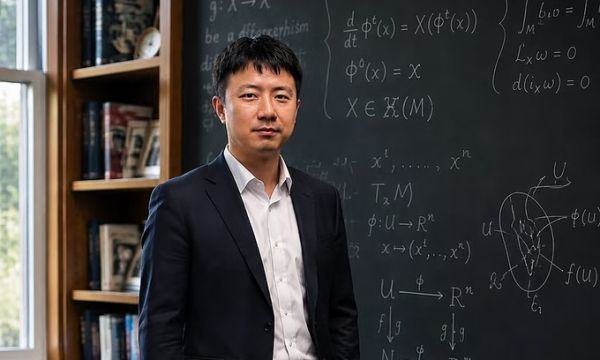
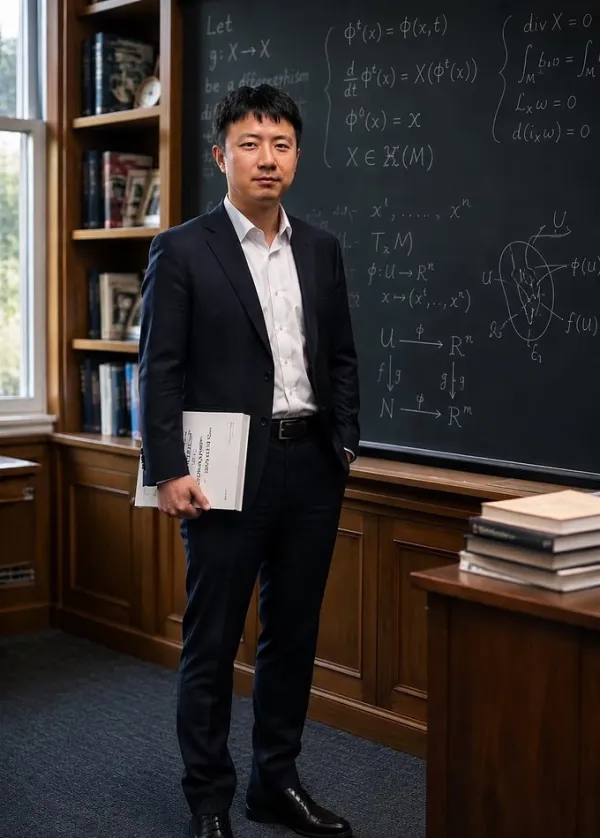
Deng, 37, received the Fields Medal for breakthroughs in partial differential equations. He grew up in Shenzhen with a gastroenterologist mother and a software engineer father. Quiet and inquisitive, Deng loved reading and often worked his way through every book available at home.
During family walks, his father would give him mathematical puzzles to solve. At just seven, Deng solved a geometry problem using mathematical induction, years before he formally learned the method in school.
 |
|
Chinese mathematician Yu Deng. Photo from Xiaohongshu |
His parents later introduced him to Go, the ancient Chinese strategy board game, partly in hopes of steering him away from spending so much time reading. Deng quickly became highly skilled at the game, drawn to the same patience and problem-solving it shared with mathematics.
After narrowly failing to qualify as a professional Go player, he decided to concentrate on mathematics instead. “Since I lost, I decided to move my focus to math,” he later recalled.
As a first-year student at Shenzhen Senior High School, Deng won first prize at the 2006 Chinese Mathematical Olympiad. Later that year, at age 16, he represented China at the International Mathematical Olympiad and won a gold medal, according to 36Kr.
Exempted from China’s national university entrance examination, Deng enrolled at Peking University in 2007, the same year as Wang. He later transferred to the Massachusetts Institute of Technology, graduating with a bachelor’s degree in mathematics in 2011, before earning his PhD from Princeton University in 2015.
Deng is now a professor at the University of Chicago.
-
Make-up does not sit on oily face? Simple home remedies will make the skin oil-free before the puja

-
Nauheed Cyrusi Tries Viral Ice Cream Hack, Says It Tastes Just Like Salted Caramel

-
What do you not recommend to make for breakfast every day? Then make soft-textured bun dosa in 10 minutes, instant breakfast

-
Snapchat connection in Ankit Balyan murder case! Gangsters are creating digital networks through these 5 apps

-
14 fours-sixes… Vaibhav Suryavanshi's chaos, Sachin Tendulkar's record narrowly saved