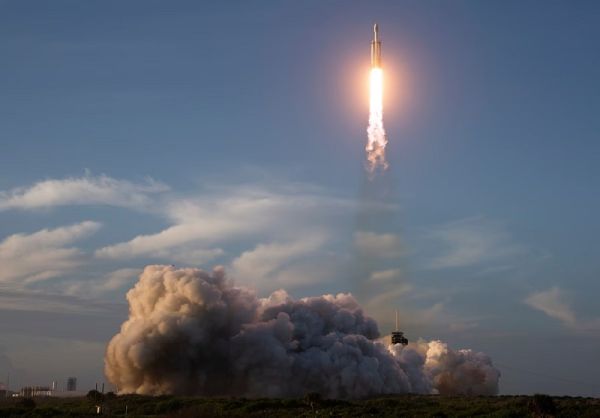
Washington. NASA's newest and most advanced space telescope left for space on Sunday. Its purpose is to discover planets around other stars, study mysterious 'Dark Energy' and conduct the most comprehensive survey of the universe to date.
Nikki Fox, science mission director at the National Aeronautics and Space Administration (NASA), said that this telescope will be able to discover thousands of supernovae, tens of thousands of planets, billions of galaxies and trillions of stars. Due to its large field of view, it will be able to do things that we could never do before.
SpaceX launched the $4.3 billion 'Roman Space Telescope' from the Kennedy Space Center in the morning using a highly powerful Falcon Heavy rocket. This telescope left for the place 16 lakh kilometers away where another major space telescope of NASA, 'James Webb Space Telescope' is already present. This bus-sized telescope is named after the late Nancy Grace Roman, NASA's first chief astronomer.
-
Read this also 70 percent work of world's largest telescope completed, ELT will search for signs of life on planets like Earth
It will take more than three months to reach its destination. Once there, it will present the most comprehensive picture ever of the hidden parts of space and explore the unknown secrets of the universe. The field of view of the 'Roman Space Telescope' is more than 100 times larger than that of NASA's 'Hubble Space Telescope'. Hubble has been sending back stunning images of space while in orbit for 36 years. At the same time, the James Webb telescope had joined this campaign a few years ago and started studying very old celestial bodies to the beginning of the universe.
These three space telescopes, together with the European Space Agency's Euclid spacecraft and the Vera C. Rubin Observatory in Chile, will help uncover many of the biggest mysteries of the universe. Julie McEnery, senior scientist on the Roman project, said the vast reach of Roman will help us find strange, rare and unusual things. It will change our definition of finding a needle in a haystack.
Scientists hope the Roman telescope will also provide new information about 'dark matter' and 'dark energy' that make up most of the universe. Both of these still remain a mystery to scientists. The catalog of galaxies prepared by Roman will help the scientist to understand how fast the universe is expanding due to these invisible forces.
Roman's biggest feature will be his speed. According to McEnery, it would take Hubble about a century to complete the number of observations of the Milky Way that Roman will make in one month. He said that Roman will be able to make the deepest study ever of the part present in the center of our galaxy.
A state-of-the-art infrared camera has been installed in this telescope, which has the same sensitivity as Hubble, but it will work about 1000 times faster than Hubble. Apart from this, it also has a device which can block the starlight. This may enable Roman to take direct images of extremely faint planets orbiting a star.
This telescope has also been designed for future refueling. If a robotic fuel tanker becomes available in the coming decade, it could extend Roman's life.
-
Why Champions League clubs should push to finish as high as possible in the league phase

-
West Bengal announces new Durga Puja Rules 2026; bans liquor on Maha Ashtami day and no DJ music during idol immersion

-
3 Zodiac Signs Attract Luck & Good Fortune When Venus Aligns With Lilith On September 9, 2026

-
World’s second most visited city suspends 2 travel agencies over forced shopping

-
Free YouTube Premium will be available in Jio's ₹ 200 plan, know complete information about data and validity.