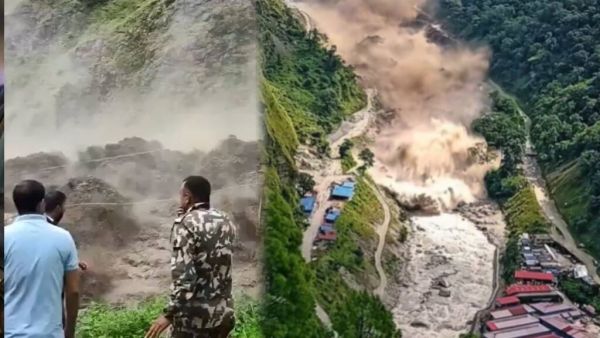
The difficulties are not over yet after the devastating floods that occurred in Nepal on 26th August. After the water level of Bhotekoshi river increased on Sunday, the authorities once again issued a flood warning. People of flood affected districts have been asked to remain on high alert. Flood alerts were also sent to people’s mobile phones in the morning, which increased fear and anxiety in areas already facing devastation. Meanwhile, relief and rescue teams are busy dealing with the situation after the flood.
At least 800 people have died so far in this flood disaster in Nepal and Tibet. According to Nepal’s disaster agency, the death toll in the country has reached 788, while 2,502 people are still missing. In the part bordering China, information has been given about the death of 16 people and 546 people missing. At the same time, the work of clearing the major highway connecting Kathmandu to one of the areas most affected by floods is also going on. Let us know how the situation is in Nepal after the flood…
Why has the danger of flood increased again in Nepal?
After the water level of Bhotekoshi river rose on Sunday, Nepalese authorities issued a fresh flood warning. People living in flood affected districts were asked to remain alert and on high alert. Flood warning messages were sent to people’s mobile phones early in the morning. The continuous warnings have increased the concern of those people who have already gone through the devastation of the severe flood a few days ago.
According to Dharam Raj Upreti, Chief Executive Officer of Nepal’s National Disaster Risk Reduction and Management Authority, the latest warning was issued after receiving information from Chinese officials. Information was given from China about increasing upward flow of water.
China’s official news agency Xinhua quoted the country’s Water Resources Ministry as saying that after Wednesday’s flood, a new lake-like reservoir built in the mountains has been largely emptied. However, the danger has not completely ended.
There is still water in the pit located 5.6 kilometers above
According to Xinhua, a crater about 5.6 kilometers (3.5 miles) above the flood-affected area is still posing a threat. It is estimated that about 14 lakh cubic meters i.e. 37 crore gallons of water is present in it. Officials have expressed the need to keep a constant watch on this place.
Are people returning?
In Dhading, one of the most affected areas of Nepal, people returned on Sunday to see the condition of their homes. The walls of many houses have been washed away in the flood waters. The balconies and window frames are covered with silt and debris. People are searching for their belongings in the debris and whatever they find, they are washing them.
Sharmila Tamang, a resident of Dhading, was also trying to save belongings from her house. “Everything is gone. Nothing is left. Not even our house,” he told The Associated Press.
Inspection of damaged power plant begins
Inspection of a big power plant badly damaged by the flood was started on Sunday. Employees began assessing the damage caused to the plant. This power plant provides electricity to more than 20 thousand people in four districts.
Strong flow of river in Galchi, people reached heights
After the strong flow of river water in Galchi, the local people moved towards a higher place on a nearby bridge. Large stones that were washed away from the mountains during the last flood are still visible. People present on the suspension bridge were being warned by blowing whistles to stay away from there.
The devastation of flood is clearly visible in the area. Thick brown-grey silt and debris is deposited all over the villages. Amidst this debris, houses, vehicles and even tractors used in farming are visible. Due to the landslide, some parts of the terraced paddy farming land built on the banks of the river have also been submerged in the river.
People troubled by repeated warnings
Constant alerts have become a new problem for people living in flood affected areas. People have to be prepared to leave their belongings again and again and go to high altitude areas. Local resident Govind Shrestha told AP that sometimes they are told that a flood is coming and then they have to flee to higher ground again, even at night. He told that it is also raining.
Shrestha said that he was tired of taking his elderly parents to a safe place. He has a 72 year old father and 70 year old mother. He said that he has to carry his parents and he is completely tired. According to him, this trend continues for those who survived this disaster.
Broken bridges cut off contact with villages
Along with large concrete bridges, small suspension bridges have also been destroyed in the floods. Due to this many communities have become cut off from each other. 47-year-old Sattan Singh Tamang was working near a bridge when the flood occurred on Wednesday. He said that those who are on that side are stuck there and those who are on this side are stuck here. According to him, the situation ahead is going to be very difficult.
Hundreds of foreign nationals also missing
Hundreds of foreign citizens from more than a dozen countries are also among the people missing after the flood. These include people who came to this area for work, were traveling to the mountains or had come on pilgrimage to a sacred mountain.
Chinese government media reported on Sunday that 261 foreign nationals are missing in Tibet. These include more than 100 Nepali citizens. Apart from this, people from many other countries have also been reported missing.
Why did the flash flood occur?
The devastating flash flood on Wednesday started after the collapse of a high altitude glacier in the Himalayan region. Scientists who studied satellite images said that a part of the rocky base beneath the glacier collapsed and took a part of the glacier down with it.
This incident of falling rocks was so powerful that it was recorded as an earthquake of 5.2 magnitude. After this, the rocks and melted water suddenly increased the flow of rivers in the valleys below. The strong current of water and rocks came down towards Tibet and Nepal and washed away buildings, bridges and land in its path.
-
GTA 6 previews achieve 31.1 million views on Netflix

-
Does wearing a hat continuously cause hair fall? Know what to do if it is so…

-
Your Love Horoscope Is Here For Thursday, September 3, 2026

-
Tamarind isn’t just a cooking ingredient: 5 ways it can help make kitchen cleaning easier |

-
Tamarind isn’t just a cooking ingredient: 5 ways it can help make kitchen cleaning easier |