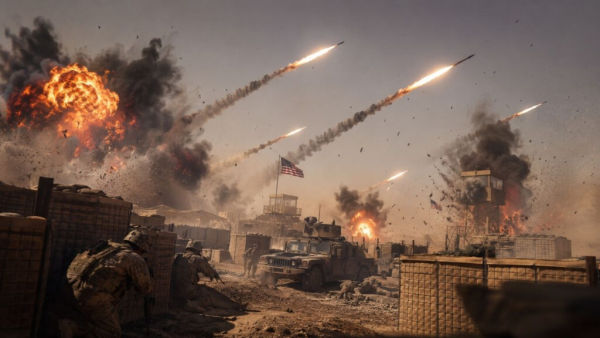
New Delhi: The military standoff between America and Iran in the strategically sensitive Strait of Hormuz has taken a severe form. The US Army on Sunday carried out a precise airstrike targeting two missile launchers on Iran’s Larak Island. Washington claims that the Iranian Revolutionary Guard Corps (IRGC) was planning to deploy mines in the main sea route through these launchers.
A few hours after this US military action, Iran launched a sharp counterattack. The IRGC issued an official statement confirming the firing of several ballistic missiles and drones at Jordan’s King Hussein and US military bases in Al-Azraq. According to Iranian media, this massive attack was carried out in retaliation for the American attack on Larak Island which had resulted in casualties among many of its military personnel and civilians.
America’s ‘zero tolerance’ policy and lark strike
According to US Central Command (CENTCOM) officials, this action was taken to ensure the safety of international ships in the Strait of Hormuz. America had recently completed the operation to remove sea mines from this route. President Donald Trump had warned that any ships or launchers attempting to lay new mines in the strait would be immediately destroyed.
What do US officials say
This is the first major direct attack by US forces near the Iranian mainland since the end of July. US officials say they are monitoring the entire area and are committed to maintaining unimpeded movement of commercial ships.
Blasts in Jordan and Iran’s warning On the other hand, Iran’s semi-official news agency Tasnim and state broadcaster IRIB reported that the missile attacks on the US airbase in Jordan have caused heavy damage to technical and maintenance structures. The IRGC spokesperson warned that America will have to pay the price for its misadventure on Larak Island on both the military and economic fronts. However, initial US media reports claim that most of the Iranian missiles were destroyed in the air by air defense systems.
This regional conflict, which has entered its seventh month, has increased uncertainty in the global energy market and led to a surge in Brent crude oil prices. The latest military escalation in Hormuz has deepened fears of a wider war in the Gulf region.
-
Arsenal’s major transfer setback leaves Mikel Arteta with only one route

-
Southampton keen to reveal Tonda Eckert’s attacking side in their Championship promotion push

-
Method of making fertilizer from banana peel

-
My wild weekend at a 24-hour sex ‘camp’

-
Is the egg diet a safe way to lose weight quickly?