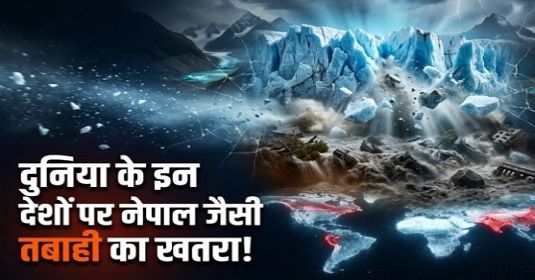
Nepal flood: The devastating flood on the Nepal-Tibet border has caused huge devastation. Hundreds of people are reported dead in this natural disaster, while more than 2400 people are still reported missing. Scientists' initial assessment is that this horrific disaster may have been triggered by the collapse of the glacier in the Langtang-Lirung mountain region. However, it may take several months for experts to understand the reasons for the incident and its entire sequence of events.
Scientists have also warned that this incident in Nepal cannot be considered an isolated or unusual incident. Due to climate change, glaciers and permafrost are melting rapidly in many mountainous regions of the world, which may increase the risk of such disasters in the future.
Warming mountains are increasing the danger-
According to Dr. Jonathan Carwick, a glacial flood expert at the University of Leeds, the temperature of the mountains is increasing due to climate change. Due to this, permafrost and glaciers are melting rapidly. As a result, mountain slopes may become unstable and incidents of rock slides, landslides and glacier breakage may increase.
According to researchers' estimates, about 15 million people around the world live in areas where the risk of glacial floods exists. Among these, High Mountain Asia i.e. Himalaya, Karakoram, Hindukush and surrounding mountain ranges are included in the most sensitive areas.
How did the devastating flood occur in Nepal?
According to initial analysis by experts, a massive landslide may have occurred shortly before the floods in Nepal. After this a part of the rocks and glacier came down rapidly and mixed with the debris.
Due to this debris, Lhende Khola river was obstructed for some time and a temporary lake was formed there. Later, due to the breaking of the natural barrier of the lake, the water flowed downwards at a very high speed and took the form of a devastating flood.
However, scientists are currently not sure whether it is a Glacial Lake Outburst Flood (GLOF). Satellite images do not reveal clear evidence of the formation of any large lake in this area before the landslide.
Threat to many countries including India and Pakistan-
According to scientists, more than half of the approximately 15 million people at potential risk of GLOF live in India, Pakistan, Peru and China. Among these, High Mountain Asia is among the areas most at risk.
According to research, about 62 percent of the world's GLOF-risk population lives in High Mountain Asia. Of these, about 30 lakh people are in India and about 20 lakh are in Pakistan.
How can the lake break if the glacier melts?
GLOF can happen when a large lake is formed due to the melting of a glacier and its water accumulates behind a weak natural dam. If any part of the glacier falls into the lake or the water level rises too much, the natural dam may break.
In such a situation, extremely powerful flows of water, snow and debris can rush down the mountain and cause huge damage to settlements and infrastructure along the way.
Danger increasing in Andes and North America too-
Scientists have also expressed concern about the Andes mountain region. According to the research, the number of glacial lakes in the Andes has increased by about 93 percent since 1990, while in High Mountain Asia this increase was about 37 percent.
Peru is included among the most at-risk countries in the world. Peru's Santa River Basin and Bolivia's Beni River Basin are among the world's high-risk river basins.
Apart from this, there is also a risk of glacial floods in North America, especially the Pacific Northwest region and the Alps mountain region along with Canada.
It is difficult to say when and where the next big disaster will occur.
Experts say the threat is not limited to rural areas only. Many large cities also depend on mountain glaciers for their water needs.
The stability of the mountains is being affected by the shrinking of glaciers and melting of permafrost due to climate change. This may increase the risk of incidents like landslides, rock falls and avalanches.
The biggest concern is that scientists cannot yet say with certainty where and when the next major glacial flood will occur. It is certain that amidst rising temperatures and rapidly changing mountain environment, the risk of incidents like Nepal may become more serious in the future.
-
Anxiety Relief: How Sujok Therapy Can Help Calm The Mind

-
'Get Him In Test Team': Netizens Demand Team India Call-Up For Vaibhav Sooryavanshi After Stunning 92-Run Knock In Duleep Trophy

-
iPhone 18 Pro, iPhone 18 Pro Max Pre-Orders May Be Pushed To September 12: All You Need To Know

-
'A Small Gift Of Love And Hope': Ex-Venezuelan President Nicolas Maduro Shares Photos From New York Prison

-
Who Is Runa Khan? Bangladesh’s ‘Friendship’ NGO Founder Wins 2026 Ramon Magsaysay Award