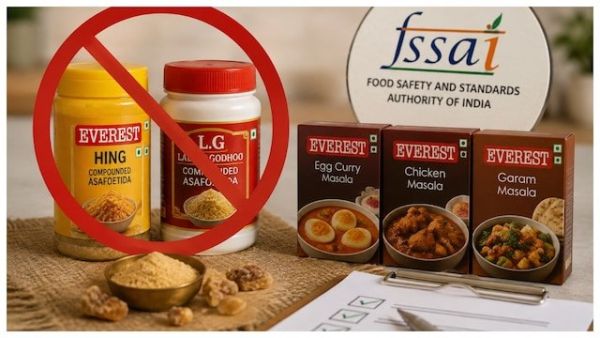
The Food Safety and Standards Authority of India (FSSAI) has taken a major step regarding the purity and quality of spices sold across the country. During a nationwide intensive inspection campaign conducted by the food safety regulator, serious violations of quality standards were found in the samples of compounded asafoetida of the famous spice manufacturing company Everest, after which the sale and distribution of the concerned batch has been banned with immediate effect. The regulator has issued strict show cause notices to the companies after samples of spices not only of Everest but also of other renowned brands sold in the market failed. This action has created a stir among retailers, spice industry and common consumers across the country. Lab testing revealed adulteration and disregard for prescribed standards. The samples taken by the food safety officials were microscopically examined in government and NABL accredited laboratories. The report found that the amount of starch, gum and synthetic additives in these asafoetida samples was much higher than the prescribed limits of Indian food safety standards. Additionally, the amount of natural volatile oil and essential elements of asafoetida in the product was found to be below the standards. According to experts, low-grade fillers and chemical fragrances were being used to artificially increase the weight and aroma of the product, which could prove to be extremely harmful to the digestive system and overall health of the consumers. Apart from asafoetida, samples of red chilli, coriander and garam masala also failed. The scope of the regulator's investigation was not limited to asafoetida only. Serious irregularities were also found in samples of other ground spices collected from wholesale and retail markets of various states of the country like Uttar Pradesh, Maharashtra, Gujarat, Delhi and Rajasthan. According to preliminary reports, there is evidence of adulteration of harmful unapproved synthetic colors (such as Sudan dye and bitumen dye) and fine brick powder in several leading brands of red chilli powder. At the same time, bran, weed seeds and excessive amounts of pesticide residues have been recorded in the ground coriander powder. The presence of lead chromate and non-standard starch in garam masala and turmeric powder has exposed food safety. The adverse effects of chemical and adulterated spices on the health of consumers. Adulteration of spices used daily in the kitchen poses a serious threat to human health. Gastroenterologists and nutritionists say that continuous consumption of artificially flavored and chemical-rich asafoetida can cause problems like stomach ulcers, acidity, intestinal inflammation and chronic gastritis. Additionally, the chemical colors and lead-containing compounds used to give the spices their bright colors cause severe damage to the liver, kidneys and nervous system. Accumulation of such chemicals in the body for a long time can also become a major cause of fatal diseases like cancer. FSSAI directs recall of disputed stock from market and legal action FSSAI has issued strict instructions to Food Safety Commissioners of all States and Union Territories to immediately seize the batches declared substandard from supermarkets, grocery stores and bulk warehouses in their respective jurisdictions. The regulator has given a clear order to the companies to ensure immediate recall of all the products of the affected batch from the market. The process of imposing heavy financial penalty and filing legal cases against the guilty companies, packagers and distributors under various sections of the Food Safety and Standards Act, 2006 has been initiated. If found guilty, legal provisions including cancellation of license and sending to jail are being implemented. How to identify genuine and adulterated spices Consumers FSSAI and the Department of Consumer Affairs have appealed to the common citizens to exercise extra caution while purchasing spices from the market. To identify pure asafoetida, dissolve it in some water; Pure asafoetida dissolves in water and forms a completely milky white solution and no sediment or sand particles settle down in it. When asafoetida is burnt on fire, it burns brightly like a candle flame. When purchasing ground spices only check the FSSAI license number, batch number and integrity of the packaging. Avoid loose and unbranded spices and if you suspect any adulteration, lodge a complaint immediately on FSSAI's official 'Food Safety Connect' portal or consumer helpline. Google Keywords (Hindi & English): fssai action on everest hing, everest hing ban news, everest spices controversy, fssai spice quality testing, adulterated spices in india, banned spices brand list, everest asafoetida recall, fake hing identification tips, pesticide in indian spices, red chilli powder adulteration fssai, fssai food safety drive, everest asafoetida ban, FSSAI spice investigation, adulterated asafoetida Identification, action on Everest spices, fake spices food safety action, raid of food safety department, investigation of adulteration in spices.
-
Chelsea in advanced deadline-day talks with AS Roma over £52m swap deal

-
Aston Villa open contract talks with Ian Maatsen after Manchester United approach

-
Aston Villa complete £77m double signing as Harwood-Bellis arrives to replace Konsa

-
Your Zodiac Sign’s Monthly Horoscopes Is Here For September 2026

-
Janmashtami Prasad Recipe: Make creamy laddus without burning gas, offer delicious food to Kanha.