
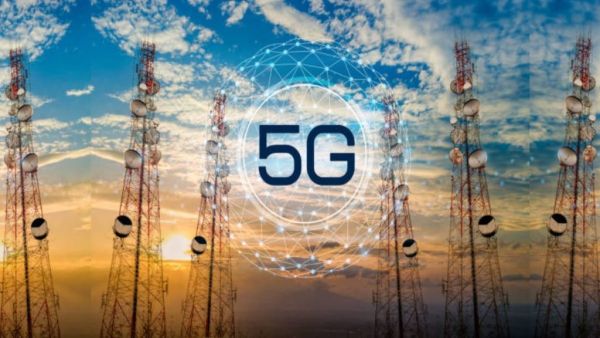
Technology Desk: If the internet speed remains slow despite 5G network being visible in your mobile, then you may see improvement in it in the coming time. In view of the problems to increasing traffic and coverage on 5G network, the government is preparing to increase the electromagnetic field i.e. EMF limit.
According to the report, the revised EMF rules may come into effect from next month. After this, the power density limit fixed for 5G base tower stations in India will be increased. The existing limit of 5 watts per square meter will be increased to 10 watts per square meter.
What is EMF limit?
EMF limits determine the maximum amount of radio frequency energy that devices connected to mobile networks can emit. The government sets rules for mobile towers and network equipment based on this limit.
Under the new arrangement, 5G networks will be allowed to work with higher power density. With this, telecom companies will be able to plan to provide network coverage in more areas than one tower.
More coverage in fewer towers
A major benefit of increasing the EMF limit can be in terms of network coverage. Higher power density can help 5G signals reach greater distances.
This may reduce the need for telecom companies to install more towers in every area. Network expansion costs for companies can also be reduced by extending the network to a larger area through fewer sites.
Pressure on network due to increase in 5G traffic
5G users and data traffic are continuously increasing in India. In such a situation, despite having 5G network in many places, there is a difference in internet speed. In some areas good speed is available, while in some places the network becomes slow.
The new EMF limit may give telecom companies more options in network planning. However, it is not necessary that just increasing the EMF limit will immediately increase the internet speed of every user. Many other factors like spectrum, tower capacity, network traffic and area also affect network speed.
The limit will be double the current limit
According to the report, India previously had a power density limit of 1 watt per square meter, which was increased to 5 watts per square meter last year. Now there are preparations to increase it to 10 watts per square meter.
The limit of 10 watts per square meter is equivalent to the International Commission on Non-Ionizing Radiation Protection (ICNIRP) recommendation. ICNIRP provides international guidelines regarding radio frequency and EMF exposure.
There was a demand from telecom companies for a long time
Telecom companies have long been demanding to bring EMF regulations in India closer to global standards. Companies say the current limits are not practical for the expansion and coverage of 5G networks.
The new limit may help operators like Vodafone Idea expand 5G networks. At the same time, companies like Reliance Jio and Bharti Airtel can also make better use of existing network sites and reduce additional network investment.
The limit will be equal to the standards of about 137 countries
According to the report, the new rule of 10 watts per square meter will be at par with the standards applicable in about 137 countries of the world. These include many countries of the European Union, Britain, Australia, Japan, South Korea and Singapore.
According to the report, the Department of Telecommunications (DoT) was contacted for confirmation regarding the new rules, but no response was received till the time of publishing the report.
-
'Cheating And Still Losing': Al-Ittihad Take A Dig At Cristiano Ronaldo After Al-Nassr Lose Despite 'Spying' Attempt

-
'Tameez Mein Rehna Chahiye': Kailash Kher Reacts To Samay Raina, Sharon Verma's Bihari-Kashmiri Pandit Jokes On India's Got Latent

-
Not CM Thalapathy Vijay, But His Look-Alike! Dance At Udupi’s Vitlapindi Festival Goes Viral

-
‘Completely Baseless’: ISRO Rejects Reports Of Privatisation, Role Cut
-
Virgin Atlantic London flight returns to Bengaluru due to snag