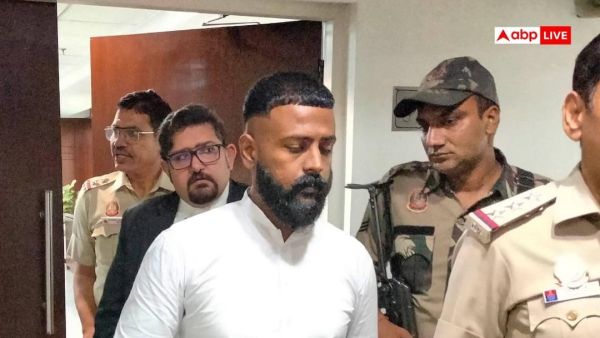
A Delhi court has convicted jailed conman Sukesh Chandrasekhar for allegedly impersonating a sitting Supreme Court judge and attempting to influence a judicial officer to grant him bail.
Chief Judicial Magistrate Harshita Mishra of the Tis Hazari Courts found Chandrasekhar guilty under Sections 170, 189 and 507 of the Indian Penal Code, relating to impersonation of a public servant, threatening a public servant and criminal intimidation through anonymous communication.
The court described his attempt as an “absurd theatrical production” aimed at interfering with an ongoing judicial proceeding.
Chandrasekhar Allegedly Posed As SC Judge
The case dates back to April 2017, when Chandrasekhar was in police custody in connection with a corruption case before Special Judge Poonam Chaudhary.
According to the prosecution, Chandrasekhar gained access to a mobile phone belonging to Constable Manjeet and used it to contact the judge's official landline and personal mobile number.
The caller initially claimed to be the personal secretary of a Supreme Court judge, identified in the judgment by the initials “KJ”. Another person then joined the call and allegedly introduced himself as the judge.
The caller claimed to be speaking on behalf of the Union Home Ministry and the Supreme Court Collegium and directed the judicial officer to grant Chandrasekhar bail or interim bail immediately. The judge was allegedly warned of serious professional consequences if she did not comply.
The judicial officer later contacted the Supreme Court and spoke to the actual private secretary of the judge concerned. She was told that no such call had been made and that the person identified as the secretary did not work in the judge's office.
The court found the judge's testimony reliable and said it was supported by call detail records and evidence establishing that Chandrasekhar had access to the constable's phone.
'Orders Are Passed In Courtrooms, Not Over Secret Calls'
The court stressed that judicial decisions cannot be secured through telephone calls or intimidation.
“Orders are passed in courtrooms, not dictated over clandestine telephone calls,” the court observed, adding that judicial discretion is based on the court record rather than the designation claimed by a caller.
The court said Chandrasekhar appeared to have become convinced by the deception he had allegedly used for years while spoofing caller IDs and impersonating people in positions of authority.
It observed that impersonating a Supreme Court judge or the judge's secretary represented a serious challenge to the authority of the judicial system.
Court Slams Delhi Police Investigation
While convicting Chandrasekhar, the court sharply criticised the Delhi Police investigation, describing it as superficial and lacking due diligence.
The court pointed out that investigators failed to recover the mobile phone, obtain CCTV footage from the Crime Branch premises, collect crucial call records or promptly question important witnesses.
The investigation also did not adequately examine how Chandrasekhar managed to access a supposedly secured mobile phone while in police custody.
The court said the circumstances raised questions about whether Constable Manjeet merely lost control of his phone or had facilitated Chandrasekhar's access to it. However, it clarified that this observation did not amount to a finding of guilt against the constable.
Police Asked To Re-Examine Constable's Role
The court directed the concerned Commissioner of Police or Deputy Commissioner of Police to examine the constable's role and determine whether fresh departmental or criminal proceedings were warranted.
It stressed that an investigation must follow the evidence even when it leads to a member of the police force.
Despite the shortcomings in the probe, the court held that the evidence available on record was sufficient to establish Chandrasekhar's guilt beyond reasonable doubt.
Additional Public Prosecutor Amit Yadav appeared for the State, while advocate Praveen Dabas represented Chandrasekhar.