In football, just as in fiction, personality often reveals itself through symbolism. Or at least, it used to.
Before social media made almost every player look like a carbon-copy human perm-fade with torn socks, many of the country’s greatest footballers had a visual style that perfectly reflected the way they played.
Here are 10 of the Premier League’s most memorable signature figures – players who wore their identity on their sleeves, or somewhere else entirely, and were more than happy to stand apart from the rest of the starting XI.
“Collar up, back straight, chest stuck out, he glided into the arena as if he owned the f***ing place”. That is how Roy Keane described Eric Cantona’s commanding presence at Old Trafford.
The Manchester United forward’s raised collar looked every bit as regal as a crown, and said more than words ever could.
Cantona, though, insisted the upturned collar was not some carefully planned statement of intent, but something that happened almost by accident: “I didn’t plan it. During one game it was cold and my collar just stayed up. We won, so it became a habit”.
It does make you wonder how history might have changed if England had a better climate, or if Umbro’s designers had not put collars on all of United’s shirts in the mid-1990s.
Thierry Henry’s famous knee-slide across the Highbury turf has appeared on countless lists of classic Premier League goal celebrations, so it feels only fair to mention the nylon pairing that became tied to that image.
‘Stockings and black gloves’ may sound more like something from a shopping-centre nativity costume than the matchday look of a world-class striker, but, as with Cantona, Henry’s French flair meant he carried it off effortlessly.
His elegant runs, long in both stride and sock length, became just as recognisably graceful as the side-footed finishes into the far corner that so often came at the end of them.
These days, of course, Jack Grealish – not a fan of fringe – has created his own variation on the look with short socks. It is just not quite the same.
What is it about playing for Aston Villa that makes footballers want to resemble tennis players? Juan Pablo Angel gets the nod here ahead of fellow Villa style-makers Grealish and Milan Baros.
Just as the ponytail became synonymous with Italian footballers, South America seems to be the spiritual home of the Alice band hairstyle. Colombia’s Angel wore the first one seen in the Premier League, and he was later followed by Argentina’s Hernan Crespo at Chelsea and Manchester United’s Uruguay striker Edinson Cavani, both equally committed to the elasticated look.
Perhaps the very visible roots of that trend can be traced back to the legendary Brazil midfield captain Socrates, who sported a sweatband in the 1970s and 1980s and belongs on any list of football’s most stylish figures.
If Pele was the King, and Fernando Redondo the Prince, then this predatory centre-forward was football’s Duke of Yorke.
Pictures of Dwight Yorke, the greatest player Trinidad and Tobago has produced, now feel like snapshots from a lost Premier League era: joyful goal celebrations, Aston Villa sides finishing in the top four, and Reebok-sponsored kits.
Some of those things have returned, but jewellery has definitely been left in the past. Perhaps that is necessary, but it means players can no longer look like a member of Run-DMC while casually dinking in panenkas.
The chain was as golden as a Ballon d’Or, as Cuban as Fidel Castro’s cigar collection, and as linked as the telepathic strike partnership Yorke would later build at Manchester United with Andy Cole – who, if memory serves right, was also rather fond of a carat or two, or perhaps 24.
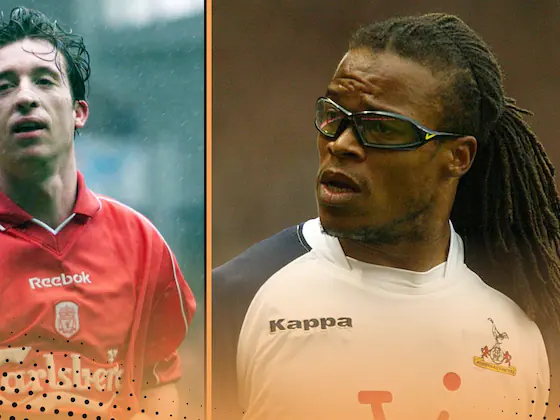
These were the most notorious nostrils in Premier League history. Mention Robbie Fowler alongside the words ‘nose’ and ‘white line’, and one particular controversial goal celebration immediately comes to mind.
But this is not about glamorising drug use, nor about whether sportspeople should set an example to children. It is about those strange things Fowler used to stick across his face.
The company Breathe Right claimed – without offering any evidence – that the product opened up the nasal passages to increase oxygen intake during exercise.
In reality, the strips were basically glorified rubber bands, and all they really achieved was making Fowler look ill and chilly.
Not ill in the slang sense they may have intended, but genuinely under the weather – like a 10-year-old with sinusitis being forced through a PE lesson. Though perhaps he did inspire rapper Nelly to start wearing sticking plasters.
We all know Cristiano Ronaldo has never been afraid of a makeover. In fact, there could easily be an entire accessories list devoted only to him: earrings, customised boots, bleached hair and more. The only problem is David Beckham had already done all of that first.
For all his glossy flamboyance, the Portuguese star found his true sartorial USP through one of the most ordinary items possible: adhesive tape.
Unlike his more fashion-led additions, the tape served a practical purpose – keeping his ankle and shin pads in place while opposition full-backs attempted to kick those same ankles and shins to pieces.
Yet when he was in full flow, those flashes of white rayon looked like racing stripes on a sports car, and young players everywhere copied CR7 by wearing white ankle liners over black football socks.
During the 2010s, hipster culture seeped into football and transformed facial hair into a sport within the sport.
Serie A may have led the way, with Andrea Pirlo matching his midfield artistry with a wise, elder-statesman beard.
In Spain, Sergio Ramos embraced a ruggedly hairy look, while Arda Turan came to resemble the very Turkish barbers he no longer needed for a towel shave.
The Premier League was slower to catch on, but by the end of the decade beards were everywhere. Only one of them, though, truly deserves a place here – a prehistoric thicket more suited to Middle Earth than South London, and so impressive it even had its own Twitter account.
You have to give credit to former Crystal Palace and Wales midfielder Joe Ledley. How on earth did he make it so thick?
Staying with the subject of male grooming, the media line at the time was “Silver hair, silverware” when Fabrizio Ravanelli – a Champions League winner and apparent sceptic of Just for Men – joined Middlesbrough in 1996.
The Italian was only 27 then, even if his prematurely grey buzz cut made him look decades older.
Did opponents take him lightly because of that? It might help explain Ravanelli’s hat-trick on debut in a thrilling 3-3 draw with Liverpool.
Although the silver fox in the box could not stop Boro from being relegated that season, his 17 league goals made him a cult hero on Teesside and helped popularise his famous shirt-over-the-head celebration.
Like the ‘divine ponytail’ of fellow Italian Roberto Baggio, Ravanelli’s au naturel style earned him one of football’s rare hair-based nicknames: The White Feather.
Petr Cech was clumsily kneed in the head by over-eager Reading player Stephen Hunt in 2006 and suffered a fractured skull.
The injury was life-threatening at the time, but it was by no means career-ending, with the Czech international returning only three months later wearing protective headgear.
The helmet looked like a rugby scrum cap mixed with something a lesser-known Marvel supervillain actor might wear on a green-screen set – especially when Cech was playing in the same Chelsea team as mask-wearing forward Demba Ba.
Cech became so associated with the helmet that, after retiring from football, he even turned out as a semi-professional ice hockey goalkeeper. And that brings us neatly to another medically protective device that became a player’s trademark.
“Every disadvantage has its advantage”. Johan Cruyff was speaking about Total Football, but the Dutch great’s philosophy often stretches far beyond tactics or technique. This particular idea of a problem becoming a gift perfectly captures the visual identity of another former Ajax star.
Edgar Davids’ problem was glaucoma, along with having to constantly endure terrible jokes about swimming. His gift?
Quite simply, one of the coolest looks in world football. In 2000, while playing for Juventus, Davids appeared as a footballing cyborg in ‘The Mission’, a Nike advert that summed up his aura perfectly: bespectacled, bionic and belligerent.
The Dutchman’s combination of goggles and dreadlocks eventually arrived in the Premier League when he joined Martin Jol’s Tottenham on a free transfer in 2005.
Even in the closing stages of his career, his gifts – both in terms of footballing ability and visual presence – remained undimmed, and Davids was still a commanding force in central midfield. There will never be another player quite like the Pitbull.
-
Arsenal set record asking price for Martin Zubimendi as Real Madrid circle, but Mikel Arteta is keen to keep him
-
Home Loan: A 'cheap' loan could end up costing you dearly! Understand these 6 points before taking a home loan..

-
Retirement Planning: How much money should you withdraw from your retirement fund each year? Learn these 6 'golden rules'..

-
FD vs SCSS: Which scheme is best for senior citizens? Understand the full calculation..

-
Check the new petrol and diesel rate list; have prices risen in your city today?