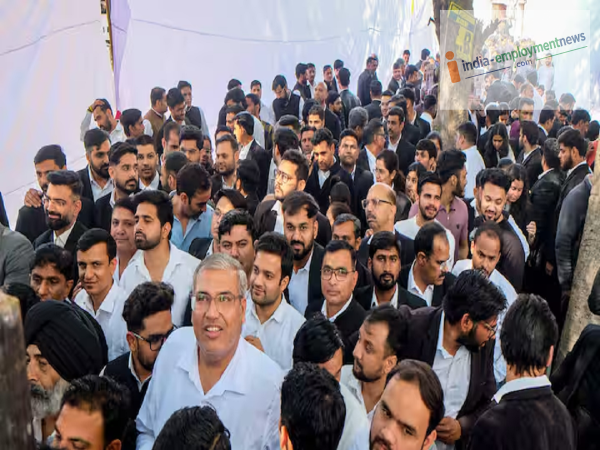
The Supreme Court has reduced the mandatory legal practice requirement for appearing in the entry-level judicial service examination from three years to one year.
The Supreme Court has delivered a verdict concerning law graduates aspiring to become civil judges. The Court has lowered the requirement for legal practice—previously set at three years—to one year for eligibility to take the entry-level judicial service exam. However, following their selection, candidates will be required to gain necessary practical experience through judicial training and a law clerkship.
The Supreme Court announced this decision today with a 2-1 majority. Chief Justice of India Surya Kant and Justice August George Masih formed the majority, while Justice K. Vinod Chandran dissented.
Under the Supreme Court's new rules, for judicial service recruitment notifications issued on or after April 1, 2027, a candidate must possess at least one year of active legal practice to appear for the Civil Judge (Junior Division) examination.
This practice must be certified in accordance with a prescribed procedure. Verification will involve examining records related to the candidate's presence and effective participation in court proceedings. In other words, it will no longer be possible to take the civil judge examination immediately after completing law school; however, the previously mandatory three-year practice period has been reduced.
The Supreme Court clarified that candidates will not be immediately appointed as regular judicial officers upon passing the examination. Selected candidates must first complete one year of judicial training, followed by a one-year structured law clerkship. Thus, even after selection, candidates will gain practical experience regarding court functioning and judicial processes.
Judicial training will take place at the respective state judicial academy. Subsequently, during the clerkship, candidates will have the opportunity to work under the supervision of senior judicial officers and High Court judges. The one-year law clerkship for selected candidates is divided into two phases. For the first six months, they will work as law clerks under the Principal District Judge or members of the Higher Judicial Service. Subsequently, they will undergo a clerkship for the next six months under the supervision of sitting judges of the respective High Court. Upon completion of the clerkship, the supervising judge at the High Court will submit an evaluation report regarding the candidate's progress and suitability.
Following a satisfactory evaluation, the candidate will be appointed to a regular judicial post and receive the associated salary and service allowances. The Supreme Court has also granted relief to law graduates who were caught in the transition between the old and new rules. Candidates applying under judicial examination notifications issued between May 20, 2025, and March 31, 2027, will not be required to have completed three years of legal practice.
For the purpose of their application, these candidates will be deemed to have completed one year of practice and will not need to submit a separate practice certificate for this period. However, selected candidates will still be required to undergo one year of training at a judicial academy, followed by a one-year supervised clerkship.
It is worth noting that the Supreme Court has previously altered its stance regarding the requirement of legal practice experience for Civil Judge recruitment. In 2002, the Court abolished the mandatory three-year practice requirement, allowing law graduates to appear for the judicial service examination without prior legal practice experience. However, in 2025, the Supreme Court reinstated the three-year practice condition, holding the view that candidates should possess experience in the actual functioning of the courts before assuming a judicial role.
Following this decision, numerous law graduates and other stakeholders filed review petitions. They argued that the requirement for a prolonged period of practice would create difficulties for young aspirants who had planned their careers based on the previously prevailing system.
-
BMW India i5 LWB And X1 LWB To Be Crucial For Its Sales Growth

-
Royal Champ Looks The One To Beat In Free Press Journal Trophy

-
Two Ships Carrying 22 Indians Hijacked Off Yemen, Somalia As Piracy Threat Resurges
-
5-Year-Old Chinese Girl Swallows 50-Gram Gold Bar; Retrieved Successfully
-
Can Arsenal retain the Premier League title? The arguments for and against