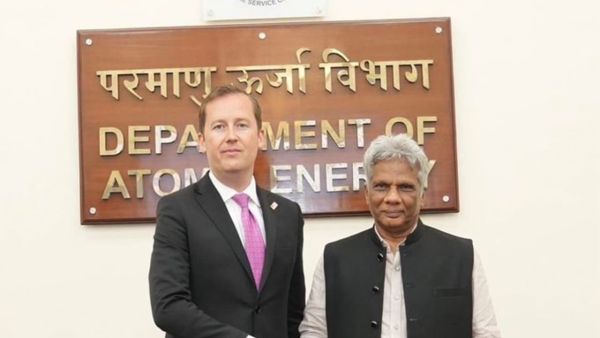
US Ambassador Sergio Gor spoke with DAE Secretary Ajit Mohanty to advance civil nuclear partnerships. The talks precede Mohanty's US visit and follow India's landmark SHANTI Act, which paves the way for private sector entry into nuclear energy.
United States Ambassador to India Sergio Gor spoke with Department of Atomic Energy Secretary Ajit Kumar Mohanty ahead of his upcoming visit to the United States.
In a post on X, the US Embassy in India stated, "Ambassador Sergio Gor spoke with @DAEIndia Secretary Ajit Mohanty ahead of his forthcoming travel to the United States. Our nations are working closely together to advance civil nuclear capabilities and partnerships." Ambassador Sergio Gor spoke with @DAEIndia Secretary Ajit Mohanty ahead of his forthcoming travel to the United States. Our nations are working closely together to advance civil nuclear capabilities and partnerships. — U.S. Embassy India (@USAndIndia) August 21, 2026
Strengthening Bilateral Energy Ties
The high-level engagement comes against the backdrop of significant momentum in bilateral energy ties following the passage of India's landmark Sustainable Harnessing and Advancement of Nuclear Energy for Transforming India (SHANTI) Act.
The key dialogue builds on previous interactions between the two officials, including an earlier meeting in June when Ambassador Gor met Secretary Mohanty to congratulate him on the historic enactment of the legislation. Reflecting on that interaction in a post on X, Ambassador Gor had highlighted the critical role of the bilateral energy relationship, stating, "The United States is charting the future of energy security, and India is one of our consequential partners. I met Dr. Ajit Kumar Mohanty, Secretary of India's Department of Atomic Energy, congratulating him on the passage of the SHANTI Act."
US Industry Responds to SHANTI Act
As civil nuclear cooperation between the two nations accelerates, the United States nuclear sector is now preparing an extensive submission for the Department of Atomic Energy (DAE) regarding India's draft rules and regulations under the SHANTI Act, which paves the way for private sector involvement in civil atomic energy.
"USISPF is coordinating a comprehensive industry submission to the Department of Atomic Energy (DAE), Government of India (GOI) by the September 4 deadline," the US-India Strategic Partnership Forum (USISPF) shared in a social media post. This industry mobilisation follows the DAE's release last week of the draft rules and regulations under the SHANTI Act, where comments and feedback were invited from all relevant stakeholders until September 4.
USISPF Convenes Industry Leaders
To formulate its response to the regulatory framework, the USISPF convened a virtual briefing for its Nuclear Industry Committee focusing on the proposed draft rules and regulations. "The virtual session convened senior industry leaders from across the nuclear value chain and covered: key provisions of the Draft SHANTI Rules and Draft SHANTI Regulations, what they mean for industry; implications for private sector entry, licensing, liability, and project structuring; and areas requiring industry attention and potential feedback to the government," the USISPF said.
Unpacking the SHANTI Act Framework
The newly introduced draft framework represents New Delhi's initial concrete measures to allow commercial entities into the nuclear landscape. While establishing clear guidelines covering licensing, insurance arrangements, and statutory clearances, the regulations ensure that the Centre retains supervision over sensitive operations.
Under the provisions of the SHANTI Act, private enterprises and joint venture entities are permitted to build, own, and operate nuclear facilities, carry out decommissioning activities, and conduct nuclear research and development. Furthermore, the statutory framework enables non-governmental entities to manufacture nuclear fuel and deploy ionising radiation across non-power sectors, including healthcare, agriculture, and industrial manufacturing.
India's Ambitious Nuclear Energy Goals
These reforms align with New Delhi's ambitious long-term energy goals, as India aims to achieve an installed nuclear power generation capacity of 100 GW by 2047. As part of this transition strategy, the nation also intends to deploy at least five indigenous Small Modular Reactors (SMRs), advanced fission units capable of producing up to 300 megawatts of electricity, by 2033. (ANI)
(Except for the headline, this story has not been edited by Asianetnews Editorial staff and is published from a syndicated feed.)-
You’re supporting Gaza genocide: Protester confronts NZ PM Luxon

-
Shubman Gill polishes game against left-arm spinners at nets

-
SC comes to rescue of 105-yr-old murder convict

-
Manipur: Public transport services resume on NH-2 after 3 years

-
Dipke demands thorough investigation into MMRDA JE exam results